(Z)-Stilbene
 | |
-Stilbene-3D-spacefill.png) | |
| Names | |
|---|---|
| IUPAC name
cis-1,2-Diphenylethylene
| |
| Preferred IUPAC name
(Z)-1,2-Diphenylethene | |
| Other names
cis-Stilbene
| |
| Identifiers | |
CAS Number
|
|
3D model (JSmol)
|
|
Beilstein Reference
|
1616739 |
| ChEBI | |
| ChEMBL | |
| ChemSpider | |
| ECHA InfoCard | 100.010.406 |
| EC Number |
|
Gmelin Reference
|
4380 |
PubChem CID
|
|
| UNII | |
CompTox Dashboard (EPA)
|
|
InChI
| |
SMILES
| |
| Properties | |
Chemical formula
|
C14H12 |
| Molar mass | 180.250 g·mol−1 |
| Appearance | Liquid |
| Melting point | 5 to 6 °C (41 to 43 °F; 278 to 279 K) |
| Boiling point | 307 °C (585 °F; 580 K) at 1 atm (82°C to 84°C at 0.4 mmHg) |
Solubility in water
|
Practically insoluble |
| Hazards[1] | |
| GHS labelling: | |
Pictograms
|

|
Signal word
|
Warning |
Hazard statements
|
H315, H319 |
Precautionary statements
|
P264, P280, P302+P352, P305+P351+P338, P321, P332+P313, P337+P313, P362 |
| Safety data sheet (SDS) | Oxford MSDS |
Except where otherwise noted, data are given for materials in their standard state (at 25 °C [77 °F], 100 kPa).
Infobox references
| |


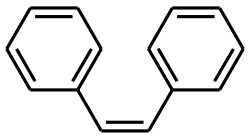
(Z)-Stilbene is a diarylethene, that is, a hydrocarbon consisting of a cis ethene double bond substituted with a phenyl group on both carbon atoms of the double bond. The name stilbene was derived from the Greek word stilbos, which means shining.
Isomers
Stilbene exists as two possible isomers known as (E)-stilbene and (Z)-stilbene. (Z)-Stilbene is sterically hindered and less stable because the steric interactions force the aromatic rings 43° out-of-plane and prevent conjugation.[2] (Z)-Stilbene has a melting point of 5–6 °C (41–43 °F), while (E)-stilbene melts around 125 °C (257 °F), illustrating that the two compounds are quite different.
Uses
- Stilbene is used in manufacture of dyes and optical brighteners, and also as a phosphor and a scintillator.
- Stilbene is one of the gain mediums used in dye lasers.
Properties
- Stilbene will typically have the chemistry of a diarylethene, a conjugated alkene.
- Stilbene can undergo photoisomerization under the influence of UV light.
- Stilbene can undergo stilbene photocyclization, an intramolecular reaction.
- (Z)-Stilbene can undergo electrocyclic reactions.
- In strong (protic) acid, cis-stilbene oligomerizes to a phenylmethylene chain capped by diphenylindane groups. The analogous trans compound doees not so react.[3]
Natural occurrence
Many stilbene derivatives (stilbenoids) are present naturally in plants. An example is resveratrol and its cousin, pterostilbene.
References
- ^ "cis-Stilbene". pubchem.ncbi.nlm.nih.gov. Retrieved 5 December 2021.
- ^ Eliel, Ernest L.; Wilen, Samuel H. (1994). Stereochemistry of Organic Compounds. John Wiley and Sons. pp. 566–567. ISBN 0-471-01670-5.
- ^ Price, Charles C.; Berti, Giancarlo (5 March 1954) [21 Sep 1953]. "The polymerization of stilbene in boron fluoride etherate". Journal of the American Chemical Society. 76 (5): 1221. Bibcode:1954JAChS..76.1219P. doi:10.1021/ja01634a004. Abstracted from Berti, Giancarlo. (PhD). Notre Dame University.
{{cite thesis}}: Missing or empty|title=(help)