1,3,5-Trinitrobenzene
 | |
 | |
| Names | |
|---|---|
| Preferred IUPAC name
1,3,5-Trinitrobenzene | |
| Other names
sym-Trinitrobenzene
| |
| Identifiers | |
CAS Number
|
|
3D model (JSmol)
|
|
| ChEBI | |
| ChemSpider | |
| ECHA InfoCard | 100.002.502 |
| EC Number |
|
Gmelin Reference
|
27979 |
PubChem CID
|
|
| UNII | |
| UN number | 0388 |
CompTox Dashboard (EPA)
|
|
InChI
| |
SMILES
| |
| Properties | |
Chemical formula
|
C6H3N3O6 |
| Molar mass | 213.105 g·mol−1 |
| Density | 1.76 g/cm3 |
| Melting point | 123.2 °C (253.8 °F; 396.3 K) |
| Boiling point | 315 °C (599 °F; 588 K) |
Solubility in water
|
330 mg/L |
Magnetic susceptibility (χ)
|
−74.55·10−6 cm3/mol |
| Hazards | |
| GHS labelling:[1] | |
Pictograms
|
   
|
Signal word
|
Danger |
Hazard statements
|
H201, H300, H310, H330, H373, H410 |
Precautionary statements
|
P210, P230, P240, P250, P260, P262, P264, P270, P271, P273, P280, P284, P301+P316, P302+P352, P304+P340, P316, P319, P320, P321, P330, P361+P364, P370+P380, P372, P373, P391, P401, P403+P233, P405, P501 |
| NFPA 704 (fire diamond) | 
2
3
4 |
Except where otherwise noted, data are given for materials in their standard state (at 25 °C [77 °F], 100 kPa).
Infobox references
| |


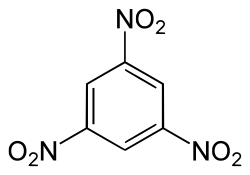
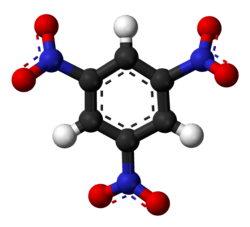
1,3,5-Trinitrobenzene is one of three isomers of trinitrobenzene with the formula C6H3(NO2)3. A pale yellow solid, the compound is highly explosive.[2]
Synthesis and reactions
1,3,5-Trinitrobenzene is produced by decarboxylation of 2,4,6-trinitrobenzoic acid.[2][3]
1,3,5-Trinitrobenzene forms charge-transfer complexes with electron-rich arenes.
Reduction of 1,3,5-trinitrobenzene gives 1,3,5-triaminobenzene, a precursor to phloroglucinol.[4]
Uses and applications
Trinitrobenzene is more explosive than TNT, but more expensive.[2] It is primarily used as a high explosive compound for commercial mining and military applications. It has also been used as a narrow-range pH indicator, an agent to vulcanize natural rubber, and a mediating agent to mediate the synthesis of other explosive compounds.[5]
See also
- 1,2,3-Trinitrobenzene
- TNT equivalent
- RE factor
References
- ^ Record of 1,3,5-Trinitrobenzene in the GESTIS Substance Database of the Institute for Occupational Safety and Health
- ^ a b c Booth, Gerald (2005). "Nitro Compounds, Aromatic". Ullmann's Encyclopedia of Industrial Chemistry. Weinheim: Wiley-VCH. doi:10.1002/14356007.a17_411. ISBN 978-3-527-30673-2.
- ^ Clarke, H. T.; Hartman, W. W. (1922). "1,3,5-Trinitrobenzene". Organic Syntheses. 2: 93. doi:10.15227/orgsyn.002.0093.
- ^ Clarke, H. T.; Hartman, W. W. (1929). "Phloroglucinol". Organic Syntheses. 9: 74. doi:10.15227/orgsyn.009.0074.
- ^ John Pike (1997-05-21). "Explosives – Nitroaromatics". Globalsecurity.org. Retrieved 2013-10-28.