1,3-Cycloheptadiene
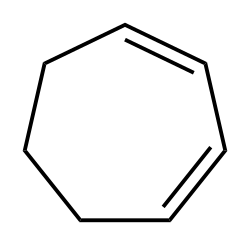 | |
| Names | |
|---|---|
| Preferred IUPAC name
Cyclohepta-1,3-diene | |
| Other names
1,3-Cycloheptadiene
| |
| Identifiers | |
CAS Number
|
|
3D model (JSmol)
|
|
| Abbreviations | 1,3-CHDN |
Beilstein Reference
|
1900733 |
| ChemSpider | |
| ECHA InfoCard | 100.021.603 |
| EC Number |
|
Gmelin Reference
|
1656 |
| MeSH | 1,3-cycloheptadiene |
PubChem CID
|
|
| UNII | |
| UN number | 3295 |
CompTox Dashboard (EPA)
|
|
InChI
| |
SMILES
| |
| Properties | |
Chemical formula
|
C7H10 |
| Molar mass | 94.157 g·mol−1 |
| Appearance | Colorless liquid |
| Density | 0.868 g cm−3 |
| Melting point | −110.40 °C; −166.72 °F; 162.75 K |
| Boiling point | 120.6 °C; 249.0 °F; 393.7 K |
Refractive index (nD)
|
1.498 |
| Thermochemistry | |
Heat capacity (C)
|
J K−1 mol−1 |
Std molar
entropy (S⦵298) |
J K−1 mol−1 |
Std enthalpy of
formation (ΔfH⦵298) |
kJ mol−1 |
Std enthalpy of
combustion (ΔcH⦵298) |
- kJ mol−1 |
| Hazards | |
| GHS labelling: | |
Pictograms
|
 
|
Signal word
|
Danger |
Hazard statements
|
H225, H340, H350, H373 |
Precautionary statements
|
P201, P210, P308+P313 |
| NFPA 704 (fire diamond) | 
2
3
0 |
| Flash point | 11 °C (52 °F; 284 K) |
Except where otherwise noted, data are given for materials in their standard state (at 25 °C [77 °F], 100 kPa).
Infobox references
| |

1,3-Cycloheptadiene is a highly flammable cycloalkene that occurs as a colorless clear liquid.
Reactions
Over a heated Pt(111) surface, 1,3-cycloheptadiene binds to the platinum, loses hydrogen to form a cycloheptatriene, and when strongly heated forms a layer of carbon.[1]
References
- ^ Manner, William L.; Hostetler, Michael J.; Girolami, Gregory S.; Nuzzo, Ralph G. (1 August 1999). "Structures and Reactivities of Cycloheptane, Cycloheptene, 1,3-Cycloheptadiene, and Cycloheptatriene on Pt(111)". The Journal of Physical Chemistry B. 103 (32): 6752–6763. doi:10.1021/jp990501a.