1,4-Dichlorobut-2-ene
 | |
 | |
| Names | |
|---|---|
| IUPAC name
1,4-Dichlorobut-2-ene
| |
| Other names
trans-1,4-Dichlorobutene
| |
| Identifiers | |
CAS Number
|
|
3D model (JSmol)
|
|
| ChEBI | |
| ChEMBL | |
| ChemSpider | |
| ECHA InfoCard | 100.003.437 |
| EC Number |
|
| KEGG | |
PubChem CID
|
|
| UNII | |
| UN number | 2920 2927 2922 |
CompTox Dashboard (EPA)
|
|
InChI
| |
SMILES
| |
| Properties | |
Chemical formula
|
C4H6Cl2 |
| Molar mass | 124.99 g·mol−1 |
| Appearance | Colorless liquid |
| Density | 1.13 g/mL |
| Melting point | 1 °C (34 °F; 274 K) |
| Boiling point | 125.5 °C (257.9 °F; 398.6 K) |
| Hazards[1] | |
| GHS labelling: | |
Pictograms
|
   
|
Signal word
|
Danger |
Hazard statements
|
H301, H311, H314, H330, H350, H410 |
Precautionary statements
|
P201, P202, P210, P233, P240, P241, P242, P243, P260, P264, P270, P271, P273, P280, P281, P284, P301+P310, P301+P330+P331, P302+P352, P303+P361+P353, P304+P340, P305+P351+P338, P307+P311, P308+P313, P310, P312, P314, P320, P321, P330, P361, P363, P370+P378, P391, P403+P233, P403+P235, P405, P501 |
Except where otherwise noted, data are given for materials in their standard state (at 25 °C [77 °F], 100 kPa).
Infobox references
| |


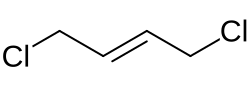
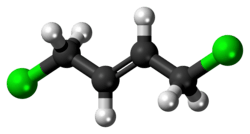
1,4-Dichlorobut-2-ene are organochlorine compounds with the formula ClCH2CH=CHCH2Cl. Cis and trans isomers exist. These compounds are intermediates in the industrial production of chloroprene. They are main impurity in technical grade chloroprene.[2]
Synthesis and reactions
1,4-Dichlorobut-2-ene (both isomers) are produced by chlorination of butadiene:
- CH2=CHCH=CH2 + Cl2 → ClCH2CH=CHCH2Cl
It is isomerized to 3,4-dichlorobut-1-ene by heating to temperatures of 60–120 °C in the presence of a catalyst:
- ClCH2CH=CHCH2Cl → ClCH2CHClCH=CH2
The resulting 3,4-dichlorobut-1-ene is a precursor to chloroprene, the monomer for the synthetic rubber neoprene.[3]
1,4-Dichlorobut-2-ene is a precursor to various heterocycles.[4] The (E)-isomer is also one of the starting materials for the poriferic natural product sceptrin.[5]
References
- ^ Index no. 602-073-00-X of Annex VI, Part 3, to Regulation (EC) No 1272/2008 of the European Parliament and of the Council of 16 December 2008 on classification, labelling and packaging of substances and mixtures, amending and repealing Directives 67/548/EEC and 1999/45/EC, and amending Regulation (EC) No 1907/2006. OJEU L353, 31.12.2008, pp 1–1355 at p 473.
- ^ Re-evaluation of Some Organic Chemicals, Hydrazine and Hydrogen Peroxide (PDF), IARC Monographs on the Evaluation of Carcinogenic Risks to Humans 71, Lyon, France: International Agency for Research on Cancer, 1999, pp. 227–50, ISBN 92-832-1271-1.
- ^ Rossberg, M.; Lendle, W.; Pfleiderer, G.; Tögel, A.; Dreher, E.-L.; Langer, E.; Rassaerts, H.; Kleinschmidt, P.; Strack, H.; Cook, R.; Beck, U.; Lipper, K.-A.; Torkelson, T. R.; Löser, E.; Beutel, K.K.; Mann, T. (15 July 2006). "Chlorinated Hydrocarbons". Ullmann's Encyclopedia of Industrial Chemistry. Weinheim: Wiley-VCH. doi:10.1002/14356007.a06_233.pub2. ISBN 978-3-527-30673-2.Stewart, C. A. Jr. (1993), "Chlorocarbons, -hydrocarbons (chloroprene)", in Kroschwitz, J. I.; Howe-Grant, M. (eds.), Kirk-Othmer Encyclopedia of Chemical Technology, vol. 6 (4th ed.), New York: John Wiley, pp. 70–78.
- ^ Albert I. Meyers, Joseph S. Warmus, Garrett J. Dilley (1996). "3-Pyrroline". Organic Syntheses. 73: 246. doi:10.15227/orgsyn.073.0246.
{{cite journal}}: CS1 maint: multiple names: authors list (link) - ^ Birman, Vladimir B.; Jiang, Xun-Tian (2004), "Synthesis of Sceptrin Alkaloids", Org. Lett., 6 (14): 2369–71, doi:10.1021/ol049283g, PMID 15228281. Baran, Phil S.; Zografos, Alexandros L.; O'Malley, Daniel P. (2004), "Short Total Synthesis of (±)-Sceptrin", J. Am. Chem. Soc., 126 (12): 3726–27, doi:10.1021/ja049648s, PMID 15038721.