1-Pentyne[ 1]
Skeletal formula of 1-pentyne
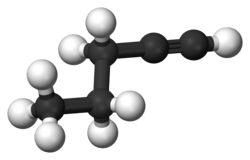
Ball-and-stick model of 1-pentyne
Names
Preferred IUPAC name
Other names
Propylacetylene
Identifiers
CAS Number
3D model (JSmol)
ChEMBL
ChemSpider
ECHA InfoCard
100.009.989
UNII
InChI=1S/C5H8/c1-3-5-4-2/h1H,4-5H2,2H3
Y Key: IBXNCJKFFQIKKY-UHFFFAOYSA-N
Y InChI=1/C5H8/c1-3-5-4-2/h1H,4-5H2,2H3
Key: IBXNCJKFFQIKKY-UHFFFAOYAX
Properties
Chemical formula
C5 H8
Molar mass
68.12
Appearance
colorless liquid
Density
0.691 g/mL
Melting point
−106 to −105 °C
Boiling point
40.2 °C (104.4 °F; 313.3 K)
Solubility in water
Insoluble
Hazards
Occupational safety and health (OHS/OSH):
Main hazards
Flammable Liquid
Flash point
−20 °C (−4 °F; 253 K)
Except where otherwise noted, data are given for materials in their standard state (at 25 °C [77 °F], 100 kPa).
Infobox references
1-Pentyne is an organic compound with the formula CH3 CH2 CH2 C≡CH . It is a terminal alkyne, in fact the smallest that is liquid at room temperature. The compound is a common terminal alkyne substrate in diverse studies of catalysis.[ 2] [ 3]
See also
References
^ 1-Pentyne at Sigma-Aldrich^ Guimond, Nicolas; Gouliaras, Christina; Fagnou, Keith (2010). "Rhodium(III)-Catalyzed Isoquinolone Synthesis: The N−O Bond as a Handle for C−N Bond Formation and Catalyst Turnover". Journal of the American Chemical Society . 132 (20): 6908– 6909. doi:10.1021/ja102571b . PMID 20433170 . ^ Cassar, L. (1975). "Synthesis of aryl- and vinyl-substituted acetylene derivatives by the use of nickel and palladium complexes". Journal of Organometallic Chemistry . 93 (2): 253– 257. doi:10.1016/s0022-328x(00)94048-8 .
External links
Alkynes
Ethyne (C2 H2 )Propyne (C3 H4 )Butyne (C4 H6 )
Pentyne (C5 H8 )
Hexyne (C6 H10 )
Heptyne (C7 H12 )
Octyne (C8 H14 )
Nonyne (C9 H16 )
Decyne (C10 H18 )
Preparations
Cracking
Dehydrogenation of alkane, alkene
Alkylation of alkynyl anion
Dehydrohalogenation of dihaloalkane
Fritsch–Buttenberg–Wiechell rearrangement
Corey–Fuchs reaction
Seyferth–Gilbert homologation Reactions
Deprotonation
Hydrogenation
Halogenation
Hydration
Hydroboration
Hydrohalogenation
Alkynylation
Thiol-yne reaction
Alkyne trimerisation
Diels–Alder reaction
Pauson–Khand reaction
Azide-alkyne Huisgen cycloaddition
Sonogashira coupling
Cadiot–Chodkiewicz coupling
Glaser coupling
Favorskii reaction
Binary compounds of hydrogen
Alkali metal Alkaline (Group 2)
Group 13
Group 14 hydrides
Hydrocarbons
alkanes
alkenes
alkynes
Cycloalkanes
Cycloalkenes
Cycloalkynes
Annulenes
Pnictogen
Phosphanes
PH3 P2 H4 P3 H5
P4 H6
P5 H7
P6 H8
P7 H9
P8 H10
P9 H11
P10 H12
more...
HN3 NH
HN5 (hypothetical)
NH5 (hypothetical) Hydrogen
Polysulfanes
H2 S H2 S2
H2 S3
H2 S4
H2 S5
H2 S6
H2 S7
H2 S8
H2 S9
H2 S10
more...
HO
HO2 HO3
H2 O+ –O– (hypothetical)
H2 S+ -S-
HS
HS2
HDO
D2 O T2 O Hydrogen halides Transition
ScH2
YH2
YH3
YH6
YH9
LuH2
LuH3
LrH3 (predicted) TiH2 TiH4
ZrH2 ZrH4
HfH2
HfH4
VH
VH2
NbH
NbH2
TaH
TaH2
CrH
CrH2
CrHx
FeH
FeH2
FeH5
CoH2
RhH2
IrH3
NiH
PdHx x < 1)
PtHx x < 1)
DsH2 (predicted) CuH AgH
AuH
RgH (predicted) ZnH2
CdH2
HgH
Hg2 H2
HgH2
CnH2 (predicted) Lanthanide
LaH2
LaH3
LaH10 CeH2
CeH3
PrH2
PrH3
NdH2
NdH3
SmH2
SmH3
EuH2
GdH2
GdH3
TbH2
TbH3
DyH2
DyH3
HoH2
HoH3
ErH2
ErH3
TmH2
TmH3
YbH2 Actinide
AcH2
ThH2
ThH4
Th4 H15
PaH3
UH3 UH4
NpH2
NpH3
PuH2
PuH3
AmH2
AmH3
CmH2
BkH2
BkH3
CfH2
CfH3 Exotic matter hydrides