3,5-Lutidine
 | |
| Names | |
|---|---|
| Preferred IUPAC name
3,5-Dimethylpyridine | |
| Other names
3,5-Lutidine
| |
| Identifiers | |
CAS Number
|
|
3D model (JSmol)
|
|
Beilstein Reference
|
105682 |
| ChemSpider | |
| ECHA InfoCard | 100.008.827 |
| EC Number |
|
PubChem CID
|
|
| UNII | |
CompTox Dashboard (EPA)
|
|
InChI
| |
SMILES
| |
| Properties | |
Chemical formula
|
C7H9N |
| Molar mass | 107.156 g·mol−1 |
| Appearance | oily liquid |
| Density | 0.944 g/cm3 |
| Melting point | −6.5 °C (20.3 °F; 266.6 K) |
| Boiling point | 171.9 °C (341.4 °F; 445.0 K) |
| Acidity (pKa) | 6.15[1] |
Magnetic susceptibility (χ)
|
−71.72×10⁻⁶ cm3/mol |
| Hazards | |
| GHS labelling: | |
Pictograms
|
   
|
Signal word
|
Danger |
Hazard statements
|
H226, H301, H302, H311, H312, H314, H315, H331, H332, H335 |
Precautionary statements
|
P210, P233, P240, P241, P242, P243, P260, P264, P270, P271, P280, P301+P310, P301+P312, P301+P330+P331, P302+P352, P303+P361+P353, P304+P312, P304+P340, P305+P351+P338, P310, P311, P312, P321, P322, P330, P332+P313, P361, P362, P363, P370+P378, P403+P233, P403+P235, P405, P501 |
Except where otherwise noted, data are given for materials in their standard state (at 25 °C [77 °F], 100 kPa).
Infobox references
| |

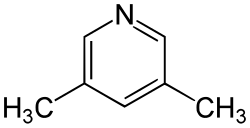
3,5-Lutidine is a heterocyclic organic compound with the formula (CH3)2C5H3N. It is one of several dimethyl-substituted derivatives of pyridine, all of which are referred to as lutidines. It is a colorless liquid with mildly basic properties and a pungent odor. The compound is a precursor to the drug omeprazole.
3,5-Lutidine is produced industrially by condensation of acrolein, ammonia, and formaldehyde:[1]
- 2 CH2=CHCHO + CH2O + NH3 → (CH3)2C5H3N + 2 H2O
Biodegradation
The biodegradation of pyridines proceeds via multiple pathways.[2] Although pyridine is an excellent source of carbon, nitrogen, and energy for certain microorganisms, methylation significantly retards degradation of the pyridine ring.[3][4]
Safety
The LD50 is 200 mg/kg (oral, rats).
See also
- 2,6-Lutidine
- 2,4-Lutidine
References
- ^ a b Shimizu, Shinkichi; Watanabe, Nanao; Kataoka, Toshiaki; Shoji, Takayuki; Abe, Nobuyuki; Morishita, Sinji; Ichimura, Hisao (2007). "Pyridine and Pyridine Derivatives". Ullmann's Encyclopedia of Industrial Chemistry. Weinheim: Wiley-VCH. doi:10.1002/14356007.a22_399. ISBN 978-3-527-30673-2.
- ^ Philipp, Bodo; Hoff, Malte; Germa, Florence; Schink, Bernhard; Beimborn, Dieter; Mersch-Sundermann, Volker (2007). "Biochemical Interpretation of Quantitative Structure-Activity Relationships (QSAR) for Biodegradation of N-Heterocycles: A Complementary Approach to Predict Biodegradability". Environmental Science & Technology. 41 (4): 1390–1398. Bibcode:2007EnST...41.1390P. doi:10.1021/es061505d. PMID 17593747.
- ^ Sims, G. K.; Sommers, L. E. (1985). "Degradation of pyridine derivatives in soil". Journal of Environmental Quality. 14 (4): 580–584. Bibcode:1985JEnvQ..14..580S. doi:10.2134/jeq1985.00472425001400040022x.
- ^ Sims, G. K.; Sommers, L. E. (1986). "Biodegradation of Pyridine Derivatives in Soil Suspensions". Environmental Toxicology and Chemistry. 5 (6): 503–509. Bibcode:1986EnvTC...5..503S. doi:10.1002/etc.5620050601.