3-Hydroxy-2-naphthoic acid
 | |
| Names | |
|---|---|
| Preferred IUPAC name
3-Hydroxynaphthalene-2-carboxylic acid | |
| Other names
3-Hydroxy-2-naphthoic acid
BON acid β-Hydroxynaphthoic acid | |
| Identifiers | |
CAS Number
|
|
3D model (JSmol)
|
|
Beilstein Reference
|
744100 |
| ChEBI | |
| ChEMBL | |
| ChemSpider | |
| ECHA InfoCard | 100.001.983 |
| EC Number |
|
| KEGG | |
PubChem CID
|
|
| RTECS number |
|
| UNII | |
CompTox Dashboard (EPA)
|
|
InChI
| |
SMILES
| |
| Properties | |
Chemical formula
|
C11H8O3 |
| Molar mass | 188.182 g·mol−1 |
| Appearance | Yellow solid |
| Melting point | 222 °C (432 °F; 495 K) |
| Hazards | |
| GHS labelling: | |
Pictograms
|
 
|
Signal word
|
Warning |
Hazard statements
|
H302, H312, H317, H319, H361, H371, H412 |
Precautionary statements
|
P201, P202, P260, P264, P270, P272, P273, P280, P281, P301+P312, P302+P352, P305+P351+P338, P308+P313, P309+P311, P312, P321, P322, P330, P333+P313, P337+P313, P363, P405, P501 |
Except where otherwise noted, data are given for materials in their standard state (at 25 °C [77 °F], 100 kPa).
Infobox references
| |
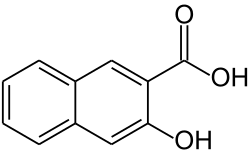
3-Hydroxy-2-naphthoic acid is an organic compound with the formula C10H6(OH)(CO2H). It is one of the several hydroxynaphthoic acids. It is a precursor to some azo dyes and pigments. It is prepared by carboxylation of 2-naphthol by the Kolbe–Schmitt reaction.[1]
Reactions
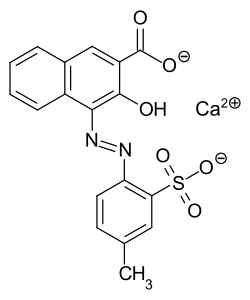
3-Hydroxy-2-naphthoic acid is a precursor to many anilides, such as Naphthol AS, which are reactive toward diazonium salts to give deeply colored azo compounds. Azo coupling of 3-hydroxy-2-naphthoic acid gives many dyes as well. Heating 3-hydroxy-2-naphthoic acid in ammonia give 3-amino-2-naphthoic acid.[2]
3-Hydroxy-2-naphthoic acid can be condensed with 4-amino-2-benzimidazolinone. The resulting amide is a precursor to commercial dyes and pigments via azo coupling.[3][4]
3-Hydroxy-2-naphthoic acid can be used to make Dynasore [304448-55-3].
Related compounds
- 2-Hydroxy-1-naphthoic acid
References
- ^ Gerald Booth (2005). "Naphthalene Derivatives". Ullmann's Encyclopedia of Industrial Chemistry. Weinheim: Wiley-VCH. doi:10.1002/14356007.a17_009. ISBN 9783527303854.
- ^ Allen, C. F. H.; Bell, Alan (1942). "3-Amino-2-Naphthoic Acid". Organic Syntheses. 22: 19. doi:10.15227/orgsyn.022.0019.
- ^ Jaffe, Edward E. (2004). "Pigments, Organic". Kirk-Othmer Encyclopedia of Chemical Technology. doi:10.1002/0471238961.151807011001060605.a01.pub2. ISBN 978-0-471-48494-3.
- ^ Hans-Joachim Metz, Frank Morgenroth (2009). "Benzimidazolone Pigments and Related Structures". In Edwin B. Faulkner, Russell J. Schwartz (ed.). High Performance Pigments. John Wiley & Sons. p. 135. ISBN 978-3-527-62692-2.