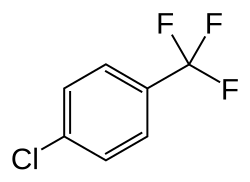
4-Chlorobenzotrifluoride
 | |
| Names | |
|---|---|
| Preferred IUPAC name
1-Chloro-4-(trifluoromethyl)benzene | |
Other names
| |
| Identifiers | |
CAS Number
|
|
3D model (JSmol)
|
|
| Abbreviations | PCBTF |
Beilstein Reference
|
510203 |
| ChemSpider | |
| ECHA InfoCard | 100.002.438 |
| EC Number |
|
| MeSH | C037723 |
PubChem CID
|
|
| UNII | |
| UN number | 2234 |
CompTox Dashboard (EPA)
|
|
InChI
| |
SMILES
| |
| Properties | |
Chemical formula
|
C7H4ClF3 |
| Molar mass | 180.55 g·mol−1 |
| Appearance | Colorless liquid |
| Density | 1.33-1.35 @ 22 °C (72 °F)[1] |
| Melting point | −32.8 °C (−27.0 °F; 240.3 K) [1] |
| Boiling point | 138.6 °C (281.5 °F; 411.8 K) [1] |
Solubility in water
|
29 mg/L |
| log P | 3.7 @ 25 °C (77 °F) |
| Vapor pressure | 5.3 millimetres of mercury (0.0070 atm) @ 20 °C (68 °F)[1] |
Henry's law
constant (kH) |
0.0347 |
| Hazards | |
| GHS labelling: | |
Pictograms
|
  
|
Signal word
|
Warning |
Hazard statements
|
H226, H315, H319, H335, H411 |
Precautionary statements
|
P210, P233, P240, P241, P242, P243, P261, P264, P271, P273, P280, P302+P352, P303+P361+P353, P304+P340, P305+P351+P338, P312, P321, P332+P313, P337+P313, P362, P370+P378, P391, P403+P233, P403+P235, P405, P501 |
| NFPA 704 (fire diamond) | 
1
2
1 |
| Flash point | 42.8 °C (109.0 °F; 315.9 K) |
Autoignition
temperature |
600 °C (1,112 °F; 873 K) |
| Explosive limits | 0.9%-10.5% (V)[1] |
| Lethal dose or concentration (LD, LC): | |
LD50 (median dose)
|
|
LC50 (median concentration)
|
Inhalation, rat: 33 mg/L |
| Safety data sheet (SDS) | https://smc-global.com/wp-content/uploads/2020/07/SMC-msds_m900.pdf |
Except where otherwise noted, data are given for materials in their standard state (at 25 °C [77 °F], 100 kPa).
Infobox references
| |


4-Chlorobenzotrifluoride is a organofluorine compound with the molecular formula C7H4ClF3. Frequently abbreviated PCBTF (for parachlorobenzotrifluoride), it is a colorless liquid with a distinct aromatic odor. PCBTF has been commercially-produced since the 1960s. It is a precursor to commercial dyes.[2]
Preparation
4-Chlorobenzotrifluoride is produced commercially by trifluoromethylation of chlorobenzene.[2]
Historically, Occidental Chemical Corporation was a leading producer and sold it as part of its Oxsol product line, specifically under the brand name of Oxsol 100.[3] Occidental Chemical Corporation sold the OXSOL line to Makhteshim Agan Industries, Ltd., in 2002.[4]
Uses
Nitration of PCBTF gives 4-chloro-3,5-dinitrobenzotrifluoride, a precursor to the herbicides trifluralin, fluorodifen, and acifluorfen. It is also a precursor to the insecticide fluvalinate.[2]
PCBTF has also been used as a solvent.[5]
Health and Environmental effects
Health effects:
- Points of entry: eyes, ingestion, inhalation, skin.
- Target organs: central nervous system, kidneys, liver.
- Irritancy: eyes, respiratory tract, skin[3]
In the troposphere, PCBTF has an estimated half-life of 67 days. It is transformed by reaction with photochemically-produced hydroxyl radicals to give mainly 2-chloro-5-trifluoromethylphenol.[5]
Regulation
PCBTF currently has VOC Exempt status from the U.S. Environmental Protection Agency.[6] However, California's Office of Environmental Health Hazard Assessment (OEHHA) has adopted inhalation risk factors for PCBTF as of June 2019, which could have implications for its ongoing VOC Exempt status.[7][8]
References
- ^ a b c d e "PCBTF 900, Technical Grade, Liquid, Bulk Datasheet". UnivarSolutions. Retrieved 13 November 2024.
- ^ a b c Siegemund, Günter; Schwertfeger, Werner; Feiring, Andrew; Smart, Bruce; Behr, Fred; Vogel, Herward; McKusick, Blaine; Kirsch, Peer (2016). "Fluorine Compounds, Organic". Ullmann's Encyclopedia of Industrial Chemistry. pp. 1–56. doi:10.1002/14356007.a11_349.pub2. ISBN 978-3-527-30673-2..
- ^ a b "MSDS provided by Islechem" (PDF). Archived from the original (PDF) on 2021-12-26. Retrieved 2021-12-23.
- ^ "Trifluoromethylbenzene 98-08-8" (PDF). National Cancer Institute. Archived from the original (PDF) on September 9, 2015. Retrieved 14 December 2022.
- ^ a b Rayner-Canham, Geoff (March 2014). "Para-Chlorobenzotrifluoride (PCBTF) – the 'super-solvent'". Chem 13 News Magazine. The University of Waterloo. Retrieved 14 December 2022.
- ^ "EPA Exempt Volatile Organic Compound: Parachlorobenzotrifluoride" (PDF). American Coatings Association. 2018-01-30. Retrieved 2019-03-20.
- ^ "Chemical Listed Effective June 28, 2019 as Known to the State Of California To Cause Cancer: P-Chloro-a,a,a-Trifluorotoluene (Para-Chlorobenzotrifluoride, PCBTF)". oehha.ca.gov. Retrieved 2021-08-14.
- ^ p-Chloro-α,α,α-trifluorotoluene (p-Chlorobenzotrifluoride, PCBTF) - Cancer Inhalation Unit Risk Factor Scientific Review Panel Draft - January 2020 - California Office of Environmental Health Hazard Assessment