Anilinium chloride
 | |
 | |
| Identifiers | |
|---|---|
CAS Number
|
|
3D model (JSmol)
|
|
| ChEMBL | |
| ChemSpider | |
| ECHA InfoCard | 100.005.018 |
| EC Number |
|
PubChem CID
|
|
| UNII | |
| UN number | 1548 |
CompTox Dashboard (EPA)
|
|
InChI
| |
SMILES
| |
| Properties | |
Chemical formula
|
C6H5NH+3Cl− |
| Molar mass | 129.59 g·mol−1 |
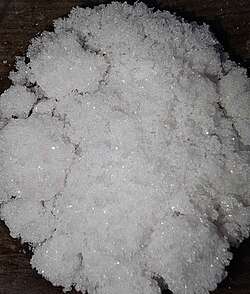
| Appearance | white solid |
| Density | 1.68 g/cm3 |
| Melting point | 196 °C (385 °F; 469 K) |
| Boiling point | 245 °C (473 °F; 518 K) |
Solubility in water
|
1070 g/l |
| Hazards | |
| GHS labelling:[1] | |
Pictograms
|
|
Signal word
|
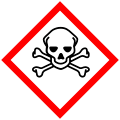
Danger |
Hazard statements
|
H301, H311, H317, H318, H331, H341, H351, H372, H400 |
Precautionary statements
|
P203, P260, P264, P264+P265, P270, P271, P272, P273, P280, P281, P301+P316, P302+P352, P304+P340, P305+P354+P338, P316, P317, P318, P319, P321, P330, P333+P313, P361+P364, P362+P364, P391, P403+P233, P405, P501 |
| NFPA 704 (fire diamond) | 
3
1
0 |
Except where otherwise noted, data are given for materials in their standard state (at 25 °C [77 °F], 100 kPa).
Infobox references
| |

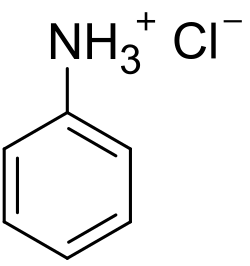
Anilinium chloride is the organic compound with the formula C6H5NH+3Cl−. It is a white solid and the chloride salt of anilinium, which is the conjugate acid of aniline, C6H5NH2. Anilinium chloride is produced by treatment of aniline with hydrochloric acid. The cation consists of a phenyl ring attached to a tetrahedral ammonium center. The C-N bond elongates from 1.41 Å in aniline to 1.474 Å in anilinium.[2]
Uses
Anilinium chloride is used as a precursor to diphenylamine by heating with aniline:[3]
- C6H5NH2 + C6H5NH3Cl → (C6H5)2NH + NH3 + HCl
It reacts with formaldehyde to give methylenedianiline, a precursor to commercial polymers.[3]
References
- ^ "Aniline hydrochloride". pubchem.ncbi.nlm.nih.gov. Retrieved 31 August 2023.
- ^ Anderson, Kirsty M.; Goeta, Andres E.; Hancock, Kirsty S. B.; Steed, Jonathan W. (2006). "Unusual variations in the incidence of Z? > 1 in oxo-anion structures". Chemical Communications (20): 2138–2140. doi:10.1039/b602492k. PMID 16703133.
- ^ a b Amini, Bijan; Lowenkron, Steven (2003). "Aniline and Its Derivatives". Kirk-Othmer Encyclopedia of Chemical Technology. doi:10.1002/0471238961.0114091201130914.a01.pub2. ISBN 978-0-471-48494-3.