Antimony triiodide
| |||
 | |||
| Names | |||
|---|---|---|---|
| IUPAC name
Antimony triiodide, Antimony(III) iodide
| |||
| Systematic IUPAC name
Triiodostibane | |||
| Identifiers | |||
CAS Number
|
|||
3D model (JSmol)
|
|||
| ChemSpider | |||
| ECHA InfoCard | 100.029.278 | ||
| EC Number |
| ||
PubChem CID
|
|||
| UNII | |||
CompTox Dashboard (EPA)
|
|||
InChI
| |||
SMILES
| |||
| Properties | |||
Chemical formula
|
I3Sb | ||
| Molar mass | 502.473 g·mol−1 | ||
| Appearance | red crystals | ||
| Density | 4.921 g/cm3 | ||
| Melting point | 170.5 °C (338.9 °F; 443.6 K) | ||
| Boiling point | 401.6 °C (754.9 °F; 674.8 K) | ||
Solubility in water
|
soluble, partially hydrolyses | ||
| Solubility | soluble in benzene, alcohol, acetone, CS2, HCl, KI, SnCl4, C2H7N, HI, alkali metal triiodides | ||
| Solubility in diiodomethane | 10.15% v/v (12 °C)[2] | ||
Magnetic susceptibility (χ)
|
−147.0·10−6 cm3/mol | ||
| Structure | |||
Crystal structure
|
Rhombohedral, hR24, | ||
Space group
|
R-3, No. 148 | ||
Dipole moment
|
1.58 D | ||
| Thermochemistry | |||
Heat capacity (C)
|
81.6 J/mol·K (gas)[1] | ||
Std enthalpy of
formation (ΔfH⦵298) |
−100.4 kJ/mol[1] | ||
| Hazards | |||
| GHS labelling:[4] | |||
Pictograms
|
| ||
Signal word
|
Warning | ||
Hazard statements
|
H302, H332, H411 | ||
Precautionary statements
|
P273 | ||
| NIOSH (US health exposure limits): | |||
PEL (Permissible)
|
TWA 0.5 mg/m3 (as Sb)[3] | ||
REL (Recommended)
|
TWA 0.5 mg/m3 (as Sb)[3] | ||
| Related compounds | |||
Other anions
|
Antimony trifluoride Antimony trichloride Antimony tribromide | ||
Other cations
|
Nitrogen triiodide Phosphorus triiodide Arsenic triiodide Bismuth iodide | ||
Except where otherwise noted, data are given for materials in their standard state (at 25 °C [77 °F], 100 kPa).
Infobox references
| |||
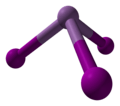
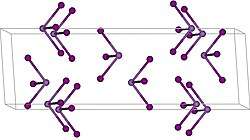


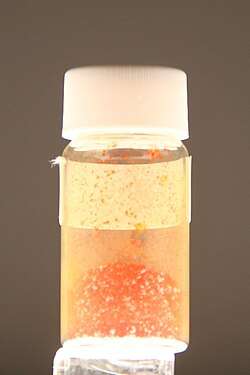
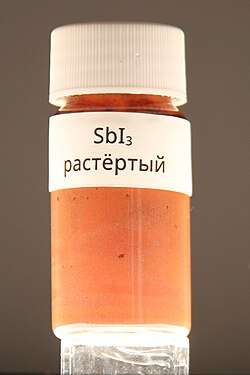
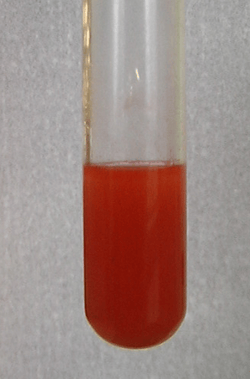
Antimony triiodide is the chemical compound with the formula SbI3. This ruby-red solid is the only characterized "binary" iodide of antimony, i.e. the sole compound isolated with the formula SbxIy. It contains antimony in its +3 oxidation state. Like many iodides of the heavier main group elements, its structure depends on the phase. Gaseous SbI3 is a molecular, pyramidal species as anticipated by VSEPR theory. In the solid state, however, the Sb center is surrounded by an octahedron of six iodide ligands, three of which are closer and three more distant.[5] For the related compound BiI3, all six Bi—I distances are equal.[6]
Production
It may be formed by the reaction of antimony with elemental iodine, or the reaction of antimony trioxide with hydroiodic acid.
Alternatively, it may be prepared by the interaction of antimony and iodine in boiling benzene or tetrachloroethane.
Uses
SbI3 has been used as a dopant in the preparation of thermoelectric materials.[7]
References
- ^ a b c "Antimony triiodide".
- ^ Seidell, Atherton; Linke, William F. (1952). Solubilities of Inorganic and Organic Compounds. Van Nostrand. Retrieved 18 May 2017.
- ^ a b NIOSH Pocket Guide to Chemical Hazards. "#0036". National Institute for Occupational Safety and Health (NIOSH).
- ^ Sigma-Aldrich Co., Antimony(III) iodide. Retrieved on 2014-05-29.
- ^ Hsueh, H.C.; Chen, R.K.; Vass, H.; Clark, S.J.; Ackland, G.J.; Poon, W.C.K.; Crain, J. (1998). "Compression mechanisms in quasimolecular XI3 (X = As, Sb, Bi) solids" (PDF). Physical Review B. 58 (22): 14812–14822. Bibcode:1998PhRvB..5814812H. doi:10.1103/PhysRevB.58.14812. hdl:20.500.11820/6b565e3e-900c-465c-a037-6929e8a7c18b. S2CID 121883973.
- ^ Holleman, A. F.; Wiberg, E. "Inorganic Chemistry" Academic Press: San Diego, 2001. ISBN 0-12-352651-5.
- ^ D.-Y. Chung; T. Hogan; P. Brazis; M. Rocci-Lane; C. Kannewurf; M. Bastea; C. Uher; M. G. Kanatzidis (2000). "CsBi4Te6: A High-Performance Thermoelectric Material for Low-Temperature Applications". Science. 287 (5455): 1024–7. Bibcode:2000Sci...287.1024C. doi:10.1126/science.287.5455.1024. PMID 10669411.
External links
