Benzocyclobutene
 | |
 | |
| Names | |
|---|---|
| Preferred IUPAC name
Bicyclo[4.2.0]octa-1,3,5-triene | |
| Other names
Benzocyclobutane
BCB Benzocyclobutene (not in accordance with IUPAC nomenclature) | |
| Identifiers | |
CAS Number
|
|
3D model (JSmol)
|
|
| ChEBI | |
| ChemSpider | |
| ECHA InfoCard | 100.161.355 |
PubChem CID
|
|
| UNII | |
CompTox Dashboard (EPA)
|
|
InChI
| |
SMILES
| |
| Properties | |
Chemical formula
|
C8H8 |
| Molar mass | 104.152 g·mol−1 |
| Density | 0.957 g/cm3 |
| Boiling point | 150 °C (302 °F; 423 K) |
Refractive index (nD)
|
1.541 |
Except where otherwise noted, data are given for materials in their standard state (at 25 °C [77 °F], 100 kPa).
Infobox references
| |


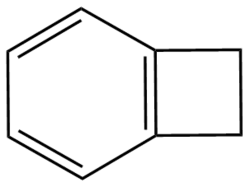
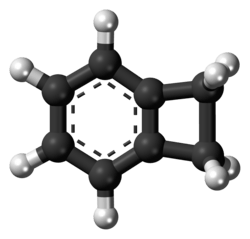
Benzocyclobutene (BCB) is a benzene ring fused to a cyclobutane ring. It has chemical formula C8H8.[1]
BCB is frequently used to create photosensitive polymers. BCB-based polymer dielectrics may be spun on or applied to various substrates for use in Micro Electro-Mechanical Systems (MEMS) and microelectronics processing. Applications include wafer bonding, optical interconnects, low-κ dielectrics, or even intracortical neural implants.
Reactions
Benzocyclobutene is a strained system which, upon heating to approximately 180 °C, causes the cyclobutene to undergo a conrotatory ring-opening reaction, forming o-xylylene. Since this process destroys the aromaticity of the benzene ring, the reverse reaction is highly favored.
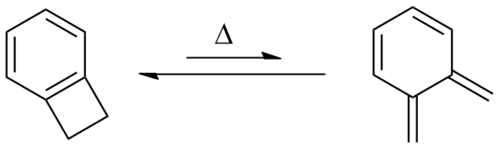
o-Xylylenes generated in this way have been used prolifically in cycloaddition reactions, which restore the aromaticity to the benzene ring, while forming a new annulated species.[2]
Derivatives
The benzocyclobutene moiety has also appeared in a number of chemical compounds with pharmacological properties such as ivabradine and S33005.
Additionally, cyclized phenethylamine psychedelic drugs containing the benzocyclobutene ring system, including TCB-2, tomscaline, bromotomscaline, and 2CBCB-NBOMe (NBOMe-TCB-2), have been described.[3] A benzocyclobutene-derived amphetamine has been patented as well,[4] and a benzocyclobutene containing designer drug, the substituted cathinone derivative 3,4-EtPV, has been sold in Europe.[5] The benzocyclobutene derivative 2C-G-2 has also been claimed in a patent as an antiinflammatory,[6] but no synthesis or activity data is provided so it is unclear if it has actually been made.
See also
- Benzocyclobutadiene
References
- ^ 164410 Benzocyclobutene 98%
- ^ Mehta, G.; Kotha, S. (2001). "Recent chemistry of benzocyclobutenes" (PDF). Tetrahedron Lett. 57 (4): 625–659. doi:10.1016/s0040-4020(00)00958-3.
- ^ Trachsel, D.; Lehmann, D.; Enzensperger, C. (2013). Phenethylamine: von der Struktur zur Funktion [Phenethylamines: From Structure to Function]. Nachtschatten-Science (in German) (1 ed.). Solothurn: Nachtschatten-Verlag. ISBN 978-3-03788-700-4. OCLC 858805226. Archived from the original on 12 August 2025. Retrieved 30 November 2025.
{{cite book}}: CS1 maint: bot: original URL status unknown (link) - ^ US 3149159, "Substituted 7-aminoalkylbicyclo-[4. 2. 0]octa-1,3,5-trienes"
- ^ "European Drug Report 2025 – Full Book" (PDF). European Union Drugs Agency (euda.europa.eu). 6 June 2025.
- ^ Halpert M. Substituted phenethylamine for treating inflammation and psychological disorders. WO 2022/271982