Chlorodifluoroamine
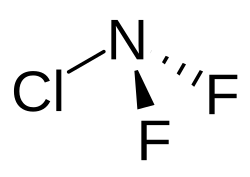 | |
| Names | |
|---|---|
| IUPAC name
Chloro(difluoro)amine
| |
| Other names
Nitrogen chloride difluoride, difluorochloroamine, chlorodifluoroammonia, chlorodifluoroazane
| |
| Identifiers | |
CAS Number
|
|
3D model (JSmol)
|
|
| ChEBI | |
| ChemSpider | |
Gmelin Reference
|
259733 |
PubChem CID
|
|
CompTox Dashboard (EPA)
|
|
InChI
| |
SMILES
| |
| Properties | |
Chemical formula
|
ClF2N |
| Molar mass | 87.45 g·mol−1 |
| Appearance | colorless gas |
| Melting point | −190 °C (−310.0 °F; 83.1 K) |
| Boiling point | −66 °C (−87 °F; 207 K) |
Solubility in water
|
reacts with water |
| Related compounds | |
Related compounds
|
|
Except where otherwise noted, data are given for materials in their standard state (at 25 °C [77 °F], 100 kPa).
Infobox references
| |

Chlorodifluoroamine is an inorganic chemical compound of nitrogen, chlorine, and fluorine with the molecular formula NClF2.[1][2]
Synthesis
Chlorodifluoroamine can be synthesized by the effect of fluorine on sodium azide in the presence of sodium chloride:[3]
- 2 F2 + NaN3 + NaCl → NClF2 + 2 NaF + N2
The effect of fluorine and chlorine on sodium azide also forms the compound:
- 3 F2 + Cl2 + 2 NaN3 → 2 NClF2 + 2 NaF + 2 N2
Also, the reaction of ammonium chloride with fluorine makes it:
- NH4Cl + 3 F2 → NF2Cl + 4 HF
Other methods of synthesis are also known.[4]
Physical properties
The compound forms a colorless air-stable gas[5] that decomposes when heated (sometimes with an explosion).
Chemical properties
The compound decomposes in several ways when heated:
- 2 NClF2 → N2F2 + Cl2
- 6 NClF2 → 4 NF3 + N2 + 3 Cl2
References
- ^ "Chlorodifluoroamine". NIST. Retrieved 16 January 2026.
- ^ Zabrowski, Leon M.; De Marco, Ronald A.; Shreeve, Jean'ne M.; Max, Lustig (1973). "Chlorodifluoroamine and Difluorodiazene". Inorganic Syntheses. Vol. 14. John Wiley & Sons, Ltd. pp. 34–39. doi:10.1002/9780470132456.ch7. ISBN 978-0-470-13174-9. Retrieved 16 January 2026.
- ^ Austin, T. A.; Mason, R. W. (1 June 1963). "Preparation of Chlorodifluoroamine, NF2Cl". Inorganic Chemistry. 2 (3): 646–647. doi:10.1021/ic50007a060. ISSN 0020-1669. Retrieved 16 January 2026.
- ^ Advances in Inorganic Chemistry. Academic Press. 17 July 1989. p. 168. ISBN 978-0-08-057882-8. Retrieved 16 January 2026.
- ^ Sarner, Stanley F. (1966). Propellant Chemistry. New York. p. 235. Retrieved 16 January 2026.