Dibutyltin dilaurate
 | |
| Names | |
|---|---|
| IUPAC name
[Dibutyl(dodecanoyloxy)stannyl] dodecanoate
| |
| Other names | |
| Identifiers | |
CAS Number
|
|
3D model (JSmol)
|
|
| ChemSpider | |
| ECHA InfoCard | 100.000.946 |
| EC Number |
|
PubChem CID
|
|
| RTECS number |
|
| UNII | |
| UN number | 3146 |
CompTox Dashboard (EPA)
|
|
InChI
| |
SMILES
| |
| Properties | |
Chemical formula
|
(CH3(CH2)10CO2)2Sn((CH2)3CH3)2 |
| Molar mass | 631.570 g·mol−1 |
| Appearance | Colourless oily liquid or soft waxy crystals |
| Odor | Fatty[2] |
| Density | 1.066 g/cm3[2] |
| Melting point | 22 to 24 °C (72 to 75 °F; 295 to 297 K) [1] |
| Boiling point | 205 °C at 1.3 kPa[1][2] |
Solubility in water
|
Practically insoluble (0.00143 g/l at 68 °F (20 °C))[1][2] |
| Solubility | Practically insoluble in methanol Soluble in petroleum ether, benzene, acetone, ether, carbon tetrachloride, organic esters |
| Vapor pressure | <0.01 hPa (0.2 mmHg at 25 °C)[2] |
Refractive index (nD)
|
1.4683 at 20 °C (for light at wavelength of 589.29 nm)[1] |
| Viscosity | 42 cP[1] |
| Hazards | |
| Occupational safety and health (OHS/OSH): | |
Main hazards
|
Very toxic, very flammable, causes serious injuries to skin, eyes, thymus, lungs and other organs. Can cause paralysis. |
| GHS labelling: | |
Pictograms
|
|
Signal word
|
Danger |
Hazard statements
|
H317, H319, H341, H360, H360FD, H370, H372, H410[1][2] |
Precautionary statements
|
P201, P202, P260, P264, P270, P272, P273, P280, P281, P302+P352, P305+P351+P338, P307+P311, P319, P333+P313, P337+P313, P363, P391, P405, P501[1][2] |
| Flash point | 191 °C[1] |
| Lethal dose or concentration (LD, LC): | |
LD50 (median dose)
|
|
LC50 (median concentration)
|
150 mg/m3 (inhalation, mouse, 2 hours)[1] |
Except where otherwise noted, data are given for materials in their standard state (at 25 °C [77 °F], 100 kPa).
Infobox references
| |

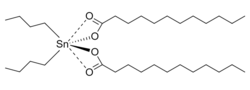
Dibutyltin dilaurate (abbreviated DBTDL) is an organotin compound with the formula (CH3(CH2)10CO2)2Sn(CH2CH2CH2CH3)2. It is a colorless viscous and oily liquid. It is used as a catalyst.
Description
Dibutyltin dilaurate consists of two laurate groups and two butyl groups coordinated to a tin(IV) atom. The coordination geometry at the tin center is tetrahedral. Based on the crystal structure of the related bis(bromobenzoate), the oxygen atoms of the carbonyl groups are weakly bonded to tin atom.[3] The compound is a dibutyltin(IV) ester of lauric acid.[1][4]
Decomposition
Upon heating to decomposition temperature (which is above 250 °C[2]), dibutyltin dilaurate emits acrid smoke and fumes.[1]
Uses
Dibutyltin dilaurate is used as a paint additive.[1] Together with dibutyltin dioctanoate, dibutyltin dilaurate is used as a catalyst for polyurethane production from isocyanates and diols. It is also useful as a catalyst for transesterification and for the room temperature vulcanization of silicones. It is also used as a stabilizer in polyvinyl chloride,[5][1] vinyl ester resins, lacquers, and elastomers.[1] It is also added to animal feed to remove cecal worms, roundworms, and tapeworms in chickens and turkeys and to prevent or provide treatment against hexamitosis and coccidiosis.[6]
Hazards and toxicity
Dibutyltin dilaurate can be absorbed through the skin. It irritates skin and eyes (causes redness of skin and eyes). It is a neurotoxin. It can cause injuries to the liver, kidneys, and gastrointestinal tract. The symptoms of poisoning with dibutyltin dilaurate include nausea, headache, muscular weakness and even paralysis.
Dibutyltin dilaurate is very reactive with acids and oxidizers, and it is combustible.[1] It emits irritating and toxic fumes and smoke when burned, which contain tin, tin oxides and carbon oxides.[2] Moreover, its vapor is much denser than air (21.8 times so[1]), so it can spread on floors, resulting in explosive conditions or asphyxiation hazards.
Related compounds
- Dibutyltin dioctanoate (CH3(CH2)6CO2)2Sn(CH2CH2CH2CH3)2: CAS#4731-77-5
- Dibutyltin diacetate (CH3CO2)2Sn(CH2CH2CH2CH3)2: CAS #1067-33-0
References
- ^ a b c d e f g h i j k l m n o p q r s t u v w x y z "Dibutyltin dilaurate". pubchem.ncbi.nlm.nih.gov.
- ^ a b c d e f g h i "SAFETY DATA SHEET - Dibutyltin dilaurate". Sigma Aldrich. November 6, 2025. Archived from the original on May 2, 2024. Retrieved December 9, 2025.
- ^ Weng Ng, Seik; Das, V. G. Kumar; Yip, Wai-Hing; Wang, Ru-Ji; Mak, Thomas C. W. (1990-08-28). "Di-n-butyltin(IV) di-o-bromobenzoate, a weakly-bridged dimer". Journal of Organometallic Chemistry. 393 (2): 201–204. doi:10.1016/0022-328X(90)80199-A. ISSN 0022-328X.
- ^ "Trimethyltin acetate | C5H12O2Sn | ChemSpider".
- ^ Davies, Alwyn George (2004). Organotin chemistry (2nd ed.). Weinheim: Wiley-VCH. Applications, Environmental Issues, and Analysis. ISBN 3-527-31023-1.
- ^ PubChem. "Butynorate". pubchem.ncbi.nlm.nih.gov. Retrieved 2019-08-23.