Diethyl carbonate
 | |
 | |
| Names | |
|---|---|
| Preferred IUPAC name
Diethyl carbonate | |
| Other names
Carbonic ether; Ethyl carbonate, di-; Eufin[1]
| |
| Identifiers | |
CAS Number
|
|
3D model (JSmol)
|
|
| ChEMBL | |
| ChemSpider | |
| ECHA InfoCard | 100.003.011 |
| EC Number |
|
PubChem CID
|
|
| RTECS number |
|
| UNII | |
| UN number | 2366 |
CompTox Dashboard (EPA)
|
|
InChI
| |
SMILES
| |
| Properties | |
Chemical formula
|
C5H10O3 |
| Molar mass | 118.132 g·mol−1 |
| Appearance | Colorless liquid |
| Density | 0.975 g/cm3 |
| Melting point | −74.3 °C (−101.7 °F; 198.8 K) [3] |
| Boiling point | 125.9 °C (258.6 °F; 399.0 K) [2] |
Solubility in water
|
Insoluble |
| Hazards | |
| GHS labelling: | |
Pictograms
|
 
|
Signal word
|
Warning |
Hazard statements
|
H226, H315, H319, H335 |
Precautionary statements
|
P210, P233, P240, P241, P242, P243, P261, P264, P271, P280, P302+P352, P303+P361+P353, P304+P340, P305+P351+P338, P312, P321, P332+P313, P337+P313, P362, P370+P378, P403+P233, P403+P235, P405, P501 |
| Flash point | 33 °C (91 °F; 306 K) |
Except where otherwise noted, data are given for materials in their standard state (at 25 °C [77 °F], 100 kPa).
Infobox references
| |


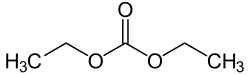
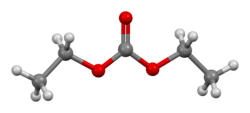
Diethyl carbonate (sometimes abbreviated DEC) is an ester of carbonic acid and ethanol with the formula OC(OCH2CH3)2. At room temperature (25 °C) diethyl carbonate is a colorless liquid with a low flash point.
Production
It can be made by combining phosgene and ethanol, i.e. a phosgenation reaction:[4]
- 2 CH3CH2OH +COCl2 → (CH3CH2O)2CO + 2 HCl
Although usually impractical, DEC can also be made by ethanolysis of urea. This reaction requires a heterogeneous catalysis that can act both as a Lewis acid and a base, such as various metal oxides. The reaction proceeds via the formation of the intermediary ethyl carbamate.[5]
- 2 CH3CH2OH +CO(NH2)2 → (CH3CH2O)2CO + 2 NH3
It can also be synthesized directly from carbon dioxide and ethanol using various methods, and via oxidative carbonylation with carbon monoxide. Another method is transesterification from dimethyl carbonate. Yet another method is from the reaction of ethyl nitrite and carbon monoxide, where the ethyl nitrite can be made from nitric oxide and ethanol. This method requires a catalyst such as palladium.[5]
Uses
Diethyl carbonate is mainly used as an industrial solvent.[4]
It is also used as a vehicle for erythromycin intramuscular injections.[6][7][8] It can be used as a component of electrolytes in lithium batteries. It has been proposed as a fuel additive to support cleaner diesel fuel combustion because its high boiling point might reduce blended fuels' volatility, minimizing vapor buildup in warm weather that can block fuel lines.[9] As a fuel additive, it can reduce emissions such as volatile organic compounds, CO2, and particulates.[5]
0.01% v/v DEC solutions can be used as a relatively gentle cold sterilizing reagent for laboratory chromatography resins.[10]
See also
References
- ^ "DIETHYL CARBONATE". Retrieved 2010-02-01.
- ^ William M. Haynes, ed. (2016). CRC Handbook of Chemistry and Physics (97th ed.). CRC Press. p. 15-15. ISBN 978-1498754293.
- ^ Ding, Michael S.; Xu, Kang; Jow, T. Richard (2001). "Liquid/Solid Phase Diagrams of Binary Carbonates for Lithium Batteries". Journal of the Electrochemical Society. 148 (5): A299–A304. doi:10.1149/1.1393419 – via ECS.
- ^ a b Buysch, Hans-Josef (2000). "Carbonic Esters". Ullmann's Encyclopedia of Industrial Chemistry. doi:10.1002/14356007.a05_197. ISBN 978-3-527-30385-4.
- ^ a b c Shukla, Kartikeya; Srivastava, Vimal Chandra (2016). "Diethyl carbonate: critical review of synthesis routes, catalysts used and engineering aspects". RSC Advances. 6 (39): 32624–32645. Bibcode:2016RSCAd...632624S. doi:10.1039/c6ra02518h. Retrieved Aug 3, 2021.
- ^ Anderson, Robert C.; Harris, Paul N.; Chen, K. K. (1955). "Further toxicological studies with ilotycin® (Erythromycin, Lilly)". Journal of the American Pharmaceutical Association. 44 (4): 199–204. doi:10.1002/jps.3030440404. ISSN 1930-2304. PMID 14367139.
- ^ US 4382086, Sciavolino, Frank C. & Hauske, James R., "9-Dihydro-11,12-ketal derivatives of erythromycin A and epi-erythromycin A", published 1983-05-03, issued 1982-03-01, assigned to Pfizer Inc.
- ^ US 4363803, Hauske, James R., "3",4"-Oxyallylene erythromycin and oleandomycin, composition and method of use", published 1982-12-14, issued 1982-03-01, assigned to Pfizer Inc.
- ^ Walter, K. Scientists Discover Method for Cleaner Fossil Fuel. MR&D Magazine. 09/18/2017 - 3:16pm
- ^ Rad, Bio-. "Bio-Gel A Gels - Instruction Manual" (PDF). Retrieved 12 April 2023.