Dihydromyrcenol
 | |
| Names | |
|---|---|
| IUPAC name
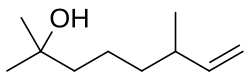
2,6-Dimethyloct-7-en-2-ol
| |
| Identifiers | |
CAS Number
|
|
3D model (JSmol)
|
|
| ChEBI | |
| ChEMBL | |
| ChemSpider | |
| DrugBank | |
| ECHA InfoCard | 100.038.497 |
PubChem CID
|
|
| UNII | |
CompTox Dashboard (EPA)
|
|
InChI
| |
SMILES
| |
| Properties | |
Chemical formula
|
C10H20O |
| Molar mass | 156.269 g·mol−1 |
| Appearance | Colorless viscous liquid[1] |
| Density | 0.832 g/cm3 (20 °C)[1] |
| Boiling point | 194–197 °C (381–387 °F; 467–470 K)[1] |
Solubility in water
|
0.939 g/L (20 °C)[1] |
| Hazards | |
| Flash point | 76 °C (169 °F; 349 K)[1] |
Except where otherwise noted, data are given for materials in their standard state (at 25 °C [77 °F], 100 kPa).
Infobox references
| |
Dihydromyrcenol is a synthetic organic compound used primarily as a fragrance ingredient. Despite its similarity to some natural compounds of the monoterpene class, such as myrcenol, it has not been reported to be found in nature.[2]
Chemical properties
Dihydromyrcenol has the chemical formula C10H20O.[3] It is a colorless viscous liquid with a boiling point of 194–197 °C (381–387 °F).[1]
Odor and uses
Dihydromyrcenol is extensively used in the fragrance industry for its fresh lime and citrus-like odor.[2] Descriptions of its scent include citrus type,[4] lime-like citrusy-floral sweet with considerable tenacity,[2] fresh citrus-like with a lavender note,[5] fresh cool metallic lime citrus floral bergamot,[6] and lavender fragrance reminiscent of lemon.[7] Worldwide use exceeded 1000 metric tons per year as of 2004.[5]
Synthesis
Dihydromyrcenol can be obtained from citronellene, a pyrolysis product of cis-pinane, via hydroxylation.[8][9][5]
Safety
A toxicologic and dermatologic review has been published on its use as a fragrance ingredient and it is considered safe under regulated use.[2]
References
- ^ a b c d e f Record in the GESTIS Substance Database of the Institute for Occupational Safety and Health
- ^ a b c d McGinty, D.; Letizia, C.S.; Api, A.M. (2010). "Fragrance material review on dihydromyrcenol". Food and Chemical Toxicology. 48: S70–S75. doi:10.1016/j.fct.2009.11.014. PMID 20141881.
- ^ CID 29096 from PubChem
- ^ "Dihydromyrcenol: 2,6-dimethyloct-7-en-2-ol".
- ^ a b c "Dihydromyrcenol".
- ^ "Dihydro Myrcenol".
- ^ "Dihydromyrcenol".
- ^ Naves, Y -R (1968). "Progress in the Synthesis of Perfumes Based on Pinenes". Russian Chemical Reviews. 37 (10): 779–788. Bibcode:1968RuCRv..37..779N. doi:10.1070/RC1968v037n10ABEH001703.
- ^ Prajapati, Rupali S.; Bhanage, Bhalchandra M. (2025). "Hydroformylation, hydroaminomethylation and related tandem reactions of bio-derived renewable olefins: A step closer to sustainability". RSC Sustainability. 3: 158–207. doi:10.1039/d4su00662c.