Hexamethyldisiloxane
 | |
 | |
| Names | |
|---|---|
| Preferred IUPAC name
Hexamethyldisiloxane | |
Other names
| |
| Identifiers | |
CAS Number
|
|
3D model (JSmol)
|
|
| Abbreviations | HMDSO, (TMS)2O |
Beilstein Reference
|
1736258 |
| ChEBI | |
| ChemSpider | |
| ECHA InfoCard | 100.003.176 |
| EC Number |
|
| MeSH | Hexamethyldisiloxane |
PubChem CID
|
|
| RTECS number |
|
| UNII | |
| UN number | 1993 |
CompTox Dashboard (EPA)
|
|
InChI
| |
SMILES
| |
| Properties | |
Chemical formula
|
C6H18OSi2 |
| Molar mass | 162.379 g·mol−1 |
| Appearance | Colourless liquid |
| Density | 0.764 g·cm−3 |
| Melting point | −59 °C (−74 °F; 214 K) |
| Boiling point | 100 to 101 °C (212 to 214 °F; 373 to 374 K) |
Solubility in water
|
930.7±33.7 ppb (23 °C) [1] |
| Vapor pressure | 43 hPa (20 °C) [2] |
Refractive index (nD)
|
1.377 |
| Hazards | |
| Occupational safety and health (OHS/OSH): | |
Main hazards
|
|
| GHS labelling: | |
Pictograms
|
  [2] [2]
|
Signal word
|
Danger[2] |
Hazard statements
|
H225, H410[2] |
Precautionary statements
|
P210, P233, P240, P273, P403+P235[2] |
| NFPA 704 (fire diamond) | 
1
4
0 |
| Flash point | −1(1) °C |
| Related compounds | |
Related compounds
|
|
Except where otherwise noted, data are given for materials in their standard state (at 25 °C [77 °F], 100 kPa).
Infobox references
| |


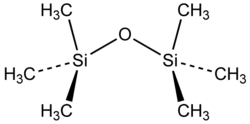
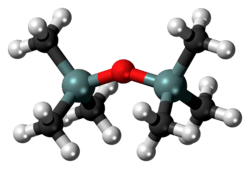
Hexamethyldisiloxane (HMDSO or MM) is an organosilicon compound with the formula O[Si(CH3)3]2, often abbreviated O[SiMe3]2. This volatile colourless liquid is used as a solvent and as a reagent in organic synthesis.[3] It is prepared by the hydrolysis of trimethylsilyl chloride. The molecule is the protypical disiloxane and resembles a subunit of polydimethylsiloxane.
Synthesis and reactions
Hexamethyldisiloxane can be produced by the addition of trimethylsilyl chloride to purified water:[4]
- 2 Me3SiCl + H2O → 2 HCl + O[SiMe3]2
It also results from the hydrolysis of silyl ethers and other silyl-protected functional groups. HMDSO can be converted to trimethylsilyl chloride by treatment with dimethyldichlorosilane:[5]
- O[SiMe3]2 + Me2SiCl2 → "Me2SiO" + 2 Me3SiCl
Hexamethyldisiloxane is mainly used as source of the trimethylsilyl functional group (-Si(CH3)3) in organic synthesis. For example, in the presence of acid catalyst, it converts alcohols and carboxylic acids into the silyl ethers and silyl esters, respectively.[3]
It reacts with rhenium(VII) oxide to give a siloxide:[6]
- Re2O7 + O[SiMe3]2 → 2 O3ReOSiMe3
HMDSO is a precursor to trimethylsilyl iodide:[4]
- O[SiMe3]2 + AlI3 → "AlI(O)" + 2 Me3SiI
Solvent-related uses
HMDSO is an effective solvent for thiations using phosphorus pentasulfide.[7]
It is used occasionally as an internal standard for 1H NMR spectroscopy. It is more easily handled since it is less volatile than the usual standard tetramethylsilane but still displays only a singlet near 0 ppm.
HMDSO has even poorer solvating power than alkanes. It is therefore sometimes employed to crystallise highly lipophilic compounds.[8]
Other
It is used in liquid bandages (spray-on plasters) such as Cavilon spray, to protect damaged skin from irritation from other bodily fluids. It is also used to soften and remove adhesive residues left by medical tape and bandages, without causing further skin irritation.
HMDSO is being studied for making low-k dielectric materials for the semiconductor industries by plasma-enhanced chemical vapour deposition (PECVD).
HMDSO has been used as a reporter molecule to measure tissue oxygen tension (pO2). HMDSO is highly hydrophobic and exhibits high gas solubility, and hence strong nuclear magnetic resonance spin lattice relaxation rate (R1) response to changes in pO2. Molecular symmetry provides a single NMR signal. Following direct injection into tissues it has been used to generate maps of tumour and muscle oxygenation dynamics with respect to hyperoxic gas breathing challenge.[9]
References
- ^ Sudarsanan Varaprath; Cecil L. Frye; Jerry Hamelink (1996). "Aqueous solubility of permethylsiloxanes (silicones)". Environmental Toxicology and Chemistry. 15 (8): 1263–1265. doi:10.1002/etc.5620150803.
- ^ a b c d e Record of Hexamethyldisiloxane in the GESTIS Substance Database of the Institute for Occupational Safety and Health, accessed on November 10, 2021.
- ^ a b Pfeifer, Joerg; Curphey, Thomas J. (2008). "Hexamethyldisiloxane". Encyclopedia of Reagents for Organic Synthesis. doi:10.1002/047084289X.rh017.pub2. ISBN 978-0-471-93623-7.
- ^ a b Michael E. Jung, Mark A. Lyster (1979). "Cleavage of Methyl Ethers with Iodotrimethylsilane: Cyclohexanol from Cyclohexyl Methyl Ether". Organic Syntheses. 59: 35. doi:10.15227/orgsyn.059.0035.
- ^ Röshe, L.; John, P.; Reitmeier, R. “Organic Silicon Compounds” Ullmann’s Encyclopedia of Industrial Chemistry. John Wiley and Sons: San Francisco, 2003. doi:10.1002/14356007.a24_021.
- ^ Schmidt, M.; Schmidbaur, H., "Trimethylsilyl perrhenate", Inorg. Synth. 1967, 9, 149-151. doi:10.1002/9780470132401.ch40
- ^ Spencer Knapp, Richard A. Huhn, Benjamin Amorelli (2007). "Thionation: GlcNAc-Thiazoline Triacetate". Organic Syntheses. 84: 68. doi:10.15227/orgsyn.084.0068.
{{cite journal}}: CS1 maint: multiple names: authors list (link) - ^ Dugan, Thomas R.; Bill, Eckhard; MacLeod, K. Cory; Brennessel, William W.; Holland, Patrick L. (2014). "Synthesis, Spectroscopy, and Hydrogen/Deuterium Exchange in High-Spin Iron(II) Hydride Complexes". Inorganic Chemistry. 53 (5): 2370–2380. doi:10.1021/ic4013137.
- ^ Kodibagkar VD, Cui W, Merritt ME, Mason RP. A novel 1H NMR approach to quantitative tissue oximetry using hexamethyldisiloxane. Magn Reson Med 2006;55:743–748 and Kodibagkar VD, Wang X, Pacheco-Torres J, Gulaka P, Mason RP. Proton Imaging of Siloxanes to map Tissue Oxygenation Levels (PISTOL): a tool for quantitative tissue oximetry. NMRBiomed 2008;21:899–907.