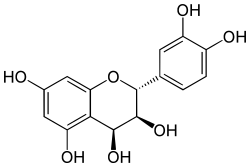
Leucocyanidin
 | |
| Names | |
|---|---|
| IUPAC name
(2R,3S,4S)-Flavan-3,3′,4,4′,5,7-hexol
| |
| Systematic IUPAC name
(2R,3S,4S)-2-(3,4-Dihydroxyphenyl)-3,4-dihydro-2H-1-benzopyran-3,4,5,7-tetrol | |
| Other names
Leucocianidol
Leucocianidolum Leucocyanidol Leukocyanidine Procyanidol Resivit Leucoanthocyanidol Vitamin P faktor 3,4-Cyanidiol (2R,3S,4S)-3,4,5,7,4-pentahydroxyflavan | |
| Identifiers | |
CAS Number
|
|
3D model (JSmol)
|
|
| ChEBI | |
| ChEMBL | |
| ChemSpider | |
PubChem CID
|
|
| UNII | |
CompTox Dashboard (EPA)
|
|
InChI
| |
SMILES
| |
| Properties | |
Chemical formula
|
C15H14O7 |
| Molar mass | 306.26 g/mol |
Except where otherwise noted, data are given for materials in their standard state (at 25 °C [77 °F], 100 kPa).
Infobox references
| |


Leucocyanidin is a colorless chemical compound that is a member of the class of natural products known as leucoanthocyanidins.
Chemistry
(+)-Leucocyanidin can be synthesized from (+)-dihydroquercetin by reduction with sodium borohydride.[1]
Molar equivalents of synthetic (2R,3S,4R or S)-leucocyanidin and (+)-catechin condense with exceptional rapidity at pH 5 under ambient conditions to give the all-trans-[4,8]- and [4,6]-bi-[(+)-catechins] (procyanidins B3, B6) the all-trans-[4,8:4,8]- and [4,8:4,6]-tri-[(+)-catechins] (procyanidin C2 and isomer).[2]
Metabolism
Leucocyanidin oxygenase uses leucocyanidin, 2-oxoglutarate, and O2 to produce cis-dihydroquercetin, trans-dihydroquercetin (taxifolin), succinate, CO2, and H2O.
Leucoanthocyanidin reductase (LAR or leucocyanidin reductase LCR) uses (2R,3S)-catechin, NADP+, and H2O to produce 2,3-trans-3,4-cis-leucocyanidin, NADPH, and H+. Its gene expression has been studied in developing grape berries and grapevine leaves.[3] Its activity has also been measured in leaves, flowers, and seeds of the legumes Medicago sativa, Lotus japonicus, Lotus uliginosus, Hedysarum sulfurescens, and Robinia pseudoacacia.[4]
The C-4 stereochemistry of leucocyanidin substrates affects anthocyanidin synthase (ANS) products. This enzyme is an iron(II) and 2-oxoglutarate (2OG) dependent oxygenase.[5]
Occurrence
Leucoyanidin can be found in these plants:[6]
- Aesculus hippocastanum (Horse chestnut)
- Anacardium occidentale (Cashew, acajou)
- Arachis hypogaea (peanut)
- Areca catechu (Areca nut)
- Asimina triloba (American custardapple)
- Cerasus vulgaris (Cherry)
- Cinnamomum camphora (Camphor)
- Erythroxylon coca (coca)
- Gleditsia triacanthos (Honey locust)
- Hamamelis virginiana (American Witch Hazel)
- Hippophae rhamnoides (Hippophae berry Sanddorn)
- Hordeum vulgare (Barley)
- Humulus lupulus (bine)
- Hypericum perforatum (perikon Amber)
- Laurus nobilis
- Magnolia denudata (Hsin-I Yulan-Magnolie)
- Malva sylvestris (Blue mallow)
- Musa acuminata × balbisiana (Banana)
- Nelumbo nucifera (Baladi bean)
- Pinus strobus (Eastern white pine)
- Prunus serotina ssp. serotina (black cherry)
- Psidium guajava (Common guava)
- Quercus alba (White oak)
- Quercus robur (Common oak)
- Rumex hymenosepalus (Arizona dock)
- Schinus terebinthifolius (Brazilian pepper tree)
- Terminalia arjuna (arjun)
- Terminalia catappa (Indian almond)
- Theobroma cacao (Cacao)
- Drimia maritima (Sea Squill)
- Vicia faba (bell-bean)
- Vitis vinifera (common grape vine)
- Zea mays (corn, maize)
- Ziziphus jujuba (jujube, Chinese date).
References
- ^ Heller, Werner; Britsch, Lothar; Forkmann, Gert; Grisebach, Hans (1985-02-01). "Leucoanthocyanidins as intermediates in anthocyanidin biosynthesis in flowers of Matthiola incana R. Br". Planta. 163 (2): 191–196. doi:10.1007/BF00393505. ISSN 0032-0935. PMID 24249337.
- ^ Synthesis of condensed tannins. Part 9. The condensation sequence of leucocyanidin with (+)-catechin and with the resultant procyanidins. Jan. A. Delcour, Daneel Ferreira and David G. Roux, J. Chem. Soc., Perkin Trans. 1, 1983, pages 1711-1717, doi:10.1039/P19830001711
- ^ Bogs, Jochen; Downey, Mark O.; Harvey, John S.; Ashton, Anthony R.; Tanner, Gregory J.; Robinson, Simon P. (2005-10-01). "Proanthocyanidin Synthesis and Expression of Genes Encoding Leucoanthocyanidin Reductase and Anthocyanidin Reductase in Developing Grape Berries and Grapevine Leaves". Plant Physiology. 139 (2): 652–663. doi:10.1104/pp.105.064238. ISSN 0032-0889. PMC 1255985. PMID 16169968.
- ^ Skadhauge, B.; Gruber, M. Y.; Thomsen, K. K.; Wettstein, D. V. (1997-04-01). "Leucocyanidin reductase activity and accumulation of proanthocyanidins in developing legume tissues". American Journal of Botany. 84 (4): 494. doi:10.2307/2446026. ISSN 0002-9122. JSTOR 2446026. (subscription required)
- ^ "The C-4 stereochemistry of leucocyanidin substrates for anthocyanidin synthase affects product selectivity TURNBULL Jonathan J.; NAGLE Michael J.; SEIBEL Jürgen F.; WELFORD Richard W. D.; GRANT Guy H.; SCHOFIELD Christopher J. 2003". Archived from the original on 2012-06-16. Retrieved 2009-09-04.
- ^ "Liber Herbarum II: DK: Leucocyanidin/ UK: Leucocyanidin/ D: Leucocyanidin". www.liberherbarum.com. Retrieved 2017-12-03.
Types of leucoanthocyanidins | |
|---|---|
| leucoanthocyanidins: |
|
 Category Category | |