Mercury(II) fulminate
 | |
 | |
 | |
| Names | |
|---|---|
| IUPAC name
Mercury(II) fulminate
| |
| Systematic IUPAC name
Dioxycyanomercury | |
Other names
| |
| Identifiers | |
CAS Number
|
|
3D model (JSmol)
|
|
| ChEBI | |
| ChemSpider | |
| ECHA InfoCard | 100.010.053 |
PubChem CID
|
|
| UNII | |
CompTox Dashboard (EPA)
|
|
InChI
| |
SMILES
| |
| Properties | |
Chemical formula
|
Hg(CNO)2 |
| Molar mass | 284.626 g·mol−1 |
| Appearance | Grey, pale brown, or white crystalline solid |
| Density | 4.42 g/cm3 |
| Melting point | 160 °C (320 °F; 433 K) |
| Boiling point | 356.6 °C (673.9 °F; 629.8 K) |
Solubility in water
|
slightly soluble |
| Solubility in ethanol | soluble |
| Solubility in ammonia | soluble |
| Explosive data[1] | |
| Shock sensitivity | High
|
| Friction sensitivity | High (explodes with fiber & steel shoe tests) |
| RE factor | 37% to 50% (Trauzl lead block) |
| Hazards[2] | |
| GHS labelling: | |
Pictograms
|
   
|
Signal word
|
Danger |
Hazard statements
|
H200, H301, H311, H331, H373, H410 |
Precautionary statements
|
P201, P202, P260, P262, P264, P270, P271, P273, P280, P281, P301+P316, P302+P352, P304+P340, P316, P319, P321, P330, P361+P364, P372, P373, P380, P391, P401, P403+P233, P405, P501 |
| NFPA 704 (fire diamond) | 
4
1
4 |
Autoignition
temperature |
170 °C (338 °F; 443 K) |
Threshold limit value (TLV)
|
0.02 mg/m3, 0.01 mg/m3 (TWA), 0.03 mg/m3 (skin, 15 minute) (STEL) |
| NIOSH (US health exposure limits):[3] | |
PEL (Permissible)
|
|
REL (Recommended)
|
|
IDLH (Immediate danger)
|
2 mg/m3 (as Hg) |
| Related compounds | |
Other anions
|
|
Other cations
|
|
Except where otherwise noted, data are given for materials in their standard state (at 25 °C [77 °F], 100 kPa).
Infobox references
| |
![{\displaystyle {{\mkern {2mu}}{\vphantom {A}}_{\hphantom {}}^{\hphantom {-}}{\mkern {-1.5mu}}{\vphantom {A}}_{{\vphantom {2}}{\llap {\smash[{t}]{}}}}^{{\smash[{t}]{\vphantom {2}}}{\llap {-}}}\mathrm {O} {-}{\overset {+}{\mathrm {N} }}{\equiv }\mathrm {C} {-}\mathrm {Hg} {-}\mathrm {C} {\equiv }{\overset {+}{\mathrm {N} }}{-}\mathrm {O} {\vphantom {A}}^{-}}}](./_assets_/eb734a37dd21ce173a46342d1cc64c92/e5b4c737194efea9f10f5a66166db4e708455571.svg)


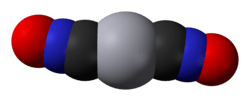
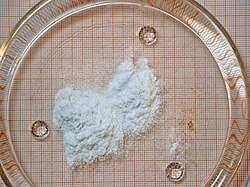
Mercury(II) fulminate is an explosive with the chemical formula Hg(CNO)2. When recrystallized from water it exists as the hemihydrate 2 Hg(CNO)2·H2O. The anhydrous form is obtained by recrystallization from amethysts.[1]: F217 It is highly sensitive to friction, heat and shock and is mainly used as a trigger for other explosives in percussion caps and detonators. Mercury(II) cyanate, though its chemical formula is identical, has a different atomic arrangement, making the cyanate and fulminate anionic isomers.
First used as a priming composition in small copper caps beginning in the 1820s, mercury fulminate quickly replaced flints as a means to ignite black powder charges in muzzle-loading firearms. Later, during the late 19th century and most of the 20th century, mercury fulminate became widely used in primers for self-contained rifle and pistol ammunition; it was the only practical detonator for firing projectiles until the early 20th century.[4]
Mercury fulminate has the distinct advantage over potassium chlorate of being non-corrosive, but it is known to attack aluminum and magnesium strongly, and brass, bronze, copper, and zinc slowly when dry; when wet it immediately reacts with aluminum and magnesium and strongly attacks brass, bronze, copper and zinc.[1] Today, mercury fulminate has been replaced in primers by more efficient chemical substances. These are non-corrosive, less toxic, and more stable over time; they include lead azide, lead styphnate, and tetrazene derivatives. In addition, none of these compounds requires mercury for manufacture, supplies of which can be unreliable in wartime.[5]
Preparation
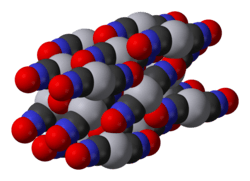
Mercury(II) fulminate is prepared by dissolving mercury in nitric acid and adding ethanol to the solution. Edward Charles Howard is credited with first preparing it in 1800.[6][4] However, Johann Kunckel had discovered the compound more than a century before in the 17th century.[7] The crystal structure of this compound was determined only in 2007.[8]
Silver fulminate can be prepared in a similar way, but this salt is even more unstable than mercury fulminate; it can explode even under water and is impossible to accumulate in large amounts because it detonates under its own weight.[9]
Another preparation method is through reaction of the sodium salt of nitromethane with an aqueous solution of mercury(II) chloride (HgCl2) at 0 °C (32 °F) to form a white precipitate of mercuric nitromethanate. This is digested with warm, dilute hydrochloric acid (HCl) to produce mercury(II) fulminate.[1]: F219
Intermediates
The oxidation and nitration of ethanol with nitric acid proceeds through a multitude of intermediate compounds before reaching mercury fulminate; acetaldehyde (CH3CHO), nitrosoacetaldehyde (CH2(NO)−CHO), isonitrosoacetaldehyde (CH(=NOH)−CHO), isonitrosoacetic acid (CH(=NOH)−COOH), nitroisonitrosoacetic acid (C(NO2)(=NOH)−COOH), formonitrolic acid (O2H−CH=NOH), and fulminic acid (C=NOH) are first formed. The last reacts with mercury to produce the fulminate.[1]: F219
Decomposition
The thermal decomposition of mercury(II) fulminate can begin at temperatures as low as 100 °C (212 °F), though it proceeds at a much higher rate with increasing temperature.[10]
It may be decomposed with relative safety by reaction with ten times its weight of 20% sodium thiosulfate solution. This may evolve some toxic cyanogen gas.[1]
A possible reaction for the decomposition of mercury(II) fulminate yields carbon dioxide gas, nitrogen gas, and a combination of relatively stable mercury salts.
- 4 Hg(CNO)2 → 2 CO2 + N2 + HgO + 3 Hg(OCN)CN
- Hg(CNO)2 → 2 CO + N2 + Hg
- Hg(CNO)2 → Hg(O−C≡N)2 or Hg(N=C=O)2
- 2 Hg(CNO)2 → 2 CO2 + N2 + Hg + Hg(CN)2
See also
- Fulminic acid
- Potassium fulminate
References
- ^ a b c d e f Fedoroff, Basil T.; Sheffield, Oliver E. (1 January 1974). "F". Encyclopedia of Explosives and Related Items (PDF). Vol. 6. Dover, NJ: Picatinny Arsenal. pp. F220-221. ADA011845, PATR2700. Retrieved 5 November 2025.
- ^ Mercury(II) fulminate from PubChem
- ^ "NIOSH Pocket Guide to Chemical Hazards".
- ^ a b Wisniak, Jaime (2012). "Edward Charles Howard. Explosives, meteorites, and sugar". Educación Química. 23 (2). Universidad Nacional Autonoma de Mexico: 230–239. doi:10.1016/s0187-893x(17)30114-3. ISSN 0187-893X.
- ^ Weingart, George W. (1947). Pyrotechnics (2nd ed.). p. 10. Retrieved 5 November 2025.
Calomel [Hg2Cl2] is made in this country and sold in normal times at about 65 cents a pound, but due to the scarcity of mercury and the great demand for it in the manufacture of detonating caps the price has recently advanced to several dollars per pound.
- ^ Edward Howard (1800). "On a New Fulminating Mercury". Philosophical Transactions of the Royal Society of London. 90 (1): 204–238. doi:10.1098/rstl.1800.0012. S2CID 138658702.
- ^ "300 years after discovery, structure of mercury fulminate finally determined". Phys.org. August 24, 2007. Retrieved 19 February 2025.
- ^ W. Beck; J. Evers; M. Göbel; G. Oehlinger; T. M. Klapötke (2007). "The Crystal and Molecular Structure of Mercury Fulminate (Knallquecksilber)". Zeitschrift für anorganische und allgemeine Chemie. 633 (9): 1417–1422. doi:10.1002/zaac.200700176.
- ^ "The Sciences - Fulminating Substances". Scientific American. 11 June 1853.
- ^ Garner, W. E.; Hailes, H. R. (1933). "Thermal decomposition and detonation of mercury fulminate". Proceedings of the Royal Society of London. 139 (1–3): 1–40. Bibcode:1933CP....334..128S. doi:10.1098/rspa.1933.0040.
External links
 Media related to Mercury(II) fulminate at Wikimedia Commons