Methyl heptanoate
 | |
| Names | |
|---|---|
| IUPAC name
Methyl heptanoate
| |
| Other names
Methyl heptylate
Methyl enanthate Methyl oenanthate Heptanoic acid, methyl ester | |
| Identifiers | |
CAS Number
|
|
3D model (JSmol)
|
|
| ChEBI | |
| ChemSpider | |
| ECHA InfoCard | 100.003.118 |
| EC Number |
|
PubChem CID
|
|
| UNII | |
CompTox Dashboard (EPA)
|
|
InChI
| |
SMILES
| |
| Properties | |
Chemical formula
|
C8H16O2 |
| Molar mass | 144.214 g·mol−1 |
| Appearance | Colorless liquid[1] |
| Density | 0.880 g/cm3 (20 °C)[1] |
| Melting point | −56 °C (−69 °F; 217 K)[1] |
| Boiling point | 171–172 °C (340–342 °F; 444–445 K)[1] |
Solubility in water
|
Insoluble in water[1] |
| Hazards | |
| GHS labelling:[1] | |
Pictograms
|
 
|
Signal word
|
Warning |
Hazard statements
|
H226, H315 |
Precautionary statements
|
P210, P233, P240, P241, P242, P243, P264, P280, P302+P352, P303+P361+P353, P321, P332+P317, P362+P364, P370+P378, P403+P235, P501 |
| Flash point | 52 °C (126 °F; 325 K)[1] |
| Lethal dose or concentration (LD, LC): | |
LD50 (median dose)
|
> 5,000 mg/kg (oral, rat) > 5,000 mg/kg (dermal, rabbit) |
Except where otherwise noted, data are given for materials in their standard state (at 25 °C [77 °F], 100 kPa).
Infobox references
| |

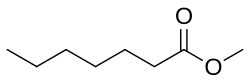
Methyl heptanoate is an organic compound with the chemical formula CH3(CH2)5CO2CH3. It is the methyl ester of heptanoic acid (also known as enanthic acid). This fatty acid ester is a colorless, oily liquid with a fruity, wine-like odor that is used in the flavor and fragrance industries.[1]
Properties
Methyl heptanoate is a colorless to pale yellow liquid at room temperature. It has a characteristic orris, winey, brandy-like aroma with cognac and fruity undertones.[2][3] The compound is practically insoluble in water but miscible with most organic solvents and oils.
Occurrence and production
Methyl heptanoate occurs naturally in trace amounts in some fruits and fermented products. It has been identified as a volatile component in fruits such as strawberries, grapes, and wine and in flowering plants such as Astragalus.[4]
Commercially, it is produced by esterification of heptanoic acid with methanol in the presence of an acid catalyst (typically sulfuric acid) or via transesterification of triglycerides containing heptanoic acid. It is also available through the methanolysis of natural oils that contain other heptanoate esters.[5]
Uses
Methyl heptanoate is primarily used in the flavor and fragrance industry:[3][6]
- As a component of artificial cognac, brandy, wine, and fruit flavorings
- In perfumes to impart green, fruity, and winey notes
- As a trace ingredient in strawberry, grape, and other fruit flavor compositions
It is approved as a flavoring agent in many countries and has the FEMA number 2705.[7]
Safety
Methyl heptanoate has low acute toxicity; its LD50s include > 5,000 mg/kg (oral, rat) and > 5,000 mg/kg (dermal, rabbit).[8] It may cause mild skin and eye irritation upon direct contact. The compound is combustible, but does not present a fire or explosion hazard beyond those typical of flammable esters.
References
- ^ a b c d e f g Record in the GESTIS Substance Database of the Institute for Occupational Safety and Health
- ^ "Methyl hepatanoate". thegoodscentscompany.com.
- ^ a b Arctander, Steffen (1969). Perfume and Flavor Chemicals. Montclair, NJ.
{{cite book}}: CS1 maint: location missing publisher (link) - ^ Miyazawa, Mitsuo; Kameoka, Hiromu (1987). "Volatile Flavor Components of ASTRAGALI RADIX ( Astragalus membranaceus Bunge)". Agricultural and Biological Chemistry. 51 (11): 3153–3154. doi:10.1080/00021369.1987.10868496.
- ^ Vonortas, Andreas; Papayannakos, Nikolaos (2014). "Comparative analysis of biodiesel versus green diesel". WIREs Energy and Environment. 3 (1): 3–23. Bibcode:2014WIREE...3....3V. doi:10.1002/wene.78.
- ^ Burdock, George A. (2010). Fenaroli's Handbook of Flavor Ingredients, 6th ed. CRC Press.
- ^ "2705: Methyl heptanoate". femaflavor.org.
- ^ "Safety Data Sheet". sigmaaldrich.com.