Nickel arsenide
 | |
| Identifiers | |
|---|---|
CAS Number
|
|
3D model (JSmol)
|
|
| ECHA InfoCard | 100.043.776 |
| EC Number |
|
PubChem CID
|
|
| UNII | |
CompTox Dashboard (EPA)
|
|
InChI
| |
SMILES
| |
| Properties | |
Chemical formula
|
AsNi |
| Molar mass | 133.6150 g·mol−1 |
| Appearance | red solid |
| Density | 7.57 g/cm3 |
| Melting point | 968 °C (1,774 °F; 1,241 K) |
Solubility in water
|
nearly insoluble |
| Hazards | |
| GHS labelling: | |
Pictograms
|
|
Signal word
|
Danger |
Hazard statements
|
H317, H350i, H372, H410 |
| Lethal dose or concentration (LD, LC): | |
LD50 (median dose)
|
6000 mg/kg (acute oral, rat)[1] |
Except where otherwise noted, data are given for materials in their standard state (at 25 °C [77 °F], 100 kPa).
Infobox references
| |
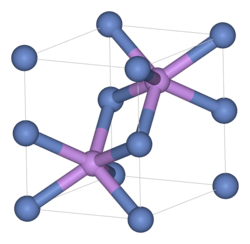
Nickel arsenide refers to inorganic compounds composed of nickel and arsenic. Several forms exist including a monoarsenide with the chemical formula NiAs and another with the formula Ni5As2.[2] It is highly toxic and a known carcinogen.[3]
Occurrence
Nickel arsenide occurs in the following minerals:
Preparation
Nickel arsenide can be prepared by direct combination of the elements:[7]
- Ni(s) + As(s) → NiAs(s)
History
Nickel arsenide was one of the first compounds that revealed the toxicity of nickel. The damage to the miners' lungs was documented by Georgius Agricola in the 16th century: "kupfer-nickel" ores in the Schneeberg mines contained red-colored NiAs mineral originally mistaken for the copper ore, thus the German: kupfer (copper) in the name. The German: Nickel (demon) name was reflecting the damage it did to the health of the workers,[8] in addition to them being unable to extract any copper from this ore.
References
- ^ Reagan, E. L. (1992). "Acute Oral LD50 Study in Rats with Nickel Arsenide". Journal of the American College of Toxicology. 11 (6). SAGE Publications: 695. doi:10.3109/10915819209142088. ISSN 0730-0913.
- ^ Heyding, R. D.; Calvert, L. D. (October 1957). "Arsenides of the transition metals: ii. the nickel arsenides". Canadian Journal of Chemistry. 35 (10): 1205–1215. doi:10.1139/v57-161. ISSN 0008-4042.
- ^ Gurley, Lawrence; Valdez, Joseph; Miglio, John; Cox, Summers; Tobey, Robert (1986). "Biological availability of nickel arsenides: Cellular response to soluble Ni5As2". Journal of Toxicology and Environmental Health, Part A. 17 (1): 101–117. doi:10.1080/15287398609530806. ISSN 1528-7394.
- ^ "Nickeline". www.mindat.org. Retrieved 2026-01-23.
- ^ "Orcelite". www.mindat.org. Retrieved 2026-01-23.
- ^ "Maucherite". www.mindat.org. Retrieved 2026-01-23.
- ^ Shriver, D.; Atkins, P. (2009). Shriver and Atkins' Inorganic Chemistry (5th ed.). New York: W. H. Freeman and Company. p. 383. ISBN 978-1-4292-1820-7.
- ^ Sunderman, F.W. (1989). "A pilgrimage into the archives of nickel toxicology" (PDF). Annals of Clinical and Laboratory Science. 19 (1): 1–16. ISSN 0091-7370. PMID 2644888. Retrieved 2024-10-13.
Further reading
- Thompson, J.G.; Rae, A.D.; Withers, R.L.; Welberry, T.R.; Willis, A.C. (1988-08-10). "The crystal structure of nickel arsenide". Journal of Physics C: Solid State Physics. 21 (22). IOP Publishing: 4007–4015. Bibcode:1988JPhC...21.4007T. doi:10.1088/0022-3719/21/22/016. ISSN 0022-3719.