Pararosaniline
 | |
| Names | |
|---|---|
| IUPAC name
[4-[Bis(4-aminophenyl)methylidene]-1-cyclohexa-2,5-dienylidene]dianiline
| |
| Other names
Pararosaniline
p-rosaniline C.I. 42500 Para magenta | |
| Identifiers | |
CAS Number
|
|
3D model (JSmol)
|
|
| ChEBI | |
| ChemSpider | |
| ECHA InfoCard | 100.106.992 |
| KEGG | |
PubChem CID
|
|
| UNII |
|
CompTox Dashboard (EPA)
|
|
InChI
| |
SMILES
| |
| Properties | |
Chemical formula
|
C19H17N3 |
| Molar mass |
|
| Appearance | Green crystalline solid |
| Melting point | 268 to 270 °C (514 to 518 °F; 541 to 543 K) decomposes |
Solubility in water
|
Slightly soluble |
| Hazards | |
| Safety data sheet (SDS) | External MSDS |
Except where otherwise noted, data are given for materials in their standard state (at 25 °C [77 °F], 100 kPa).
Infobox references
| |


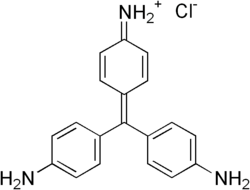
Pararosaniline, pararosaniline free base, Basic Red 9, or C.I. 42500 is an organic compound with the formula (H2NC6H4)2C=(C6H4NH).[1] It is the free base form of pararosaniline hydrochloride, [(H2NC6H4)3C]+Cl−, a magenta solid with a variety of uses as a dye.[2][3] It is one of the four components of basic fuchsine.[4] It is structurally related to other triarylmethane dyes called methyl violets (e.g. crystal violet) which feature methyl groups on nitrogen.
It is prepared by the condensation of aniline and p-aminobenzaldehyde. Alternatively, it arises from the oxidation of 4,4'-bis(aminophenyl)methane in the presence of aniline.
Uses
- It is used to dye polyacrylonitrile fibers.
- It is used to detect sulfur dioxide.[5]
- Pararosaniline is used as a colorimetric test for aldehydes, in the Schiff test. It is the only basic fuchsine component suitable for making the aldehyde-fuchsine stain for pancreatic islet beta cells.[6]
- It has use as an antischistosomal. [7]
Related compounds
- 4,4'-Thiodianiline
- 4,4'-Methylenedianiline
- 4,4'-Oxydianiline
- Dapsone
References
- ^ "pararosaniline free base (CHEBI:75372)". ChEBI. Retrieved 11 January 2025.
- ^ Thomas Gessner and Udo Mayer "Triarylmethane and Diarylmethane Dyes" in Ullmann's Encyclopedia of Industrial Chemistry 2002, Wiley-VCH, Weinheim.doi:10.1002/14356007.a27_179
- ^ "pararosaniline (CHEBI:87663)". ChEBI. Retrieved 11 January 2025.
- ^ Horobin RW, Kiernan JA (2002) Conn's Biological Stains, 10th ed. Oxford: BIOS.
- ^ J. B. Pate, J. P. Lodge, A. F. Wartburg (1962). "Effect of Pararosaniline in the Trace Determination of Sulfur Dioxide". Analytical Chemistry. 34 (12): 1660–1662. doi:10.1021/ac60192a001. ISSN 0003-2700. Retrieved 2023-03-03.
{{cite journal}}: CS1 maint: multiple names: authors list (link) - ^ Mowry, RW; Emmel, VM (1978). "Aldehyde fuchsin staining, direct or after oxidation: problems and remedies, with special reference to pancreatic B cells, pituitaries and elastic fibers". Stain Technology. 53 (3): 141–154. doi:10.3109/10520297809111457. PMID 83035.
- ^ GB 908634, "Pharmaceutical compositions containing pararosaniline or derivatives thereof", published 1962-10-24, assigned to Parke, Davis & Co.
Further reading
- Colour Index 3rd Edition Volume 4 (PDF), Bradford: Society of Dyers and Colourists, 1971, p. 4388, archived from the original (PDF) on 2011-07-19.
- Gessner, T.; Mayer, U. (2002), "Triarylmethane and Diarylmethane Dyes", Ullmann's Encyclopedia of Industrial Chemistry 6th Edition, Weinheim: Wiley-VCH, doi:10.1002/14356007.a27_179.