Promecarb
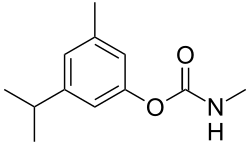
|
| Names
|
Preferred IUPAC name
3-Methyl-5-(propan-2-yl)phenyl methylcarbamate |
| Other names
5-Methyl-m-cumenyl methylcarbamate
|
| Identifiers
|
CAS Number
|
|
3D model (JSmol)
|
|
| ChemSpider
|
|
| ECHA InfoCard
|
100.018.285
|
|
|
|
| UNII
|
|
|
|
|
InChI=1S/C12H17NO2/c1-8(2)10-5-9(3)6-11(7-10)15-12(14)13-4/h5-8H,1-4H3,(H,13,14) Key: DTAPQAJKAFRNJB-UHFFFAOYSA-N InChI=1/C12H17NO2/c1-8(2)10-5-9(3)6-11(7-10)15-12(14)13-4/h5-8H,1-4H3,(H,13,14) Key: DTAPQAJKAFRNJB-UHFFFAOYAG
|
O=C(Oc1cc(cc(c1)C(C)C)C)NC
|
| Properties
|
Chemical formula
|
C12H17NO2
|
| Molar mass
|
207.273 g·mol−1
|
Except where otherwise noted, data are given for materials in their standard state (at 25 °C [77 °F], 100 kPa).
Infobox references
|
Promecarb (chemical formula: C12H17NO2) is a chemical compound previously used as an insecticide.[1]
References
- ^ Promecarb in the Pesticide Properties DataBase (PPDB)
Pest control: Insecticides |
|---|
| Carbamates | |
|---|
| Inorganic compounds | |
|---|
| Insect growth regulators | |
|---|
| Neonicotinoids |
- Acetamiprid
- Clothianidin
- Dinotefuran
- Imidacloprid
- Imidaclothiz
- Nitenpyram
- Nithiazine
- Paichongding
- Thiacloprid
- Thiamethoxam
|
|---|
| Organochlorides | |
|---|
| Organophosphorus | |
|---|
| Pyrethroids | |
|---|
| Diamides |
- Chlorantraniliprole
- Cyantraniliprole
- Flubendiamide
|
|---|
| Other chemicals | |
|---|
| Metabolites | |
|---|
| Biopesticides |
- Bacillus thuringiensis
- Baculovirus
- Beauveria bassiana
- Beauveria brongniartii
- Isaria fumosorosea
- Metarhizium acridum
- Metarhizium anisopliae
- Nomuraea rileyi
- Lecanicillium lecanii
- Paenibacillus popilliae
- Purpureocillium lilacinum
- Spinosad
|
|---|
