Quinaldine
 | |
| Names | |
|---|---|
| Preferred IUPAC name
2-Methylquinoline | |
| Other names
Quinaldine, α-methylquinoline, chinaldine, khinaldin
| |
| Identifiers | |
CAS Number
|
|
3D model (JSmol)
|
|
| ChEBI | |
| ChEMBL | |
| ChemSpider | |
| ECHA InfoCard | 100.001.896 |
| EC Number |
|
PubChem CID
|
|
| UNII | |
CompTox Dashboard (EPA)
|
|
InChI
| |
SMILES
| |
| Properties | |
Chemical formula
|
C10H9N |
| Molar mass | 143.19 g/mol |
| Appearance | colorless oil |
| Density | 1.058 g/cm3 |
| Melting point | −2 °C (28 °F; 271 K) |
| Boiling point | 248 °C (478 °F; 521 K) |
Solubility in water
|
Insoluble |
| Hazards | |
| GHS labelling: | |
Pictograms
|

|
Signal word
|
Warning |
Hazard statements
|
H302, H312, H319 |
Precautionary statements
|
P264, P270, P280, P301+P312, P302+P352, P305+P351+P338, P312, P322, P330, P337+P313, P363, P501 |
| NFPA 704 (fire diamond) | 
2
2
0 |
| Flash point | 79 °C (174 °F; 352 K) |
Except where otherwise noted, data are given for materials in their standard state (at 25 °C [77 °F], 100 kPa).
Infobox references
| |


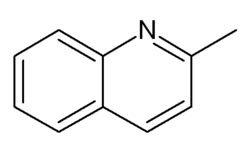
Quinaldine or 2-methylquinoline is an organic compound with the formula CH3C9H6N. It is one of the methyl derivatives of the heterocyclic compound quinoline. It is bioactive and is used in the preparation of various dyes. It is a colorless oil but commercial samples can appear colored.[1]
Production and reactions
Quinaldine is recovered from coal tar. It can be prepared from aniline and paraldehyde via Skraup synthesis or from aniline and crotonaldehyde via Doebner-von Miller variation of the Skraup reaction.[1]
Hydrogenation of quinaldine gives 2-methyltetrahydroquinoline. This reduction can be conducted enantioselectively.[2] Oxidation with selenium dioxide give the aldehyde 2-formylquinoline.[3]
Properties
Quinaldine has critical point at 787 K and 4.9 MPa and its refractive index is 1.8116.
Uses
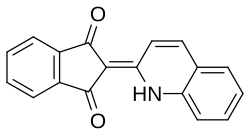
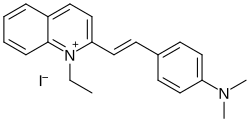
Quinaldine is used in manufacturing anti-malaria drugs, dyes and food colorants (e.g., Quinoline Yellows, pinacyanol). It is the precursor to the pH indicator Quinaldine Red.
Quinaldine sulfate is an anaesthetic used in fish transportation.[4] In some Caribbean islands it is used to facilitate the collection of tropical fish from reefs.
See also
- Lepidine, the isomer with the methyl group in position 4.
References
- ^ a b Gerd Collin; Hartmut Höke. "Quinoline and Isoquinoline". Ullmann's Encyclopedia of Industrial Chemistry. Weinheim: Wiley-VCH. doi:10.1002/14356007.a22_465. ISBN 978-3-527-30673-2.
- ^ Chen, Fei; Ding, Zi-Yuan; He, Yan-Mei; Fan, Qing-Hua (2015). "Synthesis of Optically Active 1,2,3,4-Tetrahydroquinolines via Asymmetric Hydrogenation Using Iridium-Diamine Catalyst". Org. Synth. 92: 213–226. doi:10.15227/orgsyn.092.0213.
- ^ H. A. Riley, A. R. Gray (1935). "Phenylglyoxal". Organic Syntheses. 15: 67. doi:10.15227/orgsyn.015.0067.
- ^ Blasiola G. C. Jr. (1977). "Quinaldine sulphate, a new anaesthetic formulation for tropical marine fishes". Journal of Fish Biology. 10 (2): 113–119(7). doi:10.1111/j.1095-8649.1977.tb04048.x.
External links
- MSDS at Science Lab Archived 2015-09-09 at the Wayback Machine
- Method of purifying quinaldine
- Chisholm, Hugh, ed. (1911). . Encyclopædia Britannica. Vol. 22 (11th ed.). Cambridge University Press. pp. 758–760.