Sodium butyrate
 | |
| Names | |
|---|---|
| Preferred IUPAC name
Sodium butanoate | |
| Other names
Sodium butyrate
| |
| Identifiers | |
CAS Number
|
|
3D model (JSmol)
|
|
| ChEBI | |
| ChEMBL | |
| ChemSpider | |
| ECHA InfoCard | 100.005.326 |
PubChem CID
|
|
| UNII | |
CompTox Dashboard (EPA)
|
|
InChI
| |
SMILES
| |
| Properties | |
Chemical formula
|
CH3CH2CH2COONa |
| Molar mass | 110.088 g·mol−1 |
Except where otherwise noted, data are given for materials in their standard state (at 25 °C [77 °F], 100 kPa).
Infobox references
| |


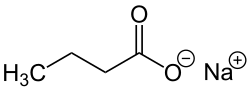
Sodium butyrate is a compound with formula CH3CH2CH2COO−Na+. It is the sodium salt of butyric acid. It has various effects on cultured mammalian cells including inhibition of proliferation, induction of differentiation and induction or repression of gene expression.[1] As such, it can be used in lab to bring about any of these effects. Specifically, butyrate treatment of cells results in histone hyperacetylation, and butyrate itself inhibits class I histone deacetylase (HDAC) activity,[2] specifically HDAC1, HDAC2, HDAC3, and butyrate can be used in determining histone deacetylene in chromatin structure and function. Inhibition of HDAC activity is estimated to affect the expression of only 2% of mammalian genes.[3]
In the lab, sodium butyrate is usually found as a white, water-soluble, crystalline solid. The chemical is notable for having a very strong, unpleasant smell that lingers.[4] When working with sodium butyrate, gloves, eye protection and respiratory masks are advised for safety purposes.[5]
The compound is found in human diet, notably produced in large amounts from dietary fiber in the gut and present in Parmesan cheese and butter.[6] Nevertheless, the most common source of sodium butyrate in the gut is from consumption of legumes.[7]
See also
References
- ^ Kruh, Jacques (1981). "Effects of sodium butyrate, a new pharmacological agent, on cells in culture". Molecular and Cellular Biochemistry. 42 (2): 65–82. doi:10.1007/BF00222695. PMID 6174854. S2CID 24214720.
- ^ Candido, E; Reeves, Raymond; Davie, James R. (1978). "Sodium butyrate inhibits histone deacetylation in cultured cells". Cell. 14 (1): 105–13. doi:10.1016/0092-8674(78)90305-7. PMID 667927. S2CID 33206068.
- ^ Davie, James R. (2003). "Inhibition of Histone Deacetylase Activity by Butyrate". The Journal of Nutrition. 133 (7 Suppl): 2485S–2493S. doi:10.1093/jn/133.7.2485s. PMID 12840228.
- ^ "Sodium butanoate | 156-54-7". Chemicalbook.com. Retrieved 2016-05-31.
- ^ "Sodium butyrate ≥98.5% (GC) | Sigma-Aldrich". Sigmaaldrich.com. Retrieved 2016-05-31.
- ^ Li, Huating; Gao, Zhanguo; Zhang, Jin; Ye, Xin; Xu, Aimin; Ye, Jianping; Jia, Weiping (1 April 2012). "Sodium Butyrate Stimulates Expression of Fibroblast Growth Factor 21 in Liver by Inhibition of Histone Deacetylase 3". Diabetes. 61 (4): 797–806. doi:10.2337/db11-0846. PMC 3314370. PMID 22338096. Retrieved 27 November 2021 – via diabetes.diabetesjournals.org.
- ^ Buettner, Dan (22 May 2015). "Want Great Longevity and Health? It Takes a Village". Wsj.com. Retrieved 27 November 2021.
Further reading
- Govindarajan, Nambirajan; Agis-Balboa, Roberto Carlos; Walter, Jonas; Sananbenesi, Farahnaz; Fischer, André (2011). "Sodium Butyrate Improves Memory Function in an Alzheimer's Disease Mouse Model When Administered at an Advanced Stage of Disease Progression". Journal of Alzheimer's Disease. 26 (1): 187–97. doi:10.3233/JAD-2011-110080. PMID 21593570.