Vanillyl alcohol
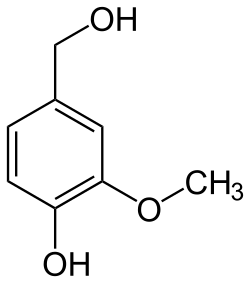 | |
| Names | |
|---|---|
| Preferred IUPAC name
4-(Hydroxymethyl)-2-methoxyphenol | |
| Other names
3-Methoxy-4-hydroxybenzyl alcohol
4-Hydroxy-3-methoxybenzenemethanol 4-Hydroxy-3-methoxybenzyl alcohol Vanillic alcohol Vanillin alcohol | |
| Identifiers | |
CAS Number
|
|
| ChEBI | |
| ChemSpider | |
| ECHA InfoCard | 100.007.140 |
PubChem CID
|
|
| UNII | |
CompTox Dashboard (EPA)
|
|
InChI
| |
| Properties | |
Chemical formula
|
C8H10O3 |
| Molar mass | 154.165 g·mol−1 |
| Appearance | Crystalline white to off-white powder |
| Melting point | 113 °C (235 °F; 386 K)[1] |
| Boiling point | 293 °C (559 °F; 566 K)[1] |
| Acidity (pKa) | 9.75[1] |
| Related compounds | |
Related phenols
|
vanillic acid, vanillin |
Except where otherwise noted, data are given for materials in their standard state (at 25 °C [77 °F], 100 kPa).
Infobox references
| |

Vanillyl alcohol is derived from vanillin.[2] It is used to flavor food[1] and scent fragrances, and is described to have a mild, sweet, balsamic vanilla-like scent. Recent studies have shown that vanillyl alcohol has some neuro-protective effects by suppressing the oxidative stress and anti-apoptotic activity in toxin-induced dopaminergic MN9D cells. This could make it a potential candidate for the treatment of neurodegenerative diseases like Parkinson's disease.[3]
Chemistry
Vanillyl alcohol can be produced by reducing vanillin with sodium borohydride under basic conditions, then quenching using a strong acid such as hydrochloric acid.
See also
References
- ^ a b c d "Vanillyl alcohol(498-00-0) MSDS Melting Point Boiling Point Density Storage Transport".
- ^ "Microsoft PowerPoint - Borohydride Reduction of Vanillin.ppt". 2005. Retrieved January 10, 2013.
- ^ "Vanillyl alcohol Ten Chongqing Chemdad Co. ,Ltd". chemdad.com. Retrieved 2025-10-18.