1,4-Cyclohexanedione
 | |
| Names | |
|---|---|
| Preferred IUPAC name
Cyclohexane-1,4-dione | |
| Identifiers | |
CAS Number
|
|
3D model (JSmol)
|
|
Beilstein Reference
|
774152 |
| ChEBI | |
| ChemSpider | |
| ECHA InfoCard | 100.010.279 |
| EC Number |
|
Gmelin Reference
|
101292 |
| KEGG | |
PubChem CID
|
|
| UNII | |
CompTox Dashboard (EPA)
|
|
InChI
| |
SMILES
| |
| Properties | |
Chemical formula
|
C6H8O2 |
| Molar mass | 112.128 g·mol−1 |
| Appearance | White solid |
| Melting point | 77 to 78.5 °C (170.6 to 173.3 °F; 350.1 to 351.6 K) |
| Boiling point | 130 to 133 °C (266 to 271 °F; 403 to 406 K) (20 mmHg) |
Solubility in water
|
Very |
| Solubility | Soluble in ethanol. Insoluble in diethyl ether. |
| Hazards | |
| GHS labelling: | |
Pictograms
|

|
Signal word
|
Warning |
Hazard statements
|
H315, H319, H335 |
Precautionary statements
|
P261, P264, P271, P280, P302+P352, P304+P340, P305+P351+P338, P312, P321, P332+P313, P337+P313, P362, P403+P233, P405, P501 |
| Flash point | 132 °C (270 °F; 405 K) |
Except where otherwise noted, data are given for materials in their standard state (at 25 °C [77 °F], 100 kPa).
Infobox references
| |


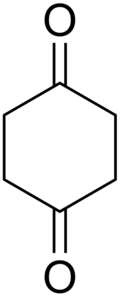
1,4-Cyclohexanedione is an organic compound with the formula (CH2)4(CO)2. This white solid is one of the three isomeric cyclohexanediones. This particular diketone is used as a building block in the synthesis of more complex molecules.
Preparation
1,4-Cyclohexanedione is prepared in two steps from diesters of succinic acid. Specifically under basic conditions, the diethyl succinate condenses to give the cyclohexenediol derivative diethylsuccinoylsuccinate. This intermediate can be hydrolysed and decarboxylated to afford the desired dione.[2]
This dione condenses with malononitrile to give an intermediate that can be dehydrogenated to tetracyanoquinodimethane (TCNQ).[3]
Reactions & Uses
Protection of one of the carbonyl groups with ethylene glycol affords 1,4-cyclohexanedione monoethylene glycol ketal aka 1,4-Dioxaspiro[4.5]decan-8-one [4746-97-8].[4][5] This compound is useful because it finds application in the synthesis of Ramatroban, Ciclindole, Flucindole, LY-344864 [1217756-94-9], Frovatriptan, Epibatidine,[6][7] Quinelorane,[8] Bromadol,[9][10] & C-8813.
References
- ^ MSDS for 1,4-Cyclohexanedione
- ^ Nielsen, Arnold T.; Carpenter, Wayne R. (1965). "1,4-Cyclohexanedione". Organic Syntheses. 45: 25. doi:10.15227/orgsyn.045.0025.
- ^ Strittmatter, Harald; Hildbrand, Stefan; Pollak, Peter (2007). "Malonic Acid and Derivatives". Ullmann's Encyclopedia of Industrial Chemistry. doi:10.1002/14356007.a16_063.pub2. ISBN 978-3-527-30673-2.
- ^ 孙玉亮, et al. CN109503545 (2019 to Hebei caike New Material Technology Co.,Ltd.).
- ^ 王淑梅, et al. CN111039917 (2020 to Tsaker Chemical Zhangzhou Co ltd).
- ^ Hassner, A.; Belostotskii, A. M. (March 1995). "A simple method of preparation of 7-alkyl-7-azabicyclo[2.2.1]heptanes". Tetrahedron Letters. 36 (10): 1709–1712. doi:10.1016/0040-4039(95)00051-D.
- ^ Davis, C. R.; Johnson, R. A.; Cialdella, J. I.; Liggett, W. F.; Mizsak, S. A.; Marshall, V. P. (1 April 1997). "Microbiological Oxygenation of Bridgehead Azabicycloalkanes". The Journal of Organic Chemistry. 62 (7): 2244–2251. doi:10.1021/jo962192f.
- ^ Doll, M. K.-H.; Nichols, D. E.; Kilts, J. D.; Prioleau, C.; Lawler, C. P.; Lewis, M. M.; Mailman, R. B. (1 March 1999). "Synthesis and Dopaminergic Properties of Benzo-Fused Analogues of Quinpirole and Quinelorane". Journal of Medicinal Chemistry. 42 (5): 935–940. doi:10.1021/jm9804533.
- ^ Bernd Sundermann, Hagen-Heinrich Hennies, Werner Englberger, Stephan Wnendt, U.S. patent 7,183,436 (2007 to Gruenenthal Gmbh).
- ^ Bernd Sundermann, Hagen-Heinrich Hennies, Werner Englberger, Babette-Yvonne Koegel, U.S. patent 7,211,694 (2007 to Gruenenthal Gmbh).