Malononitrile
 | |||
| |||
| Names | |||
|---|---|---|---|
| IUPAC name
Malononitrile[2]
| |||
| Preferred IUPAC name
Propanedinitrile[2] | |||
Other names
| |||
| Identifiers | |||
CAS Number
|
|||
3D model (JSmol)
|
|||
Beilstein Reference
|
773697 | ||
| ChEBI | |||
| ChemSpider | |||
| ECHA InfoCard | 100.003.368 | ||
| EC Number |
| ||
Gmelin Reference
|
1303 | ||
| MeSH | dicyanmethane | ||
PubChem CID
|
|||
| RTECS number |
| ||
| UNII | |||
| UN number | 2647 | ||
CompTox Dashboard (EPA)
|
|||
InChI
| |||
SMILES
| |||
| Properties | |||
Chemical formula
|
CH2(CN)2 | ||
| Molar mass | 66.063 g·mol−1 | ||
| Appearance | Colourless or white solid[1] | ||
| Odor | Sweet [3] | ||
| Density | 1.049 g/cm3 | ||
| Melting point | 30–32 °C (86–90 °F; 303–305 K)[3] | ||
| Boiling point | 220 °C (428 °F; 493 K)[3] | ||
Solubility in water
|
133 g/L (20 °C (68 °F; 293 K))[3] | ||
| Thermochemistry | |||
Heat capacity (C)
|
110.29 J⋅K−1⋅mol-1 | ||
Std molar
entropy (S⦵298) |
130.96 J⋅K−1⋅mol-1 | ||
Std enthalpy of
formation (ΔfH⦵298) |
187.7 to 188.1 kJ⋅mol−1 | ||
Std enthalpy of
combustion (ΔcH⦵298) |
−1654.0 to −1654.4 kJ⋅mol−1 | ||
| Hazards | |||
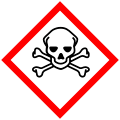
| GHS labelling:[3] | |||
Pictograms
|
| ||
Signal word
|
Danger | ||
Hazard statements
|
H300, H311+H331, H317, H319, H410 | ||
Precautionary statements
|
P261, P264, P270, P271, P272, P273, P280, P301+P310+P330, P302+P352+P312, P304+P340+P311, P305+P351+P338, P333+P313, P337+P313, P362, P391, P403+P233, P405, P501 | ||
| NFPA 704 (fire diamond) | 
4
1
1 | ||
| Flash point | 86 °C (187 °F; 359 K) | ||
Autoignition
temperature |
365 °C (689 °F; 638 K)[3] | ||
| Lethal dose or concentration (LD, LC): | |||
LD50 (median dose)
|
| ||
LC50 (median concentration)
|
0.51 mg/L (inhalation, dust/mist, 4h)[3] | ||
| NIOSH (US health exposure limits): | |||
PEL (Permissible)
|
none[1] | ||
REL (Recommended)
|
TWA 3 ppm (8 mg/m3)[1] | ||
IDLH (Immediate danger)
|
N.D.[1] | ||
| Related compounds | |||
Related alkanenitriles
|
|||
Related compounds
|
Malonic acid | ||
Except where otherwise noted, data are given for materials in their standard state (at 25 °C [77 °F], 100 kPa).
Infobox references
| |||
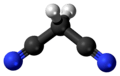
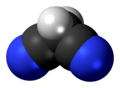

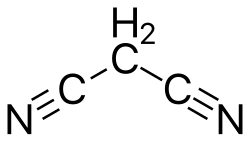
Malononitrile is an organic compound nitrile with the formula CH2(CN)2. It is a colorless or white solid, although aged samples appear yellow or even brown. It is a widely used building block in organic synthesis.
Preparation and reactions
It can be prepared by dehydration of cyanoacetamide.[5] Most commonly malononitrile is produced by the gas-phase reaction of acetonitrile and cyanogen chloride:[6]
- NCCl + CH3CN → NCCH2CN + HCl
About 20,000,000 kilograms (20,000 LT) are produced annually (2007). Important outlets include the synthesis of thiamine, the drug triamterene and minoxidil, and the dyes disperse Yellow 90 and disperse Blue 354.[6]
Malononitrile is relatively acidic, with a pKa of 11 in water.[7] This allows it to be used in the Knoevenagel condensation, for example in the preparation of CS gas:
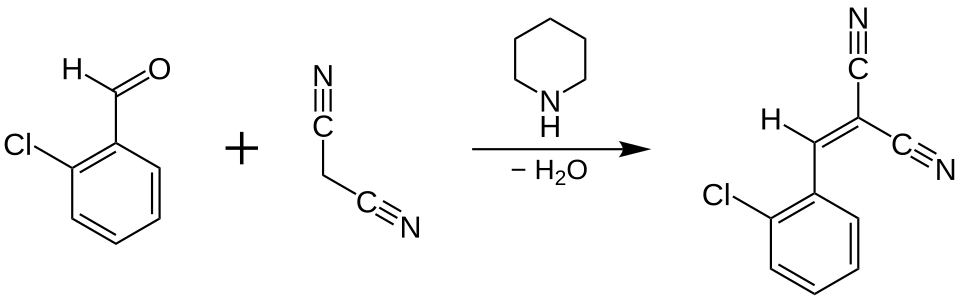
Despite its relative obscurity, malononitrile is very useful in several reactions, the prime example being a suitable starting reagent for the Gewald reaction, where the nitrile condenses with a ketone or aldehyde in the presence of elemental sulfur and a base to produce a 2-aminothiophene.[8] It can also be used as a Michael donor.[9]
Interstellar occurrence
Due to its permanent dipole moment (i.e., 3.735 ± 0.017 D),[10] malononitrile was detected in spectral emissions coming from interstellar cloud TMC-1 through the QUIJOTE line survey conducted with the Yebes 40 m radio telescope.[11][12]
References
- ^ a b c d e NIOSH Pocket Guide to Chemical Hazards. "#0378". National Institute for Occupational Safety and Health (NIOSH).
- ^ a b International Union of Pure and Applied Chemistry (2014). Nomenclature of Organic Chemistry: IUPAC Recommendations and Preferred Names 2013. The Royal Society of Chemistry. p. 902. doi:10.1039/9781849733069. ISBN 978-0-85404-182-4.
- ^ a b c d e f g h "Safety Data Sheet: Malononitrile". sigmaaldrich.com. Sigma-Aldrich. 3 January 2025. Retrieved 24 October 2025.
- ^ "Safety Data Sheet: Malononitrile". thermofisher.com. ThermoFisher Scientific. 31 January 2025. p. 3. Retrieved 24 October 2025.
- ^ Surrey, Alexander (1945). "Malononitrile". Organic Syntheses. 25: 63. doi:10.15227/orgsyn.025.0063; Collected Volumes, vol. 3, 1965, p. 535.
- ^ a b Strittmatter, Harald; Hildbrand, Stefan; Pollak, Peter. "Malonic Acid and Derivatives". Ullmann's Encyclopedia of Industrial Chemistry. Weinheim: Wiley-VCH. doi:10.1002/14356007.a16_063.pub2. ISBN 978-3-527-30673-2.
- ^ "pKa's of Inorganic and Oxo-Acids - Chem 206" (PDF). Evans. 11 April 2005. Archived from the original (PDF) on 10 October 2015. Retrieved 24 October 2025.
- ^ Sabnis, R. W.; Rangnekar, D. W.; Sonawane, N. D. (1999). "2-Aminothiophenes By The Gewald Reaction". Journal of Heterocyclic Chemistry. 36 (2): 333–345. doi:10.1002/jhet.5570360203.
- ^ "Michael Addition". Organic Chemistry Portal. Archived from the original on 2026-01-09. Retrieved 2026-01-14.
- ^ Hirota, Eizi; Morino, Yonezo (1960-02-01). "Microwave Spectrum of Malononitrile, CH2(CN)2. I. The Molecular Structure in the Ground Vibrational State". Bulletin of the Chemical Society of Japan. 33 (2): 158–162. doi:10.1246/bcsj.33.158. ISSN 0009-2673.
- ^ Agúndez, M.; Bermúdez, C.; Cabezas, C.; Molpeceres, G.; Endo, Y.; Marcelino, N.; Tercero, B.; Guillemin, J.-C.; de Vicente, P.; Cernicharo, J. (August 2, 2024). "The rich interstellar reservoir of dinitriles: Detection of malononitrile and maleonitrile in TMC-1". Astronomy & Astrophysics. 688: L31. arXiv:2408.02843. doi:10.1051/0004-6361/202451525. ISSN 0004-6361.
- ^ Victoria Corless (2024-11-12). "Scientists found 'nitriles' in an interstellar cloud — here's why that could be huge". Space.com. Retrieved 2025-01-07.