1-Bromobutane
 | |
 | |
| Names | |
|---|---|
| Preferred IUPAC name
1-Bromobutane[1] | |
| Other names
Butyl bromide
| |
| Identifiers | |
CAS Number
|
|
3D model (JSmol)
|
|
Beilstein Reference
|
1098260 |
| ChEMBL | |
| ChemSpider | |
| ECHA InfoCard | 100.003.357 |
| EC Number |
|
| MeSH | butyl+bromide |
PubChem CID
|
|
| RTECS number |
|
| UNII | |
| UN number | 1126 |
CompTox Dashboard (EPA)
|
|
InChI
| |
SMILES
| |
| Properties | |
Chemical formula
|
C4H9Br |
| Molar mass | 137.020 g·mol−1 |
| Appearance | Colourless liquid |
| Density | 1.2676 g mL−1 |
| Melting point | −112.5 °C; −170.4 °F; 160.7 K |
| Boiling point | 101.4 to 102.9 °C; 214.4 to 217.1 °F; 374.5 to 376.0 K |
| log P | 2.828 |
| Vapor pressure | 5.3 kPa |
Henry's law
constant (kH) |
140 nmol Pa kg−1 |
Refractive index (nD)
|
1.439 |
| Thermochemistry | |
Heat capacity (C)
|
162.2 J K−1 mol−1 |
Std molar
entropy (S⦵298) |
327.02 J K−1 mol−1 |
Std enthalpy of
formation (ΔfH⦵298) |
−148 kJ mol−1 |
Std enthalpy of
combustion (ΔcH⦵298) |
−2.7178–−2.7152 MJ mol−1 |
| Hazards | |
| GHS labelling: | |
Pictograms
|
|
Signal word
|
Danger |
Hazard statements
|
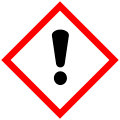
H225, H315, H319, H335, H411 |
Precautionary statements
|
P210, P261, P273, P305+P351+P338 |
| Flash point | 10 °C (50 °F; 283 K) |
Autoignition
temperature |
265 °C (509 °F; 538 K) |
| Explosive limits | 2.8–6.6% |
| Lethal dose or concentration (LD, LC): | |
LD50 (median dose)
|
2.761 g kg−1 (oral, rat) |
| Related compounds | |
Related alkanes
|
|
Except where otherwise noted, data are given for materials in their standard state (at 25 °C [77 °F], 100 kPa).
Infobox references
| |


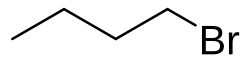
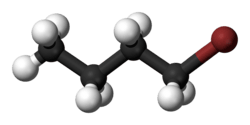
1-Bromobutane is the organobromine compound with the formula CH3(CH2)3Br. It is a colorless liquid, although impure samples appear yellowish. It is insoluble in water, but soluble in organic solvents. It is primarily used as a source of the butyl group in organic synthesis. It is one of several isomers of butyl bromide.
Synthesis
Most 1-bromoalkanes are prepared by free-radical addition of hydrogen bromide to the 1-alkene. These conditions lead to the anti-Markovnikov addition, i.e. give the 1-bromo derivatives.[2]
1-Bromobutane can also be prepared from butanol by treatment with hydrobromic acid:[3]
- CH3(CH2)3OH + HBr → CH3(CH2)3Br + H2O
Reactions
As a primary haloalkane, it is prone to SN2 type reactions. It is commonly used as an alkylating agent. When combined with magnesium metal in dry ether, it gives the corresponding Grignard reagent. Such reagents are used to attach butyl groups to various substrates.
1-Bromobutane is the precursor to n-butyllithium:[4]
- 2 Li + C4H9X → C4H9Li + LiX
- where X = Cl, Br
The lithium for this reaction contains 1-3% sodium. When bromobutane is the precursor, the product is a homogeneous solution, consisting of a mixed cluster containing both LiBr and LiBu.
1-Fluorobutane can be obtained by reacting 1-bromobutane with potassium fluoride in ethylene glycol.[5]
See also
- 1-Chlorobutane
- 1-Fluorobutane
- 1-Iodobutane
References
- ^ "butyl bromide - Compound Summary". PubChem Compound. USA: National Center for Biotechnology Information. 27 March 2005. Identification. Retrieved 17 June 2012.
- ^ Dagani, M. J.; Barda, H. J.; Benya, T. J.; Sanders, D. C. "Bromine Compounds". Ullmann's Encyclopedia of Industrial Chemistry. Weinheim: Wiley-VCH. doi:10.1002/14356007.a04_405. ISBN 978-3-527-30673-2.
- ^ Oliver Kamm, C. S. Marvel, R. H. Goshorn, Thomas Boyd, And E. F. Degering "Alkyl And Alkylene Bromides" Org. Synth. 1921, volume 1, p. 3. doi:10.15227/orgsyn.001.0003
- ^ Brandsma, L.; Verkraijsse, H. D. (1987). Preparative Polar Organometallic Chemistry I. Berlin: Springer-Verlag. ISBN 3-540-16916-4.
- ^ "1-Fluorobutane". Journal of the Chemical Society. The Society: 1322. 1964. Retrieved 6 August 2024.