Aluminium diboride
 | |
| Names | |
|---|---|
| IUPAC name
aluminium diboride
| |
| Other names
aluminium boride
| |
| Identifiers | |
CAS Number
|
|
3D model (JSmol)
|
|
| ChemSpider | |
| ECHA InfoCard | 100.031.736 |
| EC Number |
|
PubChem CID
|
|
CompTox Dashboard (EPA)
|
|
InChI
| |
SMILES
| |
| Properties | |
Chemical formula
|
AlB2 |
| Molar mass | 48.604 g/mol[1] |
| Appearance | Copper-red solid |
| Density | 3.19 g/cm3[1] |
| Melting point | >920 °C (decomposes)[1] |
Solubility in water
|
insoluble |
| Structure[2] | |
Crystal structure
|
Hexagonal, hP3 |
Space group
|
P6/mmm, No. 191 |
Lattice constant
|
a = 0.3009 nm, b = 0.3009 nm, c = 0.3262 nm, α = 90°, β = 90°, γ = 120°
|
Formula units (Z)
|
1 |
| Thermochemistry | |
Heat capacity (C)
|
43.6 J/mol K |
Std molar
entropy (S⦵298) |
34.7 J/mol K |
Std enthalpy of
formation (ΔfH⦵298) |
−151 kJ/mol |
Except where otherwise noted, data are given for materials in their standard state (at 25 °C [77 °F], 100 kPa).
Infobox references
| |


Aluminium diboride (AlB2) is a chemical compound made from the metal aluminium and the metalloid boron. It is one of two compounds of aluminium and boron, the other being AlB12, which are both commonly referred to as aluminium boride.
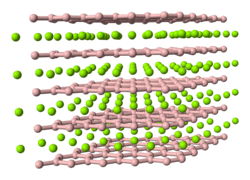
Structurally the B atoms form graphite-like sheets with Al atoms between them, and this is very similar to the structure of magnesium diboride. Single crystals of AlB2 exhibit metallic conductivity along the axis parallel to the basal hexagonal plane.[3]
Aluminium boride is considered a hazardous substance as it reacts with acids and hydrogen gas to produce toxic gases. For example, it reacts with hydrochloric acid to release borane and aluminium chloride.
The crystal structure of AlB2 is often used as a prototype structure to describe intermetallic compounds. There are a large number of structure types that fall within the AlB2 structural family.[4]
See also
- Boride
References
- ^ a b c Haynes, William M., ed. (2011). CRC Handbook of Chemistry and Physics (92nd ed.). Boca Raton, Florida: CRC Press. p. 4.45. ISBN 1-4398-5511-0.
- ^ Felten, Edward J (1956). "The Preparation of Aluminium Diboride, AlB21". Journal of the American Chemical Society. 78 (23): 5977–5978. doi:10.1021/ja01604a003.
- ^ Burkhardt, U; Gurin, Vladimir; Haarmann, Frank; Borrmann, Horst; Schnelle, Walter; Yaresko, Alexander; Grin, Yuri (2004). "On the electronic and structural properties of aluminium diboride Al0.9B2". Journal of Solid State Chemistry. 177 (2): 389. Bibcode:2004JSSCh.177..389B. doi:10.1016/j.jssc.2002.12.001.
- ^ Hoffmann, R.-D.; Pöttgen, Rainer (2001-01-01). "AlB2-related intermetallic compounds – a comprehensive view based on group-subgroup relations". Zeitschrift für Kristallographie - Crystalline Materials. 216 (3). Walter de Gruyter GmbH: 127–145. Bibcode:2001ZK....216..127H. doi:10.1524/zkri.216.3.127.20327. ISSN 2196-7105. S2CID 98251655.
External links