Caesium perchlorate
 | |
 | |
| Names | |
|---|---|
| IUPAC name
Caesium perchlorate
| |
| Other names
Cesium perchlorate
| |
| Identifiers | |
CAS Number
|
|
3D model (JSmol)
|
|
| ChemSpider | |
| ECHA InfoCard | 100.033.298 |
| EC Number |
|
PubChem CID
|
|
CompTox Dashboard (EPA)
|
|
InChI
| |
SMILES
| |
| Properties | |
Chemical formula
|
CsClO4 |
| Molar mass | 232.36 g/mol |
| Appearance | Colorless crystals |
| Density | 3.327 g/cm3 |
| Melting point | 250 °C (482 °F; 523 K) (decomposes) |
Solubility in water
|
1.974 g/100 ml (25 °C) |
Solubility product (Ksp)
|
3.95×10⁻³[3] |
Refractive index (nD)
|
1.4887 |
| Structure | |
Crystal structure
|
orthorhombic (<219 °C) cubic (>219 °C, a = 798 pm) |
Space group
|
Pnma (<219 °C) F43m (>219 °C) |
Lattice constant
|
a = 982 pm, b = 600 pm, c = 779 pm (orthorhombic, <219 °C)
|
| Hazards | |
| GHS labelling:[4] | |
Pictograms
|
 
|
Signal word
|
Danger |
Hazard statements
|
H271, H272, H302, H315, H319, H332, H335 |
Precautionary statements
|
P210, P220, P261, P264, P264+P265, P270, P271, P280, P283, P301+P317, P302+P352, P304+P340, P305+P351+P338, P306+P360, P317, P319, P321, P330, P332+P317, P337+P317, P362+P364, P370+P378, P371+P380+P375, P403+P233, P405, P420, P501 |
| Flash point | Non-flammable |
| Safety data sheet (SDS) | External MSDS |
| Related compounds | |
Other anions
|
Caesium chloride Caesium chlorate |
Other cations
|
Lithium perchlorate Sodium perchlorate Potassium perchlorate Rubidium perchlorate |
Except where otherwise noted, data are given for materials in their standard state (at 25 °C [77 °F], 100 kPa).
Infobox references
| |


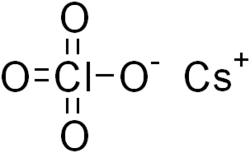
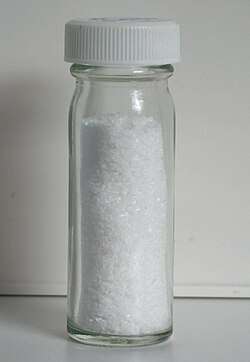
Caesium perchlorate or cesium perchlorate (CsClO4), is a perchlorate of caesium. It forms white crystals, which are sparingly soluble in cold water and ethanol. It dissolves more easily in hot water.
CsClO4 is the second least soluble of the alkali metal perchlorates (after Fr, followed by Rb, K, Li, and Na), a property which may be used for separatory purposes and even for gravimetric analysis.[5] This low solubility played an important role in the characterization of francium as an alkali metal, as francium perchlorate coprecipitates with caesium perchlorate.[6]
| Temperature (°C) | 0 | 8.5 | 14 | 25 | 40 | 50 | 60 | 70 | 99 |
|---|---|---|---|---|---|---|---|---|---|
| Solubility (g / 100 ml) | 0.8 | 0.91 | 1.91 | 1.974 | 3.694 | 5.47 | 7.30 | 9.79 | 28.57 |
When heated, CsClO4 decomposes to caesium chloride above 250 °C. Like all perchlorates, it is a strong oxidant and may react violently with reducing agents and organic materials, especially at elevated temperatures.
References
- ^ a b Perry, Dale L.; Phillips, Sidney L. (1995), Handbook of Inorganic Compounds, CRC Press.
- ^ a b Brezina, F.; Mollin, J.; Pastorek, R.; Sindelar, Z. (1986), Chemicke tabulky anorganickych sloucenin, SNTL.
- ^ John Rumble (June 18, 2018). CRC Handbook of Chemistry and Physics (99 ed.). CRC Press. pp. 5–188. ISBN 978-1138561632.
- ^ PubChem. "Cesium perchlorate". pubchem.ncbi.nlm.nih.gov. Retrieved 2026-01-18.
- ^ Greenwood, Norman N.; Earnshaw, Alan (1984). Chemistry of the Elements. Oxford: Pergamon Press. p. 1017. ISBN 978-0-08-022057-4..
- ^ Hyde, E. K. (1952), "Radiochemical Methods for the Isolation of Element 87 (Francium)", J. Am. Chem. Soc., 74 (16): 4181–84, doi:10.1021/ja01136a066, hdl:2027/mdp.39015086483156