Silver perchlorate
 | |
| Names | |
|---|---|
| IUPAC name
Silver(I) perchlorate
| |
| Systematic IUPAC name
Silver(I) chlorate(VII) | |
| Other names
Perchloric acid, silver(1+) salt
Argentous perchlorate | |
| Identifiers | |
CAS Number
|
|
3D model (JSmol)
|
|
| ChemSpider | |
| ECHA InfoCard | 100.029.123 |
| EC Number |
|
PubChem CID
|
|
| UNII | |
CompTox Dashboard (EPA)
|
|
InChI
| |
SMILES
| |
| Properties | |
Chemical formula
|
AgClO4 |
| Molar mass | 207.319 g/mol |
| Appearance | Colorless hygroscopic crystals |
| Density | 2.806 g/cm3 (monohydrate) |
| Melting point | 486 °C (907 °F; 759 K) (decomposes) |
Solubility in water
|
557 g/100 mL (25 °C) 792.8 g/100 mL (99 °C) |
| Solubility | soluble in organic solvents |
| Structure | |
Crystal structure
|
cubic |
| Hazards | |
| GHS labelling: | |
Pictograms
|
 
|
Signal word
|
Danger |
Hazard statements
|
H272, H314 |
Precautionary statements
|
P210, P220, P221, P260, P264, P280, P301+P330+P331, P303+P361+P353, P304+P340, P305+P351+P338, P310, P321, P363, P370+P378, P405, P501 |
| NFPA 704 (fire diamond) | 
2
0
2 OX |
Except where otherwise noted, data are given for materials in their standard state (at 25 °C [77 °F], 100 kPa).
Infobox references
| |


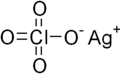
Silver perchlorate is the chemical compound with the formula AgClO4. This white solid forms a monohydrate and is mildly deliquescent. It is a useful source of the Ag+ ion, although the presence of perchlorate presents risks. It is used as a catalyst in organic chemistry.
Production
Silver perchlorate is created by heating a mixture of perchloric acid with silver nitrate.
Alternatively, it can be prepared by the reaction between barium perchlorate and silver sulfate, or from the reaction of perchloric acid with silver oxide.
Solubility
Silver perchlorate is noteworthy for its solubility in aromatic solvents such as benzene (52.8 g/L) and toluene (1010 g/L).[1] In these solvents, the silver cation binds to the arene, as has been demonstrated by X-ray crystallographic studies on crystals obtained from such solutions.[2][3] Its solubility in water is extremely high, up to 500 g per 100 mL water. X-ray diffraction experiments show that aqueous solutions contain [Ag(H2O)2]+ with Ag-O distances near 240 picometer.[4]
Related reagents
Similar to silver nitrate, silver perchlorate is an effective reagent for replacing halides ligands with perchlorate, which is a weakly or non-coordinating anion. The use of silver perchlorate in chemical synthesis has declined due to concerns about explosiveness of perchlorate salts. Other silver reagents are silver tetrafluoroborate, and the related silver trifluoromethanesulfonate and silver hexafluorophosphate.
References
- ^ F. Březina; J. Mollin; R. Pastorek; Z. Šindelář (1986). Chemické tabulky anorganických sloučenin [Chemical tables of inorganic compounds] (in Czech). Prague: SNTL.
- ^ E. A. Hall Griffith; E. L. Amma (1974). "Metal Ion-Aromatic Complexes. XVIII. Preparation and Molecular Structure of Naphthalene-Tetrakis(silver perchlorate) Tetrahydrate". Journal of the American Chemical Society. 96 (3): 743–749. doi:10.1021/ja00810a018.
- ^ R. K. McMullan; T. F. Koetzle; C. J. Fritchie Jr. (1997). "Low-Temperature Neutron Diffraction Study of the Silver Perchlorate–Benzene π Complex". Acta Crystallographica B. 53 (4): 645–653. Bibcode:1997AcCrB..53..645M. doi:10.1107/S0108768197000712. S2CID 97838907.
- ^ Masunobu Maeda; Yoshiteru Maegawa; Toshio Yamaguchi; Hitoshi Ohtaki (19 April 2006). "X-Ray Diffraction Studies on the Structures of Diammine- and Aquasilver(I) Complexes in Aqueous Solution". Bulletin of the Chemical Society of Japan. doi:10.1246/bcsj.52.2545.