Cobalt(II) carbonate
Co2+ CO32−
| |
_carbonate.jpg) | |
| Names | |
|---|---|
| IUPAC name
Cobalt(II) carbonate
| |
| Other names
Cobaltous carbonate; cobalt(II) salt
| |
| Identifiers | |
CAS Number
|
|
3D model (JSmol)
|
|
| ChemSpider | |
| ECHA InfoCard | 100.007.428 |
PubChem CID
|
|
| UNII |
|
CompTox Dashboard (EPA)
|
|
InChI
| |
SMILES
| |
| Properties | |
Chemical formula
|
CoCO3 |
| Molar mass | 118.941 g/mol |
| Appearance | pink solid |
| Density | 4.13 g/cm3 |
| Melting point | 427 °C (801 °F; 700 K) [3] decomposes before melting to cobalt(II) oxide (anhydrous) 140 °C (284 °F; 413 K) decomposes (hexahydrate) |
Solubility in water
|
0.000142 g/100 mL (20 °C)[1] |
Solubility product (Ksp)
|
1.0·10−10[2] |
| Solubility | soluble in acid negligible in alcohol, methyl acetate insoluble in ethanol |
Refractive index (nD)
|
1.855 |
| Structure | |
Crystal structure
|
Rhombohedral (anhydrous) Trigonal (hexahydrate) |
| Thermochemistry | |
Std molar
entropy (S⦵298) |
79.9 J/mol·K[3] |
Std enthalpy of
formation (ΔfH⦵298) |
−722.6 kJ/mol[3] |
Gibbs free energy (ΔfG⦵)
|
−651 kJ/mol[3] |
| Hazards | |
| GHS labelling: | |
Pictograms
|
  [4] [4]
|
Signal word
|
Warning |
Hazard statements
|
H302, H315, H317, H319, H335, H351[4] |
Precautionary statements
|
P261, P280, P305+P351+P338[4] |
| NFPA 704 (fire diamond) | 
2
0
0 |
| Lethal dose or concentration (LD, LC): | |
LD50 (median dose)
|
640 mg/kg (oral, rats) |
Except where otherwise noted, data are given for materials in their standard state (at 25 °C [77 °F], 100 kPa).
Infobox references
| |


Cobalt(II) carbonate is the inorganic compound with the formula CoCO3. This pink paramagnetic solid is an intermediate in the hydrometallurgical purification of cobalt from its ores. It is an inorganic pigment, and a precursor to catalysts.[5] Cobalt(II) carbonate also occurs as the rare red/pink mineral spherocobaltite.[6]
Preparation and structure
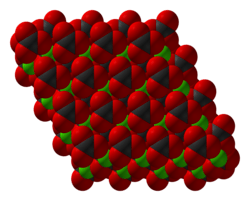
Structure of solid cobalt(II) carbonate shown with space-filling ions. Color code: red = O, green = Co, blck = C
It is prepared by combining solutions of cobalt(II) sulfate and sodium bicarbonate:
- CoSO4 + 2 NaHCO3 → CoCO3 + Na2SO4 + H2O + CO2
This reaction is used in the precipitation of cobalt from an extract of its roasted ores.[5]
CoCO3 adopts a structure like calcite, consisting of cobalt in an octahedral coordination geometry.[7]
Reactions
Aqueous solutions of cobalt chloride can be prepared from cobalt(II) carbonate with hydrochloric acid according to this idealized equation:[8]
- CoCO3 + 2 HCl + 3 H2O → CoCl2·(H2O)4 + CO2
The reaction of cobalt(II) carbonate and acetylacetone in the presence of hydrogen peroxide gives tris(acetylacetonato)cobalt(III).[9]
Heating the carbonate in air (calcining) is accompanied by partial oxidation:
- 6 CoCO3 + O2 → 2 Co3O4 + 6 CO2
The resulting Co3O4 converts reversibly to CoO at high temperatures.[10]
Uses
Cobalt carbonate is a precursor to cobalt carbonyl and various cobalt salts. It is a component of dietary supplements since cobalt is an essential element. It is a precursor to blue pottery glazes, famously in the case of Delftware.
Related compounds
At least two cobalt(II) carbonate-hydroxides are known: Co2(CO3)(OH)2 and Co6(CO3)2(OH)8·H2O.[11]
The moderately rare spherocobaltite is a natural form of cobalt carbonate, with good specimens coming especially from the Republic of Congo. "Cobaltocalcite" is a cobaltiferous calcite variety that is quite similar in habit to spherocobaltite.[6]
Sodium tris(carbonato)cobalt(III) is a cobalt(III) complex containing three carbonate ligands.
Safety
Toxicity has rarely been observed. Animals, including humans, require trace amounts of cobalt, a component of vitamin B12.[5]
References
- ^ Haynes, W.M., ed. (2017). CRC Handbook of Chemistry and Physics (97th ed.). CRC Press, Taylor & Francis Group. pp. 4–58. ISBN 978-1-4987-5429-3.
- ^ "Solubility product constants". Archived from the original on 2012-06-15. Retrieved 2012-05-17.
- ^ a b c d "Cobalt(II) carbonate".
- ^ a b c Sigma-Aldrich Co., Cobalt(II) carbonate. Retrieved on 2014-05-06.
- ^ a b c Donaldson, John Dallas; Beyersmann, Detmar (2005). "Cobalt and Cobalt Compounds". Ullmann's Encyclopedia of Industrial Chemistry. Weinheim: Wiley-VCH. doi:10.1002/14356007.a07_281.pub2. ISBN 3527306730.
- ^ a b "Spherocobaltite: Spherocobaltite mineral information and data". www.mindat.org. Retrieved 7 August 2018.
- ^ Pertlik, F. (1986). "Structures of hydrothermally synthesized cobalt(II) carbonate and nickel(II) carbonate". Acta Crystallographica Section C. 42: 4–5. doi:10.1107/S0108270186097524.
- ^ O. Glemser (1963). "Cobalt(II) Chloride". In G. Brauer (ed.). Handbook of Preparative Inorganic Chemistry, 2nd Ed. Vol. 2. NY, NY: Academic Press. p. 1515.
- ^ Bryant, Burl E.; Fernelius, W. Conard (1957). "Cobalt(III) Acetylacetonate". Inorganic Syntheses. pp. 188–189. doi:10.1002/9780470132364.ch53. ISBN 9780470132364.
{{cite book}}: ISBN / Date incompatibility (help) - ^ El-Shobaky, G. A.; Ahmad, A. S.; Al-Noaim, A. N.; El-Shobaky, H. G. (1996). "Thermal Decomposition of Basic Cobalt and Copper Carbonates". Journal of Thermal Analysis and Calorimetry. 46: 1801. doi:10.1007/BF01980784.
- ^ Bhojane, Prateek; Le Bail, Armel; Shirage, Parasharam M. (2019). "A Quarter of a Century After its Synthesis and with >200 Papers Based on its Use, 'Co(CO3)0.5(OH)0.11H2O′ Proves to be Co6(CO3)2(OH)8·H2O from Synchrotron Powder Diffraction Data". Acta Crystallographica Section C: Structural Chemistry. 75 (Pt 1): 61–64. doi:10.1107/S2053229618017734. PMID 30601132. S2CID 58657483.
External links
 Media related to Cobalt(II) carbonate at Wikimedia Commons