Glycolonitrile
 | |||
| |||
| Names | |||
|---|---|---|---|
| Preferred IUPAC name
Hydroxyacetonitrile | |||
| Other names | |||
| Identifiers | |||
CAS Number
|
|||
3D model (JSmol)
|
|||
Beilstein Reference
|
605328 | ||
| ChEBI | |||
| ChemSpider | |||
| ECHA InfoCard | 100.003.155 | ||
| EC Number |
| ||
| MeSH | glycolonitrile | ||
PubChem CID
|
|||
| UNII | |||
CompTox Dashboard (EPA)
|
|||
InChI
| |||
SMILES
| |||
| Properties | |||
Chemical formula
|
C2H3NO | ||
| Molar mass | 57.052 g·mol−1 | ||
| Appearance | Colourless, oily liquid | ||
| Odor | odorless[2] | ||
| Density | 1.10 g/mL (18.89°C)[2] | ||
| Melting point | < −72 °C; −98 °F; 201 K[2] | ||
| Boiling point | 99.6 °C; 211.2 °F; 372.7 K at 2.3 kPa | ||
Solubility in water
|
soluble[2] | ||
| Vapor pressure | 1 mmHg (62.78°C)[2] | ||
| Hazards | |||
| Occupational safety and health (OHS/OSH): | |||
Main hazards
|
forms cyanide in the body[2] | ||
| NIOSH (US health exposure limits): | |||
PEL (Permissible)
|
none[2] | ||
REL (Recommended)
|
C 2 ppm (5 mg/m3) [15-minute][2] | ||
IDLH (Immediate danger)
|
N.D.[2] | ||
| Related compounds | |||
Related alkanenitriles
|
|||
Related compounds
|
DBNPA | ||
Except where otherwise noted, data are given for materials in their standard state (at 25 °C [77 °F], 100 kPa).
Infobox references
| |||
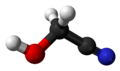
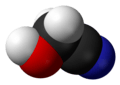


Glycolonitrile, also called hydroxyacetonitrile or formaldehyde cyanohydrin, is the organic compound with the structure HOCH2CN. It is the simplest cyanohydrin, being derived from formaldehyde. It is a colourless liquid that dissolves in water and ether, and is useful in production of several industrially important chemicals. Because glycolonitrile decomposes readily into formaldehyde and hydrogen cyanide, it is listed as an extremely hazardous substance. In January 2019, astronomers reported the detection of glycolonitrile, another possible building block of life among other such molecules, in outer space.[3]
Synthesis and reactions
Glycolonitrile is produced by combining formaldehyde with hydrogen cyanide at near-neutral pH. The reaction is catalyzed by base.[4][5] Glycolonitrile polymerizes under alkaline conditions.
Glycolonitrile can react with ammonia to give aminoacetonitrile, which can be hydrolyzed to give glycine. The general process for reaction of an aldehyde, hydrogen cyanide, and ammonia, followed by hydrolysis, to give an amino acid is the industrially important Strecker amino acid synthesis:
- HOCH2CN + NH3 → H2NCH2CN + H2O
- H2NCH2CN + 2 H2O → H2NCH2CO2H + NH3
Ethylenediaminetetraacetic acid widely used as a chelating agent, can be prepared from glycolonitrile and ethylenediamine followed by hydrolysis of the resulting tetranitrile. Nitrilotriacetic acid is prepared similarly.[5]
Reactivity
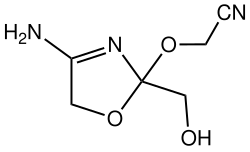
Glycolonitrile rapidly forms various dimers, trimers, and higher oligomers in alkaline solution.[6]
References
- ^ a b c d "Glycolonitrile". NIOSH Pocket Guide to Chemical Hazards. USA: Centers for Disease Control and Prevention. 4 April 2011. Retrieved 8 November 2013.
- ^ a b c d e f g h i NIOSH Pocket Guide to Chemical Hazards. "#0304". National Institute for Occupational Safety and Health (NIOSH).
- ^ Queen Mary University of London (23 January 2019). "Astronomers find star material could be building block of life". EurekAlert!. Retrieved 24 January 2019.
- ^ Gaudry, R. (1955). "Glycolonitrile". Organic Syntheses; Collected Volumes, vol. 3, p. 436.
- ^ a b Peter Pollak, Gérard Romeder, Ferdinand Hagedorn, Heinz-Peter Gelbke "Nitriles" Ullmann's Encyclopedia of Industrial Chemistry 2002, Wiley-VCH, Weinheim. doi:10.1002/14356007.a17_363
- ^ Arrhenius, Gustaf; Bladridge, Kim K.; Richards-Gross, Sarah; Siegel, Jay S. (1997). "Glycolonitrile Oligomerization: Structure of Isolated Oxazolines, Potential Heterocycles on the Early Earth". The Journal of Organic Chemistry. 62 (16): 5522–5525. doi:10.1021/jo962185r. PMID 11543606.
Molecules detected in outer space | ||||||||||||||||||||
|---|---|---|---|---|---|---|---|---|---|---|---|---|---|---|---|---|---|---|---|---|
| Molecules |
| |||||||||||||||||||
| Deuterated molecules |
| |||||||||||||||||||
| Unconfirmed |
| |||||||||||||||||||
| Related |
| |||||||||||||||||||
| ||||||||||||||||||||