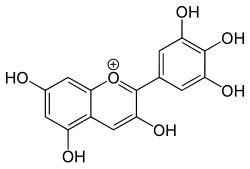
Delphinidin (also delphinidine[1][2]) is an anthocyanidin, a primary plant pigment, and also an antioxidant.[3] Delphinidin gives blue hues to flowers in the genera Viola and Delphinium. It also gives the blue-red color of the grape variety Cabernet Sauvignon, and can be found in cranberries and Concord grapes as well as pomegranates,[4] and bilberries.[5]
Delphinidin, like nearly all other anthocyanidins, is pH-sensitive, i.e. a natural pH indicator, and changes from blue in basic solution to red in acidic solution.
Glycosides
Several glycosides derived from delphinidin are known:
Myrtillin (delphinidin-3-O-glucoside) and tulipanin (delphinidin-3-O-rutinoside) can be found in blackcurrant pomace.
Violdelphin (delphinidin 3-rutinoside-7-O-(6-O-(4-(6-O-(4-hydroxybenzoyl)-β-D-glucosyl)oxybenzoyl)-β-D-glucoside) is responsible for the purplish-blue flower color of Aconitum chinense.[6]
Nasunin (delphinidin-3-(p-coumaroylrutinoside)-5-glucoside) is responsible for the colour of the eggplant fruit's purple skin.[7]
Delphinidin ternatins including Clitoria ternatea ternatins
^Ribéreau-Gayon, J.; Ribéreau-Gayon, P. (1958). "The Anthocyans and Leucoanthocyans of Grapes and Wines". American Journal of Enology and Viticulture. 9: 1–9.
^Lätti AK, Riihinen KR, Kainulainen PS (2008). "Analysis of anthocyanin variation in wild populations of bilberry (Vaccinium myrtillus L.) in Finland". J Agric Food Chem. 56 (1): 190–6. doi:10.1021/jf072857m. PMID 18072741.
^Noda Y, Kneyuki T, Igarashi K, Mori A, Packer L (2000). "Antioxidant activity of nasunin, an anthocyanin in eggplant peels". Toxicology. 148 (2–3): 119–23. doi:10.1016/s0300-483x(00)00202-x. PMID 10962130.{{cite journal}}: CS1 maint: multiple names: authors list (link)