EPTC (herbicide)
 | |
| Names | |
|---|---|
| Preferred IUPAC name
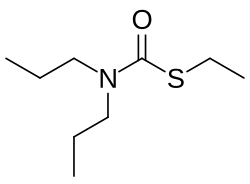
S-Ethyl N,N-dipropylcarbamothioate | |
Other names
| |
| Identifiers | |
CAS Number
|
|
3D model (JSmol)
|
|
| ChEBI | |
| ChEMBL | |
| ChemSpider | |
| ECHA InfoCard | 100.010.976 |
| EC Number |
|
| KEGG | |
PubChem CID
|
|
| UNII | |
| UN number | 2902 2992 |
CompTox Dashboard (EPA)
|
|
InChI
| |
SMILES
| |
| Properties | |
Chemical formula
|
C9H19NOS |
| Molar mass | 189.32 g·mol−1 |
| Appearance | light yellow liquid[2] |
| Odor | Aromatic, Characteristic[2] |
| Density | 955 kg/m3 at 30°C[3] |
| Melting point | <25°C (<77°F) [3] |
| Boiling point | 232 °C (450 °F; 505 K) [3] |
Solubility in water
|
375 mg/L[2] |
| Solubility in [[acetone, ethanol, isopropanol, benzene, xylene]] | miscible[2] |
| Vapor pressure | 3.2 Pa[2] |
| Viscosity | 5.2 mm2/s |
| Hazards | |
| GHS labelling: | |
Pictograms
|

|
Hazard statements
|
H302[4] |
| Flash point | 116 °C (241 °F; 389 K) |
Autoignition
temperature |
260 °C (500 °F; 533 K) |
| Lethal dose or concentration (LD, LC): | |
LD50 (median dose)
|
916 mg/kg (rat, oral)[2] |
Except where otherwise noted, data are given for materials in their standard state (at 25 °C [77 °F], 100 kPa).
Infobox references
| |


S-Ethyl dipropylthiocarbamate (EPTC) is a selective herbicide used for preëmergent control of certain grasses and broadleaf weeds in Australia and the United States.[4][5] It was introduced in 1957.[6]
EPTC can be applied preëmergently or postemergently and its effectiveness does not depend on post-application rainfall. The herbicide takes effect quickly afterward. It is registered in every US state.[7] It should be sprayed when the soil is well worked and dry, for good mixing and incorporation. It can be stored at temperatures as low as -50 °F.[8]
It is not persistent in soil, having a half-life of about 6 days.[2]
Use
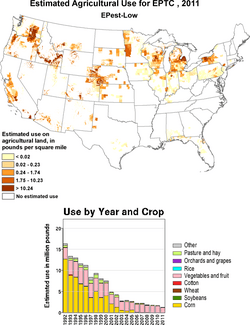
EPTC is applied at 2 to 7.5 lbs/ac in the US, or 2.5-5 kg/ha in Australia, measured by active ingredient. It is usually sold as an emulsifiable concentrate, of 70% or greater concentration,[9][10] or as granules.[6]
In 2001, 277,000 lbs (123 tonnes) of EPTC was used in California.[11]
Registrations
In the United States, EPTC is registered for use on alfalfa, almonds, beans, birdsfoot trefoil, clovers, lespedeza, sainfoin, citrus nursery stock and plantings, cotton, grass, fallow, pine seedlings, potatoes, safflower, sugar beets, sunflower, tomatoes and walnuts.[9]
In Australia, EPTC is used on beans, potatoes, maize, sweet corn, safflower, rapeseed, sunflower, lucerne, duboisia, lotus, non-crop situations and grass.[10]
The EU does not allow the use of EPTC.[12]
Safety
The EPA says in a 1999 report that EPTC produced no developmental or reproductive toxicity, and there was no cause for concern. Nevertheless, the State of California OEHHA is concerned that EPTC could be developmentally toxic.[11]
Tradenames
EPTC has been sold under the tradenames Alirox, Eradicane, Eptam, Genep, Niptan, Shortstop, Torbin and Witox.[8][1] The long-running "Eptam" trademark is the Stauffer Chemical Company's.[8]
References
- ^ a b "Ethyl Dipropylthiocarbamate". oehha.ca.gov. State of California. Retrieved 11 January 2026.
- ^ a b c d e f g "S-Ethyl dipropylthiocarbamate". pubchem.ncbi.nlm.nih.gov. PubChem.
- ^ a b c "S-Ethyl dipropylthiocarbamate". CAS Common Chemistry. Retrieved 24 January 2025.
- ^ a b "Eptam® 7E | Gowan Herbicide Safety Data Sheet". www.gowanco.com. Gowan. Retrieved 24 January 2025.
- ^ "Eptam". Nufarm Australia.
- ^ a b Lewis, K.A., Tzilivakis, J., Warner, D. and Green, A. (2016) An international database for pesticide risk assessments and management. Human and Ecological Risk Assessment: An International Journal, 22(4), 1050-1064. DOI: 10.1080/10807039.2015.1133242
- ^ "Eptam® 7E | Gowan". www.gowanco.com.
- ^ a b c "Eptam Label 1982" (PDF). Environmental Protection Agency. Stauffer Chemical Company. Retrieved 24 January 2025.
- ^ a b "Eptam® 7E Label". www.gowanco.com. Gowan. Retrieved 24 January 2025.
- ^ a b "Eptam Label". Nufarm Australia. Retrieved 24 January 2025.
- ^ a b "Proposition 65 Maximum Allowable Dose Level (MADL) for Reproductive Toxicity for Ethyl Dipropylthiocarbamate (EPTC)" (PDF). State of California OEHHA. June 2004. Retrieved 11 January 2026.
- ^ "EU Pesticides Database". ec.europa.eu.
External links
- EPTC (herbicide) in the Pesticide Properties DataBase (PPDB)
- EPTC, State of California, Office of Environmental Health Assessment