Triphenylmethyl chloride
 | |||
| |||
| Names | |||
|---|---|---|---|
| Preferred IUPAC name
1,1′,1′′-(Chloromethanetriyl)tribenzene | |||
| Other names
(Chloromethanetriyl)tribenzene
[Chloro(diphenyl)methyl]benzene Triphenylchloromethane | |||
| Identifiers | |||
CAS Number
|
|||
3D model (JSmol)
|
|||
| ChemSpider | |||
| ECHA InfoCard | 100.000.898 | ||
PubChem CID
|
|||
| UNII | |||
CompTox Dashboard (EPA)
|
|||
InChI
| |||
SMILES
| |||
| Properties | |||
Chemical formula
|
C19H15Cl | ||
| Molar mass | 278.7754 g/mol | ||
| Appearance | white solid | ||
| Density | 1.141 g/cm3 | ||
| Melting point | 109 to 112 °C (228 to 234 °F; 382 to 385 K) | ||
| Boiling point | 230 °C (446 °F; 503 K) (at 20 mmHg) and 374.3 °C (at 760 mmHg) | ||
| Solubility | soluble in chloroform, benzene, acetone,[1] ether, THF, hexane[2] | ||
| Hazards | |||
| Flash point | 177.9 °C (352.2 °F; 451.0 K) | ||
| Safety data sheet (SDS) | Corvine Chemicals MSDS | ||
Except where otherwise noted, data are given for materials in their standard state (at 25 °C [77 °F], 100 kPa).
Infobox references
| |||
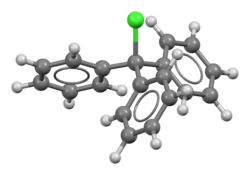


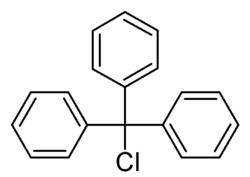
Triphenylmethyl chloride or trityl chloride (TrCl) is an organic compound with the chemical formula (C6H5)3CCl. It is a white solid although impure samples can appear yellowish.[3] It is sometimes used to introduce the trityl protecting group.[4]
Preparation
Triphenylmethyl chloride is commercially available. It may be prepared by the reaction of triphenylmethanol with acetyl chloride, or by the Friedel–Crafts alkylation of benzene with carbon tetrachloride to give the trityl chloride-aluminium chloride adduct, which is then hydrolyzed.[5]
Reactions
Triphenylmethylsodium can be prepared from trityl chloride and sodium:[3]
- (C6H5)3CCl + 2 Na → (C6H5)3CNa + NaCl
Reaction with silver hexafluorophosphate gives triphenylmethyl hexafluorophosphate.
Trityl chloride reacts with zinc in nonpolar solvents (e.g. benzene) to form Gomberg's dimer.[6]
- 2 (C6H5)3CCl + Zn → [(C6H5)3C]2 + ZnCl2
See also
- Triphenylmethyl radical
- Triphenylmethane
- Triphenylmethyl hexafluorophosphate
- Triphenylmethanol
- Gomberg's dimer
References
- ^ "Archived copy". Archived from the original on 2013-01-24. Retrieved 2014-01-08.
{{cite web}}: CS1 maint: archived copy as title (link) - ^ "Trityl chloride | CAS 76-83-5".
- ^ a b W. B. Renfrow Jr and C. R. Hauser (1939). "Triphenylmethylsodium". Organic Syntheses. 19: 83. doi:10.15227/orgsyn.019.0083.
- ^ Curtin, Michael L. (2003). "Triphenylchloromethane (Trityl chloride)". Encyclopedia of Reagents for Organic Synthesis. doi:10.1002/047084289X.rn00178. ISBN 0-471-93623-5.
- ^ W. E. Bachmann (1943). "Triphenylchloromethane". Organic Syntheses. 23: 100. doi:10.15227/orgsyn.023.0100..
- ^ Gomberg, M. (1900). "An Instance of Trivalent Carbon: Triphenylmethyl". Journal of the American Chemical Society. 22 (11): 757–771. Bibcode:1900JAChS..22..757G. doi:10.1021/ja02049a006.