1,3-Diaminopropane
 | |
| Names | |
|---|---|
| Preferred IUPAC name
Propane-1,3-diamine | |
Other names
| |
| Identifiers | |
CAS Number
|
|
3D model (JSmol)
|
|
Beilstein Reference
|
605277 |
| ChEBI | |
| ChEMBL | |
| ChemSpider | |
| ECHA InfoCard | 100.003.367 |
| EC Number |
|
Gmelin Reference
|
1298 |
| KEGG | |
| MeSH | trimethylenediamine |
PubChem CID
|
|
| RTECS number |
|
| UNII | |
| UN number | 2922 |
CompTox Dashboard (EPA)
|
|
InChI
| |
SMILES
| |
| Properties | |
Chemical formula
|
C3H10N2 |
| Molar mass | 74.127 g·mol−1 |
| Appearance | Colourless liquid |
| Odor | Fishy, ammoniacal |
| Density | 0.888 g mL−1 |
| Melting point | −12.00 °C; 10.40 °F; 261.15 K |
| Boiling point | 140.1 °C; 284.1 °F; 413.2 K |
| log P | −1.4 |
| Vapor pressure | <1.1 kPa or 11.5 mm Hg(at 20 °C) |
Magnetic susceptibility (χ)
|
−58.1·10−6 cm3/mol |
Refractive index (nD)
|
1.458 |
| Hazards | |
| GHS labelling: | |
Pictograms
|
  
|
Signal word
|
Danger |
Hazard statements
|
H226, H302, H310, H314 |
Precautionary statements
|
P280, P302+P350, P305+P351+P338, P310 |
| NFPA 704 (fire diamond) | 
3
3
0 |
| Flash point | 51 °C (124 °F; 324 K) |
Autoignition
temperature |
350 °C (662 °F; 623 K) |
| Explosive limits | 2.8–15.2% |
| Lethal dose or concentration (LD, LC): | |
LD50 (median dose)
|
|
| Related compounds | |
Related alkanamines
|
|
Related compounds
|
2-Methyl-2-nitrosopropane |
Except where otherwise noted, data are given for materials in their standard state (at 25 °C [77 °F], 100 kPa).
Infobox references
| |


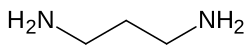
1,3-Diaminopropane, also known as trimethylenediamine, is a simple diamine with the formula H2N(CH2)3NH2. A colourless liquid with a fishy odor, it is soluble in water and many polar organic solvents. It is isomeric with 1,2-diaminopropane. Both are building blocks in the synthesis of heterocycles, such as those used in textile finishing, and coordination complexes. It is prepared by the amination of acrylonitrile followed by hydrogenation of the resulting aminopropionitrile.[1]
The potassium salt was used in the alkyne zipper reaction.[2]
Known uses of 1,3-diaminopropane are in the synthesis of piroxantrone and losoxantrone.
Safety
1,3-Diaminopropane is toxic on skin exposure with an LD50 of 177 mg kg−1 (dermal, rabbit)
References
- ^ Karsten Eller, Erhard Henkes, Roland Rossbacher, Hartmut Höke "Amines, Aliphatic" in Ullmann's Encyclopedia of Industrial Chemistry, Wiley-VCH, Weinheim, 2005. doi:10.1002/14356007.a02_001
- ^ C. A. Brown and A. Yamashita (1975). "Saline hydrides and superbases in organic reactions. IX. Acetylene zipper. Exceptionally facile contrathermodynamic multipositional isomeriazation of alkynes with potassium 3-aminopropylamide". J. Am. Chem. Soc. 97 (4): 891–892. doi:10.1021/ja00837a034.