4-Phenylbutylamine
 | |
| Clinical data | |
|---|---|
| Other names |
|
| Identifiers | |
IUPAC name
| |
| CAS Number | |
| PubChem CID | |
| DrugBank | |
| ChemSpider | |
| UNII | |
| ChEBI | |
| ChEMBL | |
| PDB ligand | |
| CompTox Dashboard (EPA) | |
| Chemical and physical data | |
| Formula | C10H15N |
| Molar mass | 149.237 g·mol−1 |
| 3D model (JSmol) | |
SMILES
| |
| Hazards | |
|---|---|
| GHS labelling:[1] | |
Pictograms
|
 
|
Signal word
|
Danger |
Hazard statements
|
H314, H315, H319, H335 |
Precautionary statements
|
P260, P264, P264+P265, P271, P280, P301+P330+P331, P302+P352, P302+P361+P354, P304+P340, P305+P351+P338, P305+P354+P338, P316, P319, P321, P332+P317, P337+P317, P362+P364, P363, P403+P233, P405, P501 |
Except where otherwise noted, data are given for materials in their standard state (at 25 °C [77 °F], 100 kPa).
Infobox references
| |
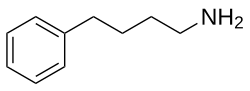
4-Phenylbutylamine, also known as benzenebutanamine or 4-PBA, is a phenylalkylamine or phenylbutylamine, consisting of a benzene ring in which one of the hydrogen atoms is substituted by a 4-aminobutyl group. It is a primary amine and a member of the benzene class of organic compounds. It penetrates lipid bilayers in the cubic liquid-crystalline phase.[2] The 4-phenylbutylamine molecule exists in the form of four stable rotamers.[3]
A serine protease inhibitor, it has been used in research as a test inhibitor to study the function of the enzyme trypsin. It is capable of mimicking the side chain of the amino acid lysine or arginine, which allows it to bind to the active site of the enzyme trypsin.[1][4][5]
Modification of hen egg-white lysozyme with 4-phenylbutylamine using EDC creates derivatives with 0.6-0.7 modified residues and about 60 percent activity. Kinetic data shows that this modified lysozyme increases the kcat of SucGly2Phe-4-nitroanilide hydrolysis by α-chymotrypsin by 20 times, without changing the Km. The apparent dissociation constant (Kd) for the lysozyme-chymotrypsin complex is 0.03 mM and does not depend on substrate concentration. This effect is specific to α and δ-chymotrypsins; other serine proteases or similar derivatives of ribonuclease and α-lactalbumin do not show this enhancement. Because chitin oligomers like GlcNAc2 and GlcNAc3 partially block the activation, the 4-phenylbutylamine group is likely located near the lysozyme binding site[6][7].
References
- ^ a b PubChem. "Benzenebutanamine". pubchem.ncbi.nlm.nih.gov. Retrieved 2026-02-02.
- ^ Engström S, Nordén TP, Nyquist H (August 1999). "Cubic phases for studies of drug partition into lipid bilayers". European Journal of Pharmaceutical Sciences : Official Journal of the European Federation for Pharmaceutical Sciences. 8 (4): 243–54. doi:10.1016/s0928-0987(99)00012-3. PMID 10425374.
- ^ "Theoretical and experimental vibrational spectroscopy study on rotational isomer of 4-phenylbutylamine".
{{cite web}}: CS1 maint: url-status (link) - ^ Leiros HK, Brandsdal BO, Andersen OA, Os V, Leiros I, Helland R, et al. (April 2004). "Trypsin specificity as elucidated by LIE calculations, X-ray structures, and association constant measurements". Protein Science. 13 (4): 1056–1070. doi:10.1110/ps.03498604. PMC 2280040. PMID 15044735.
- ^ "4-Phenylbutylamine". go.drugbank.com. Retrieved 2026-02-02.
- ^ Shechter Y, Gertler A (1978-11-10). "Enhancement of α-chymotrypsin-catalyzed hydrolysis of specific p-nitroanilide substrates by 4-phenylbutylamine derivative of hen egg-white lysozyme". Biochimica et Biophysica Acta (BBA) - Enzymology. 527 (1): 42–55. doi:10.1016/0005-2744(78)90254-1. ISSN 0005-2744.
- ^ Shechter Y, Gertler A (1978-11-10). "Enhancement of alpha-chymotrypsin-catalyzed hydrolysis of specific p-nitroanilide substrates by 4-phenylbutylamine derivative of hen egg-white lysozyme". Biochimica Et Biophysica Acta. 527 (1): 42–55. doi:10.1016/0005-2744(78)90254-1. ISSN 0006-3002. PMID 718965.