Metaraminol, also known as metaradrine and sold under the brand name Aramine among others, is a sympathomimetic medication which is used in the prevention and treatment of hypotension (low blood pressure), particularly as a complication of anesthesia.[1][3][4] It is given by intramuscular or intravenous administration.[1]
Side effects of metaraminol include reflex bradycardia among others. Metaraminol is a norepinephrine releasing agent and at high doses a α1-adrenergic receptor agonist with some β-adrenergic effect.[5][6][7] It is a substituted amphetamine and is closely related to phenylpropanolamine, ephedrine, and oxilofrine.[3][4]
Metaraminol was approved for medical use in the United States in September 1954.[8][9][10]
Medical uses
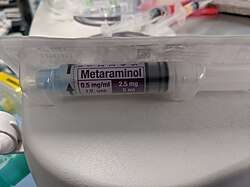
A commercially prepared pre-filled syringe of metaraminol for bolus use during anaesthesia, made up as 0.5 mg/mL (2.5 mg in 5 mL).
Metaraminol is given intravenously as either a bolus (often 0.5–1 mg doses) or as an infusion, usually via peripheral intravenous access. Metaraminol is commonly available as 10 mg in 1 mL, that requires dilution prior to administration (often made up to a 0.5 mg/mL solution), however pre-prepared syringes of metaraminol for bolus use for hypotension are also commonly available.[11][12]
Metaraminol is also used in the treatment of priapism.[13][14][15]
Pharmacology
Pharmacodynamics
The dominant mechanism of action for the vasopressor action of metaraminol is indirect,[5] with metaraminol displacing norepinephrine from neuronal vesicles in order for the noradrenaline to exert these effects.[6] Metaraminol at higher doses may have direct α-adrenergic agonist and β1-adrenergic agonist effects.[5] However at doses common in clinical practice, the indirect α1-adrenergic effects predominate, such that reflex bradycardia is a common side effect.
Chemistry
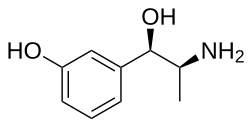
Metaraminol, also known as (1R,2S)-3,β-dihydroxy-α-methylphenethylamine or as (1R,2S)-3,β-dihydroxyamphetamine, is a substituted phenethylamine and amphetamine derivative.[3][4] It is the (1R,2S)-enantiomer of meta-hydroxynorephedrine (3,β-dihydroxyamphetamine).[3][4] The drug is closely related to phenylpropanolamine ((1RS,2SR)-β-hydroxyamphetamine; norephedrine), ephedrine ((1R,2S)-β-hydroxy-N-methylamphetamine), para-hydroxynorephedrine (4,β-dihydroxyamphetamine), and oxilofrine (4,β-dihydroxy-N-methylamphetamine).[3][4]
The experimental log P of metaraminol is -0.27 and its predicted log P ranges from -0.59 to 0.07.[16][17]
Metaraminol is used pharmaceutically as the bitartrate salt.[3][4]
History
Metaraminol was approved for medical use in the United States in September 1954.[8][9][10][3]
Society and culture
Names
Metaraminol is the generic name of the medication and its INNTooltip International Nonproprietary Name and BANTooltip British Approved Name, while its DCFTooltip Dénomination Commune Française is métaraminol and its DCITTooltip Denominazione Comune Italiana is metaraminolo.[3][4][18] As the bitartrate salt, its generic name is metaraminol bitartrate and this is its USANTooltip United States Adopted Name and JANTooltip Japanese Accepted Name, while metaraminol tartrate is its BANMTooltip British Approved Name.[3][4][18] A synonym of metaraminol is metaradrine.[4][18] Brand names of metaraminol include Aramin, Aramine, and Pressonex, among others.[3][4][18]
^ abc"Metaraminol". Deranged Physiology. Retrieved 19 October 2022.
^ abHarrison DC, Chidsey CA, Braunwald E (September 1963). "Studies on the Mechanism of Action of Metaraminol (Aramine)". Annals of Internal Medicine. 59 (3): 297–305. doi:10.7326/0003-4819-59-3-297. PMID 14065947.
^ abWeil MH, Spink WW (June 1955). "Clinical studies on a vasopressor agent: metaraminol (aramine). I. Observations in normotensive subjects". Am J Med Sci. 229 (6): 661–669. doi:10.1097/00000441-195506000-00008. PMID 14376394.
^ abWeil MH (October 1955). "Clinical studies on a vasopressor agent: metaraminol (aramine). II. Observations on its use in the management of shock". The American Journal of the Medical Sciences. 230 (4): 357–369. doi:10.1097/00000441-195510000-00001. PMID 13258566.
^Koga S, Shiraishi K, Saito Y (1990). "Post-traumatic priapism treated with metaraminol bitartrate: case report". J Trauma. 30 (12): 1591–3. doi:10.1097/00005373-199012000-00029. PMID 2258979.
^Block T, Sturm W, Ernst G, Staehler G, Schmiedt E (1988). "[Metaraminol in therapy of various forms of priapism]". Urologe A. 27 (4): 225–9. PMID 3140463.