Bephenium hydroxynaphthoate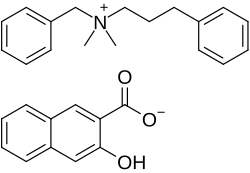 |
|
Pregnancy
category | |
|---|
Routes of
administration | Oral |
|---|
| ATC code | |
|---|
|
| Bioavailability | <1% |
|---|
| Excretion | Renal (negligible) |
|---|
|
N-Benzyl-N,N-dimethyl-2-phenoxyethanaminium 3-hydroxynaphthalene-2-carboxylate
|
| CAS Number | |
|---|
| PubChem CID | |
|---|
| ChemSpider | |
|---|
| UNII | |
|---|
| ChEMBL | |
|---|
| CompTox Dashboard (EPA) | |
|---|
| ECHA InfoCard | 100.021.189 |
|---|
|
| Formula | C28H29NO4 |
|---|
| Molar mass | 443.543 g·mol−1 |
|---|
| 3D model (JSmol) | |
|---|
C[N+](C)(CCOc1ccccc1)Cc2ccccc2.c1ccc2cc(c(cc2c1)C(=O)[O-])O
|
InChI=1S/C17H22NO.C11H8O3/c1-18(2,15-16-9-5-3-6-10-16)13-14-19-17-11-7-4-8-12-17;12-10-6-8-4-2-1-3-7(8)5-9(10)11(13)14/h3-12H,13-15H2,1-2H3;1-6,12H,(H,13,14)/q+1;/p-1  N NKey:PMPQCPQAHTXCDK-UHFFFAOYSA-M N
|
N Y (what is this?) (verify) Y (what is this?) (verify) |
Bephenium hydroxynaphthoate (INN, trade names Alcopara, Alcopar, Befenium, Debefenium, Francin, Nemex) is an anthelmintic agent formerly used in the treatment of hookworm infections and ascariasis.[1][2] It is formulated as a salt between the active pharmaceutical ingredient, bephenium, and 3-hydroxy-2-naphthoic acid.
Bephenium is not FDA-approved and is not available in the United States.[3]
References
Antiparasitics – Anthelmintics (P02) and endectocides (QP54) |
|---|
| Antiplatyhelmintic agents | Antitrematodals
(schistosomicides) | | Binds tubulin | |
|---|
| AChE inhibitor | |
|---|
| Other/unknown | |
|---|
|
|---|
Anticestodals
(taeniacides) | | Binds tubulin | |
|---|
| Other/unknown | |
|---|
|
|---|
|
|---|
Antinematodal agents
(including
macrofilaricides) | | Binds tubulin | |
|---|
| Glutamate-gated chloride channel, GABA receptor |
- avermectins
- Abamectin
- Doramectin
- Emamectin
- Eprinomectin (+esafoxolaner/praziquantel)
- Ivermectin#
- Selamectin
- milbemycins
- Moxidectin (+fluralaner)
- Milbemycin oxime
|
|---|
| NMDA | |
|---|
| Other/unknown | |
|---|
|
|---|
- #WHO-EM
- ‡Withdrawn from market
- Clinical trials:
- †Phase III
- §Never to phase III
|
Nicotinic acetylcholine receptor modulators |
|---|
| nAChRsTooltip Nicotinic acetylcholine receptors | Agonists
(and PAMsTooltip positive allosteric modulators) |
- 5-HIAA
- 6-Chloronicotine
- A-84,543
- A-366,833
- A-582,941
- A-867,744
- ABT-202
- ABT-418
- ABT-560
- ABT-894
- Acetylcholine
- Altinicline
- Anabasine
- Anatabine
- Anatoxin-a
- AR-R17779
- Bephenium hydroxynaphthoate
- Butinoline
- Butyrylcholine
- Carbachol
- Choline
- Choline m-bromophenyl ether
- Cotinine
- Cytisine
- Decamethonium
- Desformylflustrabromine
- Dianicline
- Dimethylphenylpiperazinium
- Epibatidine
- Epiboxidine
- Ethanol (alcohol)
- Ethoxysebacylcholine
- EVP-4473
- EVP-6124
- Galantamine
- GTS-21
- Ispronicline
- Ivermectin
- JNJ-39393406
- Levamisole
- Lobeline
- MEM-63,908 (RG-3487)
- Morantel
- Nicotine (tobacco)
- NS-1738
- PHA-543,613
- PHA-709,829
- PNU-120,596
- PNU-282,987
- Pozanicline
- Pyrantel
- Rivanicline
- RJR-2429
- Sazetidine A
- SB-206553
- Sebacylcholine
- SIB-1508Y
- SIB-1553A
- SSR-180,711
- Suberyldicholine
- Suxamethonium (succinylcholine)
- Suxethonium (succinyldicholine)
- TC-1698
- TC-1734
- TC-1827
- TC-2216
- TC-5214
- TC-5619
- TC-6683
- Tebanicline
- Tribendimidine
- Tropisetron
- UB-165
- Varenicline
- WAY-317,538
- XY-4083
|
|---|
Antagonists
(and NAMsTooltip negative allosteric modulators) | |
|---|
|
|---|
Precursors
(and prodrugs) | |
|---|
- See also
- Receptor/signaling modulators
- Muscarinic acetylcholine receptor modulators
- Acetylcholine metabolism/transport modulators
|