Europium(III) sulfate
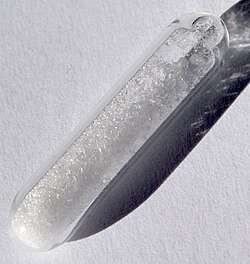 | |
| Names | |
|---|---|
| IUPAC name
Europium(III) sulfate
| |
Other names
| |
| Identifiers | |
CAS Number
|
|
3D model (JSmol)
|
|
| ChemSpider | |
| ECHA InfoCard | 100.033.534 |
| EC Number |
|
PubChem CID
|
|
CompTox Dashboard (EPA)
|
|
InChI
| |
SMILES
| |
| Properties | |
Chemical formula
|
Eu2(SO4)3 |
| Molar mass | 592.10 g·mol−1 |
| Appearance | light pink (anhydrous)[1] white (octahydrate)[1] |
| Density | 4.99 g/cm3[1] |
Solubility in water
|
0.021 g/mL (20°C) [1] |
| Structure[2] | |
Crystal structure
|
monoclinic |
Space group
|
C2/c |
Lattice constant
|
a = 21.2787 Å, b = 6.6322 Å, c = 6.8334 Å
|
| Hazards | |
| GHS labelling: | |
Pictograms
|

|
Signal word
|
Warning |
Hazard statements
|
H315, H319, H335 |
Precautionary statements
|
P261, P264, P264+P265, P271, P280, P302+P352, P304+P340, P305+P351+P338, P319, P321, P332+P317, P337+P317, P362+P364, P403+P233, P405, P501 |
Except where otherwise noted, data are given for materials in their standard state (at 25 °C [77 °F], 100 kPa).
Infobox references
| |
Europium(III) sulfate is a europium compound with the chemical formula Eu2(SO4)3·nH2O (n = 0, 1, 4, or 8).[3] It is a light pink crystalline solid,[1] stable in air up to 670 °C.[2] The octahydrate dehydrates to the anhydrous form at 375 °C.[1]
Preparation
Europium(III) sulfate can be prepared by reacting europium(III) oxide with sulfuric acid:[1]
- Eu2O3 + 3 H2SO4 → Eu2(SO4)3 + 3 H2O
It can also be precipitated from a solution of europium(III) nitrate upon the addition of sulfuric acid:[2]
- 2 Eu(NO3)3 + 3 H2SO4 → Eu2(SO4)3 + 6 HNO3
Reactions
Europium(III) sulfate can be reduced to europium(II) sulfate with hydrogen gas at 480-500 °C.[4] At temperatures between 600-1000 °C an oxysulfide (Eu2O2S) forms instead.[4]
References
- ^ a b c d e f g Perry, Dale L. (2016-04-19). Handbook of Inorganic Compounds. CRC Press. p. 168. ISBN 978-1-4398-1462-8.
- ^ a b c Denisenko, Yu. G.; Aleksandrovsky, A. S.; Atuchin, V. V.; Krylov, A. S.; Molokeev, M. S.; Oreshonkov, A. S.; Shestakov, N. P.; Andreev, O. V. (2018-12-25). "Exploration of structural, thermal and spectroscopic properties of self-activated sulfate Eu2(SO4)3 with isolated SO4 groups". Journal of Industrial and Engineering Chemistry. 68: 109–116. doi:10.1016/j.jiec.2018.07.034. ISSN 1226-086X.
- ^ Denisenko, Yu. G.; Khritokhin, N. A.; Andreev, O. V.; Basova, S. A.; Sal’nikova, E. I.; Polkovnikov, A. A. (2017-11-01). "Thermal decomposition of europium sulfates Eu2(SO4)3·8H2O and EuSO4". Journal of Solid State Chemistry. 255: 219–224. doi:10.1016/j.jssc.2017.08.020. ISSN 0022-4596.
- ^ a b Andreev, O. V.; Denisenko, Yu. G.; Sal’nikova, E. I.; Khritokhin, N. A.; Zyryanova, K. S. (2016-03-01). "Specifics of reactions of cerium sulfate and europium sulfate with hydrogen". Russian Journal of Inorganic Chemistry. 61 (3): 296–301. doi:10.1134/S0036023616030025. ISSN 1531-8613.