Manganese(II) bromide
 | |
 | |
| Names | |
|---|---|
| IUPAC name
Manganese(II) bromide
| |
| Identifiers | |
CAS Number
|
|
3D model (JSmol)
|
|
| ChemSpider | |
| ECHA InfoCard | 100.033.251 |
| EC Number |
|
PubChem CID
|
|
| UNII |
|
CompTox Dashboard (EPA)
|
|
InChI
| |
SMILES
| |
| Properties | |
Chemical formula
|
MnBr2 |
| Molar mass | 214.746 g/mol (anhydrous) 286.60 g/mol (tetrahydrate) |
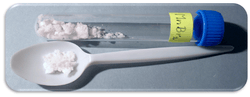
| Appearance | pink crystalline |
| Density | 4.385 g/cm3 |
| Melting point | 698 °C (1,288 °F; 971 K) (anhydrous) 64 °C (tetrahydrate) |
| Boiling point | 1,027 °C (1,881 °F; 1,300 K) |
Solubility in water
|
146 g/100 mL at 20 °C[1] |
Magnetic susceptibility (χ)
|
+13,900·10−6 cm3/mol |
| Structure | |
Crystal structure
|
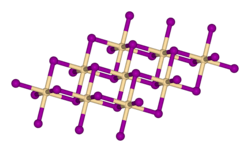
Trigonal, hP3, SpaceGroup = P-3m1, No. 164 |
Coordination geometry
|
octahedral |
| Hazards | |
| GHS labelling: | |
Pictograms
|
|
Signal word
|
Warning |
Hazard statements
|
H302, H312, H332 |
Precautionary statements
|
P280 |
| NFPA 704 (fire diamond) | 
1
0
1 |
| Flash point | Non-flammable |
| Related compounds | |
Other anions
|
Manganese(II) fluoride Manganese(II) chloride Manganese(II) iodide |
Other cations
|
Iron(II) bromide Cobalt(II) bromide Manganese(III) bromide |
Except where otherwise noted, data are given for materials in their standard state (at 25 °C [77 °F], 100 kPa).
Infobox references
| |


Manganese(II) bromide is the chemical compound composed of manganese and bromine with the formula MnBr2.
It can be used in place of palladium in the Stille reaction, which couples two carbon atoms using an organotin compound.[2]
References
- ^ http://sites.chem.colostate.edu/diverdi/all_courses/CRC%20reference%20data/solubility%20of%20inorganic%20compounds.pdf
- ^ Cepanec, Ivica (2004). Synthesis of Biaryls. Elsevier. p. 104. ISBN 0-08-044412-1. Retrieved 2008-06-18.