Chromium(III) bromide
-iodid.png) | |
| Names | |
|---|---|
| IUPAC name
Chromium(III) bromide
| |
Other names
| |
| Identifiers | |
CAS Number
|
|
3D model (JSmol)
|
|
| ChemSpider | |
| ECHA InfoCard | 100.030.068 |
| EC Number |
|
PubChem CID
|
|
| UNII | |
CompTox Dashboard (EPA)
|
|
InChI
| |
SMILES
| |
| Properties | |
Chemical formula
|
CrBr3 |
| Molar mass | 291.708 g·mol−1 |
| Appearance |
|
| Density | 4.25 g/cm3[2] |
| Melting point | 1,130 °C (2,070 °F; 1,400 K) (anhydrous)[2] 79 °C (hexahydrate) |
Solubility in water
|
anhydrous insoluble in cold water soluble with addition of chromium(II) salts[1] soluble in hot water[2]hexahydrate highly soluble[2] |
| Structure | |
Crystal structure
|
trigonal |
| Hazards | |
| GHS labelling:[4] | |
Pictograms
|
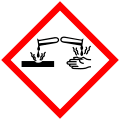 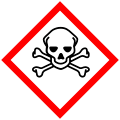 
|
Signal word
|
Danger |
Hazard statements
|
H302+H312, H314, H317, H330, H361 |
Precautionary statements
|
P203, P260, P264, P264+P265, P270, P271, P272, P280, P284, P301+P317, P301+P330+P331, P302+P352, P302+P361+P354, P304+P340, P305+P354+P338, P316, P317, P318, P320, P321, P330, P333+P317, P362+P364, P363, P403+P233, P405, P501 |
| NIOSH (US health exposure limits): | |
PEL (Permissible)
|
TWA 1 mg/m3[3] |
REL (Recommended)
|
TWA 0.5 mg/m3[3] |
IDLH (Immediate danger)
|
250 mg/m3[3] |
Except where otherwise noted, data are given for materials in their standard state (at 25 °C [77 °F], 100 kPa).
Infobox references
| |

Chromium(III) bromide is an inorganic compound with the chemical formula CrBr3. It is a dark colored solid that appears green in transmitted light but red with reflected light. It is used as a precursor to catalysts for the oligomerization of ethylene.
Synthesis
The compound is prepared in a tube furnace by the reaction of bromine vapor and chromium powder at 1000 °C. It is purified by extracting with absolute diethyl ether to remove any CrBr2, and is subsequently washed with absolute diethyl ether and absolute ethanol.[1]
- 2Cr + 3Br2 → 2CrBr3
The effect of bromine on a highly heated mixture of chromium(III) oxide with charcoal:
- Cr2O3 + 3Br2 + 3C → 2CrBr3 + 3CO
Chemical properties
Analogous to the behavior of related chromium(III) halides, the tribromide dissolves in water to give CrBr3(H2O)3 only upon the addition of catalytic amounts of a reducing agent.[1] The reducing agent generates chromous bromide on the surface of the solid, which dissolves and re-oxidizes to Cr(III).
Chromium(III) bromide is reduced by hydrogen gas at 350-400 °C to give chromium(II) bromide:[1]
- 2 CrBr3 + H2 → 2 CrBr2 + 2 HBr
Oxidizes when heated in air:
- 2 CrBr3 + 3 O2 → 2 Cr2O3 + 6 Br2
References
- ^ a b c d e F. Hein and S. Herzog (1963). "Chromium, Molybdenum, Tungsten, Uranium". In G. Brauer (ed.). Handbook of Preparative Inorganic Chemistry, 2nd Ed. Vol. 2. NY, NY: Academic Press. p. 1341.
- ^ a b c d Perry, Dale L. (2011). Handbook of Inorganic Compounds, Second Edition. Boca Raton, Florida: CRC Press. p. 122. ISBN 978-1-43981462-8. Retrieved 2014-01-10.
- ^ a b c NIOSH Pocket Guide to Chemical Hazards. "#0141". National Institute for Occupational Safety and Health (NIOSH).
- ^ PubChem. "Chromic bromide". pubchem.ncbi.nlm.nih.gov. Retrieved 2026-02-08.