Rubidium nitrate
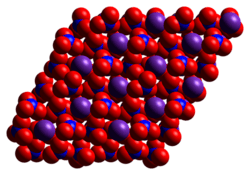 | |
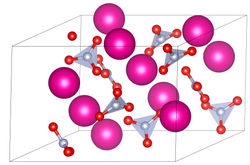 Unit cell of rubidium nitrate
| |
| Names | |
|---|---|
| IUPAC name
Rubidium nitrate
| |
| Identifiers | |
CAS Number
|
|
3D model (JSmol)
|
|
| ChemSpider | |
| ECHA InfoCard | 100.032.767 |
| EC Number |
|
PubChem CID
|
|
| RTECS number |
|
CompTox Dashboard (EPA)
|
|
InChI
| |
SMILES
| |
| Properties | |
Chemical formula
|
RbNO3 |
| Molar mass | 147.473 g/mol |
| Appearance | White hygroscopic solid |
| Density | 3.11 g/cm3 |
| Melting point | 310 °C (590 °F; 583 K) decomposes |
| Boiling point | 578 °C (1,072 °F; 851 K) |
Solubility in water
|
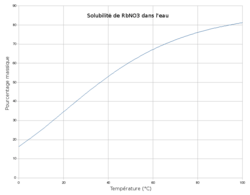
44.28 g/100 mL (16 °C) 65.0 g/100 mL (25 °C)[1] |
| Solubility in acetone | very slightly soluble |
Magnetic susceptibility (χ)
|
−41.0·10−6 cm3/mol |
Refractive index (nD)
|
1.524 |
| Structure[2] | |
Crystal structure
|
trigonal |
Space group
|
P31 |
Lattice constant
|
a = 10.474 Å, c = 7.443 Å
|
Lattice volume (V)
|
707.2 Å3 |
| Hazards | |
| Occupational safety and health (OHS/OSH): | |
Main hazards
|
Oxidant |
| GHS labelling:[3] | |
Pictograms
|
 
|
Signal word
|
Danger |
Hazard statements
|
H272, H315, H319, H335 |
Precautionary statements
|
P210, P220, P261, P264, P264+P265, P271, P280, P302+P352, P304+P340, P305+P351+P338, P319, P321, P332+P317, P337+P317, P362+P364, P370+P378, P403+P233, P405, P501 |
| NFPA 704 (fire diamond) | 
1
0
0 OX |
| Flash point | Non-flammable |
| Lethal dose or concentration (LD, LC): | |
LD50 (median dose)
|
4625 mg/kg (rat, oral) |
| Related compounds | |
Other anions
|
Rubidium sulfate Rubidium chloride |
Other cations
|
Lithium nitrate Sodium nitrate Potassium nitrate Caesium nitrate |
Except where otherwise noted, data are given for materials in their standard state (at 25 °C [77 °F], 100 kPa).
Infobox references
| |


Rubidium nitrate is an inorganic compound with the formula RbNO3. This alkali metal nitrate salt is a white hygroscopic solid that is highly soluble in water.
Properties
In a flame test, RbNO3 gives a mauve/light purple colour.
Production
RbNO3 can be prepared either by dissolving rubidium metal, its hydroxide or carbonate in nitric acid.
- RbOH + HNO3 → RbNO3 + H2O
- Rb2CO3 + 2 HNO3 → 2 RbNO3 + CO2 + H2O
- 2 Rb + 2 HNO3 → 2 RbNO3 + H2
Uses
Rubidium compounds have very few applications.[1] Like caesium nitrate, it is used in infrared radiation optics, in pyrotechnic compositions as a pyrotechnic colorant and as an oxidizer, e.g. in decoys and illumination flares although it is rarely used in fireworks to produce a red-violet colour. It is also used as a raw material for preparation of other rubidium compounds and rubidium metal, for manufacture of catalysts and in scintillation counters.
References
- ^ a b W. Lenk, H. Prinz, A. Steinmetz,"Rubidium and Rubidium Compounds" in Ullmann's Encyclopedia of Industrial Chemistry, 2010 Wiley-VCH Verlag GmbH & Co. KGaA, Weinheim. doi:10.1002/14356007.a23_473.pub2
- ^ Jutta Pohl, Dieter Pohl, Gunadi Adiwidjaja (1992). "Phase Transition in Rubidium Nitrate at 346 K and Structure at 296, 372, 413 and 437 K". Acta Crystallographica Section B. B48 (2): 160–166. doi:10.1107/S0108768191013459.
{{cite journal}}: CS1 maint: multiple names: authors list (link) - ^ PubChem. "Rubidium nitrate". pubchem.ncbi.nlm.nih.gov. Retrieved 2026-01-19.