Palladium(II) nitrate
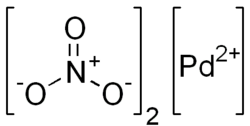 | |
2(ICD425998).png) | |
| Names | |
|---|---|
| IUPAC name
Palladium(II) nitrate
| |
| Other names
Palladium nitrate
Palladous nitrate | |
| Identifiers | |
CAS Number
|
|
3D model (JSmol)
|
|
| ChemSpider | |
| ECHA InfoCard | 100.030.228 |
PubChem CID
|
|
| UNII | |
CompTox Dashboard (EPA)
|
|
InChI
| |
SMILES
| |
| Properties | |
Chemical formula
|
Pd(NO3)2 |
| Molar mass | 230.43 g/mol |
| Appearance | yellow solid |
| Density | 3.546 g/cm3[1] |
| Melting point | Decomposes >100 °C |
Solubility in water
|
Soluble |
| Hazards | |
| Occupational safety and health (OHS/OSH): | |
Main hazards
|
Irritant, possibility of allergic reaction |
| GHS labelling:[2] | |
Pictograms
|
   
|
Signal word
|
Danger |
Hazard statements
|
H271, H272, H290, H302, H314, H410 |
Precautionary statements
|
P210, P220, P234, P260, P264, P264+P265, P270, P273, P280, P283, P301+P317, P301+P330+P331, P302+P361+P354, P304+P340, P305+P354+P338, P306+P360, P316, P317, P321, P330, P363, P370+P378, P371+P380+P375, P390, P391, P405, P420, P501 |
| Flash point | Non-flammable |
| Related compounds | |
Other anions
|
Palladium(II) chloride |
Other cations
|
Nickel(II) nitrate |
Related compounds
|
Silver nitrate |
Except where otherwise noted, data are given for materials in their standard state (at 25 °C [77 °F], 100 kPa).
Infobox references
| |


Palladium(II) nitrate is the inorganic compound with the formula Pd(NO3)2.(H2O)x where x = 0 or 2. The anhydrous and dihydrate are deliquescent solids. According to X-ray crystallography, both compounds feature square planar Pd(II) with unidentate nitrate ligands. The anhydrous compound, which is a coordination polymer, is yellow.[1][3]
As a solution in nitric acid, Pd(NO3)2 catalyzes the conversion of alkenes to dinitrate esters. Its pyrolysis affords palladium oxide.[4]
Preparation
Hydrated palladium nitrate may be prepared by dissolving palladium oxide hydrate in dilute nitric acid followed by crystallization. The nitrate crystallizes as yellow-brown deliquescent prisms. The anhydrous material is obtained by treating palladium metal with fuming nitric acid.[1]
References
- ^ a b c Bruns, Jörn; Klüner, Thorsten; Wickleder, Mathias S. (2015). "Oxoanionic Noble Metal Compounds from Fuming Nitric Acid: The Palladium Examples Pd(NO3)2 and Pd(CH3SO3)2". Chemistry - A European Journal. 21 (3): 1294–1301. doi:10.1002/chem.201405355. PMID 25431333.
- ^ PubChem. "Palladium nitrate". pubchem.ncbi.nlm.nih.gov. Retrieved 2026-02-27.
- ^ Laligant, Y.; Ferey, G.; Le Bail, A. (1991). "Crystal Structure of Pd(NO3)2(H2O)2". Materials Research Bulletin. 26 (4): 269–275. doi:10.1016/0025-5408(91)90021-D.
- ^ Timothy T. Wenzel "Palladium(II) Nitrate" Encyclopedia of Reagents for Organic Synthesis 2001, John Wiley & Sons. doi:10.1002/047084289X.rp013