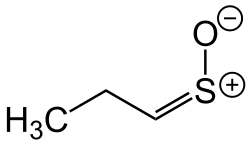
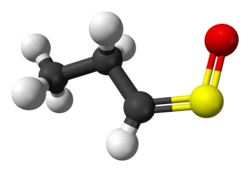
syn-Propanethial S-oxide (or (Z)-propanethial S-oxide), a member of a class of organosulfur compounds known as thiocarbonyl S-oxides (formerly "sulfines"),[2] is a volatile liquid that acts as a lachrymatory agent (triggers tearing and stinging on contact with the eyes).
Onion release
The chemical is released from onions, Allium cepa, as they are sliced. The release is due to the breaking open of the onion cells, which releases enzymes called alliinases. Alliinases then break down amino acid sulfoxides, generating sulfenic acids. A specific sulfenic acid, allicin or 1-propenesulfenic acid, is rapidly rearranged by another enzyme, the lachrymatory factor synthase (LFS), to give syn-propanethial S-oxide.[3] Vapors from this volatile liquid induce tearing.[4]
Related compounds
A structurally related lachrymatory compound, syn-butanethial S-oxide, C4H8OS, has been found in another onion relative plant, Allium siculum.[5]
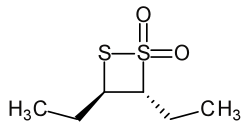
Structure of trans-3,4-diethyl-1,2-dithietane 1,1-dioxide
Propanethial S-oxide forms a stable dimer, trans-3,4-diethyl-1,2-dithietane 1,1-dioxide.[6]
^Zwanenburg, B. (2004). "Thioaldehyde and Thioketone S-Oxides and S-Imides (Sulfines and Derivatives)". In Padwa, A. (ed.). Heteroatom Analogues of Aldehydes and Ketones. Science of Synthesis. Vol. 27. pp. 135–176. ISBN 978-1-58890-204-7.
^Kubec, R.; Cody, R. B.; Dane, A. J.; Musah, R. A.; Schraml, J.; Vattekkatte, A.; Block, E. (2010). "Applications of DART Mass Spectrometry in Allium Chemistry. (Z)-Butanethial S-Oxide and 1-Butenyl Thiosulfinates and their S-(E)-1-Butenylcysteine S-Oxide Precursor from Allium siculum". Journal of Agricultural and Food Chemistry. 58 (2): 1121–1128. doi:10.1021/jf903733e. PMID 20047275.
^Block, E; Bazzi, AA; Revelle, LK (1980). "The chemistry of sulfines. 6. Dimer of the onion lachrymatory factor: the first stable 1,2-dithietane derivative". J. Am. Chem. Soc. 102 (7): 2490–2491. Bibcode:1980JAChS.102.2490B. doi:10.1021/ja00527a074.