Tantalum telluride
 | |
| Names | |
|---|---|
| IUPAC name
tantalum(IV) telluride
| |
| Other names
tantalum ditelluride
tantalum telluride | |
| Identifiers | |
CAS Number
|
|
3D model (JSmol)
|
|
| ChemSpider | |
| ECHA InfoCard | 100.031.882 |
| EC Number |
|
PubChem CID
|
|
CompTox Dashboard (EPA)
|
|
InChI
| |
SMILES
| |
| Properties | |
Chemical formula
|
TaTe2 |
| Molar mass | 436.145 g/mol |
| Density | 9.4 g/cm3 |
| Structure | |
Crystal structure
|
Monoclinic, mS18 |
Space group
|
C2/m, No. 12 |
| Related compounds | |
Other anions
|
Tantalum(IV) sulfide |
Except where otherwise noted, data are given for materials in their standard state (at 25 °C [77 °F], 100 kPa).
Infobox references
| |


Tantalum telluride is a chemical compound of tantalum and tellurium. It is most commonly found as a layered transition metal dichalcogenide (TMD) with the chemical formula TaTe2.
TaTe2 hosts structural distortions that are stable at room temperature, resulting in a distorted monoclinic structure, referred to as the 1T' phase.[1] Below a temperature of approximately 170 K, it undergoes a charge density wave (CDW) phase transition to the low temperature (LT) phase, where double zigzag chains reconstruct into discrete "butterfly" clusters.[2] This is accompanied by a sharp drop in electrical resistivity, distinguishing it from the metal-insulator transitions found in materials like TaS2.[3]
Tantalum also forms a tantalum rich telluride with the approximate formula Ta1.6Te that is unusual in that it forms dodecagonal chalcogenide quasicrystals, a formation that cannot occur in a normal crystal because it does not result in a periodic crystal lattice.[4]
Preparation
TaTe2 can be synthesized by reaction of powdered tantalum and tellurium at temperatures around 800 °C. Single crystals of TaTe2 can be crystallized from powders via chemical vapor transport using iodine as the transporting agent,[5] or flux zone growth. TaTe2 single cystals can be easily cleaved along the crystallographic ab-plane and has a characteristic grey-black metallic sheen.
Structure
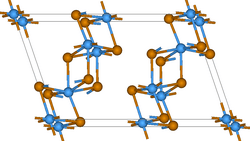
TaTe2 has a monoclinically distorted CdI2-type structure (a = 19.31 Å, b = 3.651 Å, c = 9.377 Å, β = 134.22°), where Ta atoms are surrounded by six Te atoms in an octahedron. The distortion is thought to be caused by the low electronegativity of Te, leading to a weaker Ta-Te bonds and a partial charge transfer from Te to Ta.[6]
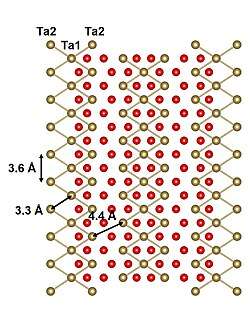
Room Temperature (1T' phase): At room temperature, Ta atoms cluster to form a intra-layer (3 × 1) linear stripe-like order, with double zigzag chains propagating along the b-axis.[7] This distortion (relative to a hypothetical undistorted 1T-TaTe2 lattice) lowers the symmetry from trigonal to monoclinic (space group C2/m), resulting in distorted octahedral coordination of the Ta atoms. The Ta atoms occupy two distinct crystallographic sites: Ta1 atoms located in the chain interior and Ta2 atoms at the chain rims. The Ta1 atoms are situated in less distorted octahedra and exhibit uniform Ta1-Ta1 distances of 3.6 Å. Conversely, the Ta2 atoms center more distorted octahedra, with Ta1-Ta2 distances of 3.3 Å. These chains are separated by a longer inter-chain Ta2-Ta2 distance of 4.4 Å. The surrounding Te sublattice forms planes of weakly interacting atoms, consistent with van der Waals or weak multicenter bonding.
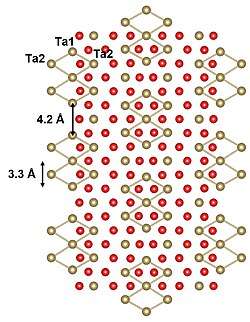
Low Temperature (LT phase): Upon cooling below TCDW (~170 K), the zigzag chains break apart to form discrete, periodic clusters of Ta atoms. The formation of butterfly clusters lead to a irregular octahedral environment where Ta1-Ta1 distances vary sharply (3.3 Å intra-cluster vs. 4.2 Å inter-cluster).[6] A distinct periodic lattice distortion also emerges in the Te sublattice, where Te atoms displace toward the Ta planes to form single zigzag chains. Te-Te bond lengths shorten inside these chains to approach the covalent bond length of elemental Te, while Te-Te distances outside the chains elongate. The covalent bond character within the Te network facilitates charge delocalization, correlating with the decreased resistivity observed in this phase.
A trigonal prismatic (1H) coordination environment has been observed in monolayer films grown by molecular beam epitaxy (MBE), but has not been observed in bulk TaTe2.[8]
Electronic and transport properties
The phase transition at ~170 K is classified as a CDW transition, although its mechanism differs from those observed in materials such as NbSe2. The transition is driven by a periodic lattice distortion with a commensurate superstructure described by the wave vector q = (0, 1/3, 0), corresponding to the butterfly cluster formation.[2] Theoretical calculations suggest that this transition is not driven by the Fermi surface nesting commonly found in other layered CDW materials, but rather by an instability associated with the formation of localized metal-metal bonds.[9]
Unlike the metal-insulator transitions observed in dichalcogenides like 1T-TaS2, the CDW transition in TaTe2 is characterized by a preservation of the metallic state down to low temperatures, with a steep decrease in resistivity around the transition temperature.[3]
The suppression of the CDW state has been reported to lead to the emergence of superconductivity.[10] As pressure is applied, the CDW transition temperature decreases until it is completely suppressed at a critical pressure of approximately 1.3 GPa, near which a superconducting state with an onset temperature of 0.4 K emerges.
External links
References
- ^ Brown, B. E. (1966-02-10). "The crystal structures of NbT2 and TaTe2". Acta Crystallographica. 20 (2): 264–267. doi:10.1107/S0365110X66000501. ISSN 0365-110X.
- ^ a b Chen, Chen; Kim, Heung-Sik; Admasu, Alemayehu S.; Cheong, Sang-Wook; Haule, Kristjan; Vanderbilt, David; Wu, Weida (2018-11-16). "Trimer bonding states on the surface of the transition-metal dichalcogenide TaT e 2". Physical Review B. 98 (19) 195423. arXiv:1807.02597. doi:10.1103/PhysRevB.98.195423. ISSN 2469-9950.
- ^ a b Chen, Hongxiang; Li, Zhilin; Guo, Liwei; Chen, Xiaolong (2017-01-01). "Anisotropic magneto-transport and magnetic properties of low-temperature phase of TaTe 2". EPL (Europhysics Letters). 117 (2) 27009. arXiv:1612.00938. doi:10.1209/0295-5075/117/27009. ISSN 0295-5075.
- ^ Tokumoto, Yuki; Hamano, Kotaro; Nakagawa, Sunao; Kamimura, Yasushi; Suzuki, Shintaro; Tamura, Ryuji; Edagawa, Keiichi (2024-03-01). "Superconductivity in a van der Waals layered quasicrystal". Nature Communications. 15 (1): 1529. doi:10.1038/s41467-024-45952-2. ISSN 2041-1723. PMC 10907369. PMID 38429267.
- ^ Lin, Yi; Huber, Maximillian; Rajpurohit, Sangeeta; Zhu, Yanglin; Siddiqui, Khalid M.; Eilbott, Daniel H.; Moreschini, Luca; Ai, Ping; Denlinger, Jonathan D.; Mao, Zhiqiang; Tan, Liang Z.; Lanzara, Alessandra (2022-04-13). "Evidence of nested quasi-one-dimensional Fermi surface and decoupled charge-lattice orders in layered TaTe 2". Physical Review Research. 4 (2) L022009. doi:10.1103/PhysRevResearch.4.L022009. ISSN 2643-1564.
- ^ a b Petkov, Valeri; Chapagain, Kamal; Yang, Junjie; Shastri, Sarvjit; Ren, Yang (2020-07-29). "Exotic bonding interactions and coexistence of chemically distinct periodic lattice distortions in the charge density wave compound Ta T e 2". Physical Review B. 102 (2) 024111. doi:10.1103/PhysRevB.102.024111. ISSN 2469-9950. OSTI 1657235.
- ^ Wang, Hong; Chai, Ke; Wei, Linlin; Li, Zi-An; Zhu, Chunhui; Zheng, Dingguo; Li, Zhongwen; Li, Jun; Tian, Huanfang; Yang, Huaixin; Li, Jianqi (2020-06-11). "Charge density wave and atomic trimerization in layered transition-metal dichalcogenides 1T-MX 2 materials". EPL (Europhysics Letters). 130 (4) 47001. doi:10.1209/0295-5075/130/47001. ISSN 1286-4854.
- ^ Di Bernardo, Iolanda; Ripoll-Sau, Joan; Silva-Guillén, Jose Angel; Calleja, Fabian; Ayani, Cosme G.; Miranda, Rodolfo; Canadell, Enric; Garnica, Manuela; Vázquez de Parga, Amadeo L. (2023). "Metastable Polymorphic Phases in Monolayer TaTe2". Small. 19 (29) 2300262. doi:10.1002/smll.202300262. hdl:10486/707542. ISSN 1613-6829.
- ^ Liu, Y.; Lu, W. J.; Shao, D. F.; Zu, L.; Kan, X. C.; Song, W. H.; Sun, Y. P. (2015-01-01). "Structural, electrical, and thermoelectric properties of distorted 1T-Ta 1−x Nb x Te 2 single crystals". EPL (Europhysics Letters). 109 (1) 17003. doi:10.1209/0295-5075/109/17003. ISSN 0295-5075.
- ^ Guo, Jing; Huang, Cheng; Luo, Huixia; Yang, Huaixin; Wei, Linlin; Cai, Shu; Zhou, Yazhou; Zhao, Hengcan; Li, Xiaodong; Li, Yanchun; Yang, Ke; Li, Aiguo; Sun, Peijie; Li, Jianqi; Wu, Qi (2022-05-09). "Observation of three superconducting transitions in the pressurized CDW-bearing compound TaTe 2". Physical Review Materials. 6 (5) L051801. arXiv:1704.08106. doi:10.1103/PhysRevMaterials.6.L051801. ISSN 2475-9953.