Silver telluride
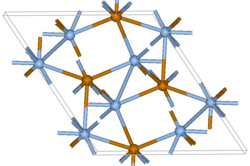 | |
| Names | |
|---|---|
| Other names
Hessite
| |
| Identifiers | |
CAS Number
|
|
3D model (JSmol)
|
|
| ChemSpider | |
| ECHA InfoCard | 100.031.277 |
| EC Number |
|
PubChem CID
|
|
CompTox Dashboard (EPA)
|
|
InChI
| |
SMILES
| |
| Properties | |
Chemical formula
|
Ag2Te |
| Molar mass | 341.3364 g/mol |
| Appearance | grey-black crystals |
| Density | 8.318 g/cm3 |
| Melting point | 955 °C (1,751 °F; 1,228 K) |
Refractive index (nD)
|
3.4 |
| Structure | |
Crystal structure
|
Monoclinic, mP12 |
Space group
|
P21/c, No. 14 |
| Related compounds | |
Related compounds
|
|
Except where otherwise noted, data are given for materials in their standard state (at 25 °C [77 °F], 100 kPa).
Infobox references
| |


Silver telluride (Ag2Te) is a chemical compound, a telluride of silver, also known as disilver telluride or silver(I) telluride. It forms a monoclinic crystal. In a wider sense, silver telluride can be used to denote AgTe (silver(II) telluride, a metastable compound) or Ag5Te3.
Properties
Silver telluride is a semiconductor which can be doped both n-type and p-type. Stoichiometric Ag2Te has n-type conductivity. On heating silver is lost from the material.
Non-stoichiometric silver telluride has shown extraordinary magnetoresistance.
Occurrence
Silver(I) telluride occurs naturally as the mineral hessite, whereas silver(II) telluride is known as empressite. A silver gold telluride occurs as sylvanite.
Synthesis
Porous silver telluride (AgTe) is synthesized by an electrochemical deposition method. A potentiostat and a three-electrode cell with sulfuric acid electrolyte containing Ag nanoparticles at are used. A silver paste used in the tungsten ditelluride (WTe2) attachment leaches into the electrolyte, causing Ag to dissolve in the electrolyte. The electrolyte is stirred to remove hydrogen bubbles. A silver-silver chloride electrode and a platinum wire can be used as reference and counter electrodes. In order to grow the porous AgTe, the WTe2 is treated with cyclic voltammetry.[1]
Glutathione-coated Ag2Te nanoparticles can be synthesized by preparing a solution containing AgNO3, Na2TeO3, and glutathione. N2H4 is added under stirring in an ice bath. The resulting product is washed for purification.[2]
References
- ^ Kwon, Hagyeong; Bae, Dongyeon; Won, Dongyeun; Kim, Heeju; Kim, Gunn; Cho, Jiung; Park, Hee Jung; Baik, Hionsuck; Jeong, Ah Reum; Lin, Chia-Hsien; Chiang, Ching-Yu; Ku, Ching-Shun; Yang, Heejun; Cho, Suyeon (2021-04-27). "Nanoporous Silver Telluride for Active Hydrogen Evolution". ACS Nano. 15 (4): 6540–6550. doi:10.1021/acsnano.0c09517. ISSN 1936-0851. PMID 33784072. S2CID 232429859.
- ^ Nieves, Lenitza M.; Dong, Yuxi C.; Rosario-Berríos, Derick N.; Mossburg, Katherine; Hsu, Jessica C.; Cramer, Gwendolyn M.; Busch, Theresa M.; Maidment, Andrew D. A.; Cormode, David P. (2022-08-03). "Renally Excretable Silver Telluride Nanoparticles as Contrast Agents for X-ray Imaging". ACS Applied Materials & Interfaces. 14 (30): 34354–34364. doi:10.1021/acsami.2c06190. ISSN 1944-8244. PMC 9482380. PMID 35867906.
General references
- Aliev, F. F. (2002). "Phase Transition of Ag_Enriched Ag2Te". Inorganic Materials. 38 (10): 995–997. doi:10.1023/A:1020512918319. S2CID 91815176.
- Chuprakov, I. S.; Dahmen, K. H. (1998). "Large positive magnetoresistance in thin films of silver telluride". Applied Physics Letters. 72 (17): 2165. Bibcode:1998ApPhL..72.2165C. doi:10.1063/1.121309.
- Dalven, Richard (1966). "Fundamental Optical Absorption in β-Silver Telluride". Physical Review Letters. 16 (8): 311. Bibcode:1966PhRvL..16..311D. doi:10.1103/PhysRevLett.16.311.
- Hagyeong Kwon, Dongyeon Bae, Dongyeun Won, Heeju Kim, Gunn Kim, Jiung Cho, Hee Jung Park, Hionsuck Baik, Ah Reum Jeong, Chia-Hsien Lin, Ching-Yu Chiang, Ching-Shun Ku, Heejun Yang, and Suyeon Cho "Nanoporous Silver Telluride for active hydrogen evolution." (n.d.) https://pubs.acs.org/doi/10.1021/acsnano.0c09517