Bromochloromethane
 | |
 | |
| Names | |
|---|---|
| Preferred IUPAC name
Bromo(chloro)methane | |
| Other names | |
| Identifiers | |
CAS Number
|
|
3D model (JSmol)
|
|
| Abbreviations |
|
Beilstein Reference
|
1730801 |
| ChEBI | |
| ChEMBL | |
| ChemSpider | |
| ECHA InfoCard | 100.000.752 |
| EC Number |
|
Gmelin Reference
|
25577 |
| KEGG | |
| MeSH | bromochloromethane |
PubChem CID
|
|
| RTECS number |
|
| UNII | |
| UN number | 1887 |
CompTox Dashboard (EPA)
|
|
InChI
| |
SMILES
| |
| Properties | |
Chemical formula
|
CH2BrCl |
| Molar mass | 129.38 g·mol−1 |
| Appearance | Colorless liquid |
| Odor | Chloroform-like[1] |
| Density | 1.991 g·mL−1 |
| Melting point | −88.0 °C; −126.3 °F; 185.2 K |
| Boiling point | 68 °C; 154 °F; 341 K |
Solubility in water
|
16.7 g·L−1 |
| log P | 1.55 |
| Vapor pressure | 15.60 kPa (at 20.0 °C) |
Magnetic susceptibility (χ)
|
−86.88·10−6·cm3/mol |
Refractive index (nD)
|
1.482 |
| Hazards | |
| GHS labelling: | |
Pictograms
|
|
Signal word
|
Danger |
Hazard statements
|
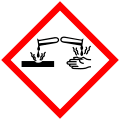
H315, H318, H332, H335 |
Precautionary statements
|
P261, P280, P305+P351+P338 |
| Flash point | Non-combustible[1] |
| Lethal dose or concentration (LD, LC): | |
LD50 (median dose)
|
|
LC50 (median concentration)
|
3000 ppm (mouse, 7 hr)[2] |
LCLo (lowest published)
|
|
| NIOSH (US health exposure limits): | |
PEL (Permissible)
|
TWA 200 ppm (1050 mg/m3)[1] |
REL (Recommended)
|
TWA 200 ppm (1050 mg/m3)[1] |
IDLH (Immediate danger)
|
2000 ppm[1] |
| Related compounds | |
Related alkanes
|
|
Related compounds
|
2-Chloroethanol |
Except where otherwise noted, data are given for materials in their standard state (at 25 °C [77 °F], 100 kPa).
Infobox references
| |


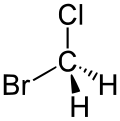
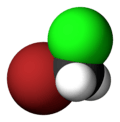
Bromochloromethane or methylene bromochloride and Halon 1011 is a mixed halomethane. It is a heavy low-viscosity liquid with refractive index 1.4808.
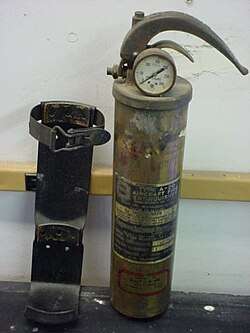
Halon 1011 was invented for use in fire extinguishers in Germany during the mid-1940s, in an attempt to create a less toxic, more effective alternative to carbon tetrachloride. This was a concern in aircraft and tanks as carbon tetrachloride produced highly toxic by-products when discharged onto a fire. It was slightly less toxic, and used up until the late 1960s, being officially banned by the NFPA for use in fire extinguishers in 1969, as safer and more effective agents such as halon 1211 and 1301 were developed. Due to its ozone depletion potential its production was banned from January 1, 2002, at the Eleventh Meeting of the Parties for the Montreal Protocol on Substances that Deplete the Ozone Layer.

Bromochloromethane's biodegradation is catalyzed by the hydrolase enzyme alkylhalidase:
- CH2BrCl + H2O → CH2O + HBr + HCl
Preparation
Bromochloromethane is prepared commercially from dichloromethane:
- 6 CH2Cl2 + 3 Br2 + 2 Al → 6 CH2BrCl + 2 AlCl3
- CH2Cl2 + HBr → CH2BrCl + HCl
The latter route requires aluminium trichloride as a catalyst. The bromochloromethane is often used as a precursor to methylene bromide.[3]
References
- ^ a b c d e f g h i j NIOSH Pocket Guide to Chemical Hazards. "#0123". National Institute for Occupational Safety and Health (NIOSH).
- ^ a b c "Chlorobromomethane". Immediately Dangerous to Life or Health Concentrations. National Institute for Occupational Safety and Health.
- ^ Dagani, M. J.; Barda, H. J.; Benya, T. J.; Sanders, D. C. "Bromine Compounds". Ullmann's Encyclopedia of Industrial Chemistry. Weinheim: Wiley-VCH. doi:10.1002/14356007.a04_405. ISBN 978-3-527-30673-2.
External links
- International Chemical Safety Card 0392
- NIOSH Pocket Guide to Chemical Hazards. "#0123". National Institute for Occupational Safety and Health (NIOSH).
- Notice with Respect to n-Propyl Bromide and Bromochloromethane
- Chemical fact sheet
- Data sheet at albemarle.com