Propicillin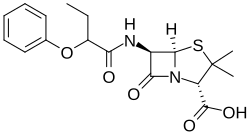 |
|
| AHFS/Drugs.com | International Drug Names |
|---|
Routes of
administration | Oral |
|---|
| ATC code | |
|---|
|
(2S,5R,6R)-3,3-dimethyl-7-oxo-6-[(2-phenoxybutanoyl)amino]-4-thia-1-azabicyclo[3.2.0]heptane-2-carboxylic acid
|
| CAS Number | |
|---|
| PubChem CID | |
|---|
| ChemSpider | |
|---|
| UNII | |
|---|
| KEGG | |
|---|
| ChEBI | |
|---|
| ChEMBL | |
|---|
| CompTox Dashboard (EPA) | |
|---|
| ECHA InfoCard | 100.008.178 |
|---|
|
| Formula | C18H22N2O5S |
|---|
| Molar mass | 378.44 g·mol−1 |
|---|
| 3D model (JSmol) | |
|---|
CCC(C(=O)N[C@H]1[C@@H]2N(C1=O)[C@H](C(S2)(C)C)C(=O)O)OC3=CC=CC=C3
|
InChI=1S/C18H22N2O5S/c1-4-11(25-10-8-6-5-7-9-10)14(21)19-12-15(22)20-13(17(23)24)18(2,3)26-16(12)20/h5-9,11-13,16H,4H2,1-3H3,(H,19,21)(H,23,24)/t11?,12-,13+,16-/m1/s1  N NKey:HOCWPKXKMNXINF-XQERAMJGSA-N N
|
N Y (what is this?) (verify) Y (what is this?) (verify) |
Propicillin is a penicillin.[1] Properties are similar to benzylpenicillin particularly used in streptococcal infections, not resistant to penicillinase. It is acid resistant and can be used orally as the potassium salt.
References
- ^ de Groot AC (2022). "Propicillin". Monographs in Contact Allergy, Volume 4: Systemic Drugs. Boca Raton, Florida: CRC Press, Taylor & Francis Group. p. 823. ISBN 978-1-00-054991-1.
Antibacterials active on the cell wall and envelope (J01C-J01D) |
|---|
β-lactams
(inhibit synthesis
of peptidoglycan
layer of bacterial
cell wall by binding
to and inhibiting
PBPs, a group of
D-alanyl-D-alanine
transpeptidases) | | Penicillins (Penams) | Narrow
spectrum | β-lactamase sensitive
(1st generation) | |
|---|
β-lactamase resistant
(2nd generation) | |
|---|
|
|---|
Extended
spectrum | | Aminopenicillins (3rd generation) | |
|---|
| Carboxypenicillins (4th generation) | |
|---|
| Ureidopenicillins (4th generation) | |
|---|
| Other | |
|---|
|
|---|
|
|---|
| Carbapenems / Penems |
- Carbapenems (Ertapenem
- Antipseudomonal (Doripenem
- Imipenem
- Meropenem)
- Biapenem‡
- Panipenem)
- Penems (Faropenem
- Ritipenem§
- Sulopenem)
|
|---|
Cephems
Cephalosporins
Cephamycins
Carbacephems | | 1st generation | |
|---|
| 2nd generation | |
|---|
| 3rd generation | |
|---|
| 4th generation |
- Cefepime
- Cefozopran‡
- Cefpirome
- Cefquinome‡
|
|---|
| 5th generation |
- Ceftaroline fosamil
- Ceftolozane
- Ceftobiprole
|
|---|
| Siderophore | |
|---|
| Veterinary |
- Ceftiofur
- Cefquinome
- Cefovecin
|
|---|
|
|---|
| Monobactams |
- Aztreonam
- Tigemonam‡
- Carumonam‡
- Nocardicin A‡
|
|---|
| β-lactamase inhibitors |
- Penam (Sulbactam
- Tazobactam
- Enmetazobactam)
- Clavam (Clavulanic acid)
- non-β-lactam (Avibactam
- Durlobactam
- Relebactam
- Taniborbactam
- Vaborbactam)
|
|---|
| Combinations |
- Amoxicillin/clavulanic acid#
- Ampicillin/flucloxacillin
- Ampicillin/sulbactam (Sultamicillin)
- Aztreonam/avibactam
- Benzathine benzylpenicillin/procaine benzylpenicillin
- Cefepime/enmetazobactam
- Cefepime/sulbactam
- Cefoperazone/sulbactam
- Ceftazidime/avibactam
- Ceftolozane/tazobactam
- Imipenem/cilastatin#
- Imipenem/cilastatin/relebactam
- Meropenem/vaborbactam
- Panipenem/betamipron
- Piperacillin/tazobactam
- Sulbactam/durlobactam
- Sulopenem/probenecid
- Ticarcillin/clavulanic acid
|
|---|
|
|---|
| Polypeptides | | Lipopeptides |
- Insert into bacterial cell wall causing perforation and depolarization: Daptomycin
- Surfactin
|
|---|
| Other |
- Inhibits PG elongation and crosslinking: Ramoplanin§
|
|---|
|
|---|
| Intracellular |
- Inhibit PG subunit synthesis and transport: NAM synthesis inhibition
- DADAL/AR inhibitors
- bactoprenol inhibitors
|
|---|
| Other |
- Hydrolyze NAM-NAG
- Tyrothricin
- Isoniazid#
- Teixobactin
|
|---|
- #WHO-EM
- ‡Withdrawn from market
- Clinical trials:
- †Phase III
- §Never to phase III
|